Question

Assertion :   The stars twinkle while the planets do not.

Reason     :  The stars are much bigger in size than the planets.

(a) If both assertion and reason are true and the reason is the correct explanation of the assertion.

(b) If both assertion and reason are true but reason is not the correct explanation of the assertion.

(c) If assertion is true but reason is false.

(d) If the assertion and reason both are false.

Answer

(b) If both assertion and reason are true but reason is not the correct explanation of the assertion.

Need a full question paper?

Generate a complete, print-ready paper with questions like this in minutes — across 16+ boards, with answer keys.

Start Generating Free

Similar questions

Resistivity of a wire depends on:
A direct current of 4 A is flowing through any circuit. Root mean square value of the current is:

A convex lens

(a) Converges light rays

(b) Diverges light rays

(c) Form real images always

(d) Always forms virtual images

If the rms current in a 50Hz ac circuit is 5A, the value of the current $\frac{1}{300}$ seconds after its value becomes zero is,

In Young's double slit experiment, if L is the distance between the slits and the screen upon which interference pattern is observed, x is the average distance between the adjacent fringes and d being the slit separation. The wavelength of light is given by

(a)  

(b)

(c)        

(d)

The electrical circuits used to get smooth d.c. output from a rectifier circuit is called

(a) Filter

(b) Amplifier

(c) Full wave rectifier

(d) Oscillator

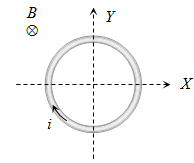
A conducting loop carrying a current I is placed in a uniform magnetic field pointing into the plane of the paper as shown. The loop will have a tendency to

(a) Contract

(b) Expand

(c) Move towards +ve x –axis

(d) Move towards –ve x-axis

Consider a magnetic dipole kept in the north to south direction. Let P1, P2, Q1, Q2 be four points at the same distance from the dipole towards north, south, east and west of the dipole respectively. The directions of the magnetic field due to the dipole are the same at:
Relation between principal quantum number ' $n$ ' and radius $r_n$ of Bohr's orbit is :

A lamp rated at 100 cd hangs over the middle of a round table with diameter 3 m at a height of 2 m. It is replaced by a lamp of 25 cd and the distance to the table is changed so that the illumination at the centre of the table remains as before. The illumination at edge of the table becomes X times the original. Then X is

(a)   

(b)       

(c)   

(d)