$Assertion$ : There is a stage when frictional force is not needed at all to provide the necessary centripetal force on a banked road.
$Reason$ : On a banked road, due to its inclination the vehicle tends to remain inwards without any chances of skidding.
$Reason$ : On a banked road, due to its inclination the vehicle tends to remain inwards without any chances of skidding.
AIIMS 2016, Easy


Download our appand get started for free
Experience the future of education. Simply download our apps or reach out to us for more information. Let's shape the future of learning together!No signup needed.*
Similar Questions
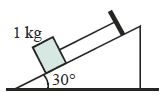
- 1The coefficient of friction between two surfaces is $\mu = 0.8$.The tension in the string shown in the figure is ........ $N$View Solution
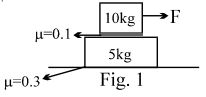
- 2The maximum acceleration of $5\, kg$ block ...... $m/s^2$View Solution
- 3A vehicle is moving with a velocity $v$ on a curved road of width $b$ and radius of curvature $R.$ For counteracting the centrifugal force on the vehicle, the difference in elevation required in between the outer and inner edges of the road isView Solution
- 4A box of mass $m\, kg$ is placed on the rear side of an open truck accelerating at $4\, m/s^2$. The coefficient of friction between the box and the surface below it is $0.4$. The net acceleration of the box with respect to the truck is zero. The value of $m$ is :- $[g = 10\,m/s^2]$View Solution
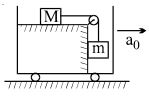
- 5Imagine the situation in which the given arrangement is placed inside a trolley that can move only in the horizontal direction, as shown in figure. If the trolley is accelerated horizontally along the positive $x$ -axis with $a_0$, then Choose the correct statement $(s)$.View Solution
- 6A railway line is taken round a circular arc of radius $1000\ m$ , and is banked by raising the outer rail $h$ $m$ above the inner rail. If the lateral force on the inner rail when a train travels round the curve at $10\ ms^{-1}$ is equal to the lateral force on the outer rail when the train's speed is $20\ ms^{-1}$ . The value of $4g\ tan\theta $ is equal to : (The distance between the rails is $1.5\ m$ )View Solution
- 7A uniform rope of length l lies on a table. If the coefficient of friction is $\mu $, then the maximum length ${l_1}$ of the part of this rope which can overhang from the edge of the table without sliding down isView Solution
- 8Radius of the curved road on national highway is $R$. Width of the road is $b$. The outer edge of the road is raised by $h$ with respect to inner edge so that a car with velocity $v$ can pass safe over it. The value of $h$ isView Solution
- 9A car of mass $1000\,kg$ negotiates a banked curve of radius $90\,m$ on a frictionless road. If banking angle is $45^o$ , the maximum speed of car is ............ $m/s$ $[g = 10\,m/s^2]$View Solution
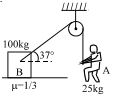
- 10Block $B$ of mass $100 kg$ rests on a rough surface of friction coefficient $\mu = 1/3$. $A$ rope is tied to block $B$ as shown in figure. The maximum acceleration with which boy $A$ of $25 kg$ can climbs on rope without making block move is:View Solution