A car of mass $1000\,kg$ negotiates a banked curve of radius $90\,m$ on a frictionless road. If banking angle is $45^o$ , the maximum speed of car is ............ $m/s$ $[g = 10\,m/s^2]$
Medium


Download our appand get started for free
Experience the future of education. Simply download our apps or reach out to us for more information. Let's shape the future of learning together!No signup needed.*
Similar Questions
- 1A block of mass $4\, kg$ rests on an inclined plane. The inclination of the plane is gradually increased. it is found that when the inclination is $3$ in $5\left( {\sin \theta = \frac{3}{5}} \right)$, the block just begins to slide down the plane. The coefficient of friction between the block and the plane isView Solution
- 2A brick of mass $2\, kg$ begins to slide down on a plane inclined at an angle of $45^° $ with the horizontal. The force of friction will beView Solution
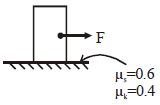
- 3$10\, kg$ block is placed as shown, if $F = 50$ newton find friction force ............ $N$View Solution
- 4A man is standing on a rough $(\mu = 0.5)$ horizontal disc rotating with constant angular velocity of $5$ $rad/sec.$ At what distance from centre should he stand so that he does not slip on the disc?View Solution
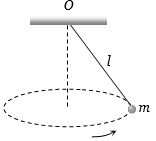
- 5A point mass $m$ is suspended from a light thread of length $l$, fixed at $O$, is whirled in a horizontal circle at constant speed as shown. From your point of view, stationary with respect to the mass, the forces on the mass areView Solution
- 6A car of $800 \mathrm{~kg}$ is taking turn on a banked road of radius $300 \mathrm{~m}$ and angle of banking $30^{\circ}$. If coefficient of static friction is $0.2$ then the maximum speed with which car can negotiate the turn safely : $\left(\mathrm{g}=10 \mathrm{~m} / \mathrm{s}^2, \sqrt{3}=1.73\right)$View Solution
- 7A particle is moving in a circle of radius $R$ with constant speed $v$, if radius is double then its centripetal force to keep the same speed should beView Solution
- 8A modern grand-prix racing car of mass $m$ is travelling on a flat track in a circular arc of radius $R$ with a speed $v$. If the coefficient of static friction between the tyres and the track is $\mu_{s},$ then the magnitude of negative lift $F_{L}$ acting downwards on the car isView Solution
(Assume forces on the four tyres are identical and $g =$ acceleration due to gravity)
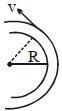
- 9A small mass $'m'$ rests at the edge of a horizontal disc of radius $'R'$ . The coefficient of static friction between mass and the disc is $\mu $ . The disc is rotated about its axis at an angular velocity such that the mass slides off the disc and lands on the floor $'h'$ meters below. What was its horizontal distance of travel from the point it left the disc?View Solution
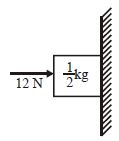
- 10A horizontal force $12 \,N$ pushes a block weighing $1/2\, kg$ against a vertical wall. The coefficient of static friction between the wall and the block is $0.5$ and the coefficient of kinetic friction is $0.35.$ Assuming that the block is not moving initially. Which one of the following choices is correct (Take $g = 10 \,m/s^2$)View Solution