MCQ
Assume that a drop of liquid evaporates by decrease in its surface energy, so that its temperature remains unchanged. What should be the minimum radius of the drop for this to be possible? The surface tension is $T$, density of liquid is $\rho$ and $L$ is its latent heat of vaporization.
  • A
    $\frac{{\rho L}}{T}$
  • B
    $\sqrt {\frac{T}{{\rho L}}} $
  • C
    $\frac{T}{{\rho L}}$
  • $\frac{2T}{{\rho L}}$

Answer

Correct option: D.
$\frac{2T}{{\rho L}}$
d
Energy for vaporization $=$ change in surface energy $\rho\left(4 \pi r^{2} \mathrm{d} r\right) L=T(8 \pi \mathbf{r d r})$

$\Rightarrow r=\frac{2 \mathrm{T}}{\rho \mathrm{L}}$

Need a full question paper?

Generate a complete, print-ready paper with questions like this in minutes — across 16+ boards, with answer keys.

Start Generating Free

Similar questions

Sound waves have the following frequencies that are audible to human beings  .... $c/s$
Two wires A and B are made of same material. The wore A has a length l and diameter r while the wire B has a length 2l and diameter $\frac{\text{r}}{2}$. If the two wires are stretched by the same force, the elongation in A divided by the elongation in 8 is:
The displacement equation of a particle is $x = 3\sin 2t + 4\cos 2t.$ The amplitude and maximum velocity will be respectively
A carnot engine has the same efficiency between $800 K$ to $500 K$ and $x\, K$ to $600 K.$ The value of $x$ is ...... $K$
If the force and displacement of particle in the direction of force are doubled, then work done would be:
Particle $A$ of mass $m _{1}$ moving with velocity $(\sqrt{3} \hat{i}+\hat{j})\, ms ^{-1}$ collides with another particle $B$ of mass $m _{2}$ which is at rest initially. Let $\overrightarrow{ V }_{1}$ and $\overrightarrow{ V }_{2}$ be the velocities of particles $A$ and $B$ after collision respectively. If $m _{1}=2\, m _{2}$ and after collision $\overrightarrow{ V }_{1}=(\hat{ i }+\sqrt{3} \hat{ j })\, ms ^{-1},$ the angle between $\overrightarrow{ V }_{1}$ and $\overrightarrow{ V }_{2}$ is$......^o$
What change in surface energy will be noticed when a drop of radius $R$ splits up into $1000$ droplets of radius $r,$ surface tension is $T.$
A sound wave is passing through air column in the form of compression and rarefaction. In consecutive compressions and rarefactions:
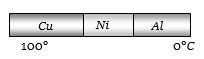
A composite metal bar of uniform section is made up of length $25 cm$ of copper, $10  cm$ of nickel and $15 cm$ of aluminium. Each part being in perfect thermal contact with the adjoining part. The copper end of the composite rod is maintained at ${100^o}C$ and the aluminium end at ${0^o}C$. The whole rod is covered with belt so that there is no heat loss occurs at the sides. If ${K_{{\rm{Cu}}}} = 2{K_{Al}}$ and ${K_{Al}} = 3{K_{{\rm{Ni}}}}$, then what will be the temperatures of $Cu - Ni$ and $Ni - Al$ junctions respectively
A vertical hanging bar of length $l$ and mass $m$ per unit length carries a load of mass $M$ at lower end, its upper end is clamped to a rigid support. The tensile stress a distance $x$ from support is $(A \rightarrow$ area of cross-section of bar)