MCQ
The displacement equation of a particle is $x = 3\sin 2t + 4\cos 2t.$ The amplitude and maximum velocity will be respectively
  • $5, 10$
  • B
    $3, 2$
  • C
    $4, 2$
  • D
    $3, 4$

Answer

Correct option: A.
$5, 10$
a
(a) $x = 3\sin 2t + 4\cos 2t.$

From given equation ${a_1} = 3,\;{a_2} = 4,$ and $\phi = \frac{\pi }{2}$

$a = \sqrt {a_1^2 + a_2^2} $$ = \sqrt {{3^2} + {4^2}} = 5$

==> ${v_{\max }} = a\omega = 5 \times 2 = 10$

Need a full question paper?

Generate a complete, print-ready paper with questions like this in minutes — across 16+ boards, with answer keys.
Start Generating Free

Similar questions

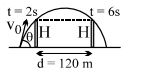
A projectile crosses two walls of equal height $H$ symmetrically as shown The velocity of projection is........ $ms^{-1}$
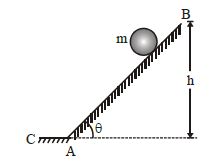
A sphere of mass $m$ comes down on a smooth inclined plane from a point $B$ at a height of $h$ from rest. The magnitude of change in momentum of the particle between the position $A$ and $C$ (assuming the angle of inclination of the plane as $\theta $ with respect to the horizontal) is
The force required to stretch a steel wire of $1\,c{m^2}$ cross-section to $1.1$ times its length would be $(Y = 2 \times {10^{11}}\,N{m^{ - 2}})$
A transverse progressive wave on a stretched string has a velocity of $10\,m{s^{ - 1}}$ and a frequency of $100 Hz.$ The phase difference between two particles of the string which are $2.5 cm$ apart will be
Water from a tap emerges vertically downwards with an initial speed of $1.0\,ms^{-1}.$ The cross-sectional area of the tap is $10^{-4}\,m^2.$ Assume that the pressure is constant throughout the stream of water and that flow is streamlined. The cross-sectional area of the stream, $0.15\,m$ below the tap would be: (take $g = 10\,ms^{-2}$ )
A planet has same density as that of earth and universal gravitational constant $G$ is twice that of earth, the ratio of acceleration due to gravity, is.
Which of the following statement must always be true?
$I.$ If an objects acceleration is zero, then its speed must remain constant.
$II.$ If an objects acceleration is constant, then it must move in a straight line.
$III.$ If an objects speed remains constant, then its acceleration must be zero.
A body $A,$ of mass $m=0.1\; kg$ has an initial velocity of $3 \hat{\mathrm{i}}\; \mathrm{ms}^{-1} .$ It collides elastically with another body, $\mathrm{B}$ of the same mass which has an initial velocity of $5 \hat{\mathrm{j}} \;\mathrm{ms}^{-1}$. After collision. A moves with a velocity $\overline{\mathrm{v}}=4(\hat{\mathrm{i}}+\hat{\mathrm{j}})$. The energy of $\mathrm{B}$ after collision is written as $\frac{\mathrm{x}}{10} \;\mathrm{J}$ The value of $x$ is
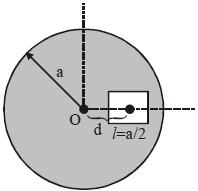
A square shaped hole of side $l=\frac{a}{2}$ is carved out at a distance $d =\frac{ a }{2}$ from the centre $'O'$ of a uniform circular disk of radius $a$. If the distance of the centre of mass of the remaining portion from $O$ is $-\frac{a}{X},$ value of $X$ (to the nearest integer) is.......
The bottoms of utensils for cooking food are blackened to: