Question
Assume the dipole model for earth's magnetic field B which is given by $B_V =$ vertical component of magnetic field $=\frac{\mu_0}{4\pi}\frac{2\text{m}\cos\theta}{\text{r}^3}$
$B_H =$ Horizontal component of magnetic field $=\frac{\mu_0}{4\pi}\frac{\sin\theta\text{m}}{\text{r}^3}$
θ = 90º - lattitude as measured from magnetic equator. Find loci of points for which,
  1. |B| is minimum,
  2. Dip angle is zero,
  3. Dip angle is ± 45º.

Answer

  1. $\text{B}_\text{V}=\frac{\mu_02\text{m}\cos\theta}{4\pi}$
$\text{B}_\text{H}=\frac{\mu_0}{4\pi}\frac{\text{m}\sin\theta}{\text{r}^3}$
These are the components of B to net magnetic field will be
$\text{B}=\sqrt{\text{B}_\text{v}^2+\text{B}_\text{H}^2}=\frac{\mu_0\text{m}}{4\pi\text{r}^3}\big[3\cos^{2}\theta+1\big]^\frac{1}{2}$
From above equation, the value of B is minimum, if cos $\theta=\frac{\pi}{2}$.
$\theta=\frac{\pi}{2}$. Thus, B is minimum at the magnetic equator.
  1. Angle of dip,
$\tan\delta=\frac{\text{B}_\text{V}}{\text{B}_\text{H}}=\frac{\frac{\mu_0}{4\pi}.\frac{2\text{m}\cos\theta}{\text{r}^3}}{\frac{\mu_0}{4\pi}.\frac{\sin\theta.\text{m}}{\text{r}^3}}=2\cot\theta\ .....(\text{i})$
$\tan\delta=2\cot\theta$
For dip angle is zero i.e., $\delta = 0$
$\cot\theta=0$
$\theta=\frac{\pi}{2}$
For this value of $\theta$ angle fo dip is vanished. It means that locus is again magnetic equator.
  1. $\tan\delta=\frac{\text{B}_\text{V}}{\text{B}_\text{H}}$
Angle of dip i.e., $\delta=\pm45^\circ$
$\frac{\text{B}_\text{V}}{\text{B}_\text{H}}=\tan(\pm45^\circ)$
$\frac{\text{B}_\text{V}}{\text{B}_\text{H}}=1$
$2\cot\theta=1\ \big[\text{From Eq. (i)}\big]$
$\cot\theta=\frac{1}{2}$
$\tan\theta=\frac{1}{2}$
$\Rightarrow\ \theta=\tan^{-1}(2)$
Thus, $\theta=\tan^{-1}(2)$ is the locus.

Need a full question paper?

Generate a complete, print-ready paper with questions like this in minutes — across 16+ boards, with answer keys.

Start Generating Free

Similar questions

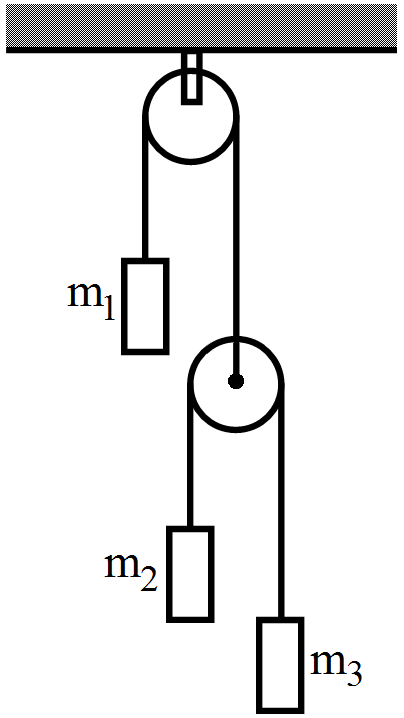
Let $m_1 = 1kg, m_2 = 2$ kg and $m_3 = 3$ kg in figure. Find the accelerations of $m_1, m_2$ and $m_3$. The string from the upper pulley to $m_1$ is 20cm when the system is released from rest. How long will it take before m, strikes the pulley?
A battery of emf 100V and a resistor of resistance $10\text{k}\Omega$ are joined in series. This system is used as a source to supply current to an external resistance R. If R is not greater than $100\Omega,$ the current through it is constant up to two significant digits. Find its value. This is the basic principle of a constant-current source.
The count rate of nuclear radiation coming from a radiation coming from a radioactive sample containing $^{128}I$ varies with time as follows.
Time t(minute): 0 25 50 75 100
Ctount rate $R(10^9s^{-1}):$ 30 16 8.0 3.8 2.0
  1. Plot In $\Big(\frac{\text{R}_0}{\text{R}}\Big)$ against t.
  2. From the slope of the best straight line through the points, find the decay constant $\lambda.$
  3. Calculate the half-life $\text{t}_{\frac{1}{2}}.$
A rod, when suspended in a magnetic field, stays in the east-west direction. Can we be sure that the field is in the east-west direction? Can it be in the north-south direction?
Answer the following question:
Some scientists have predicted that a global nuclear war on the earth would be followed by a severe ‘nuclear winter’ with a devastating effect on life on earth. What might be the basis of this prediction?
Three samples A, B and C of the same gas $(\gamma=1.5)$ have equal volumes and temperatures. The volume of each sample is doubled, the process being isothermal for A, adiabatic for B and isobaric for C. If the final pressures are equal for the three samples, find the ratio of the initial pressures.
A compound microscope consists of an objective lens of focal length 2.0 cm and an eyepiece of focal length 6.25 cm separated by a distance of 15 cm. How far from the objective should an object be placed in order to obtain the final image at (a) the least distance of distinct vision (25 cm), and (b) at infinity? What is the magnifying power of the microscope in each case?
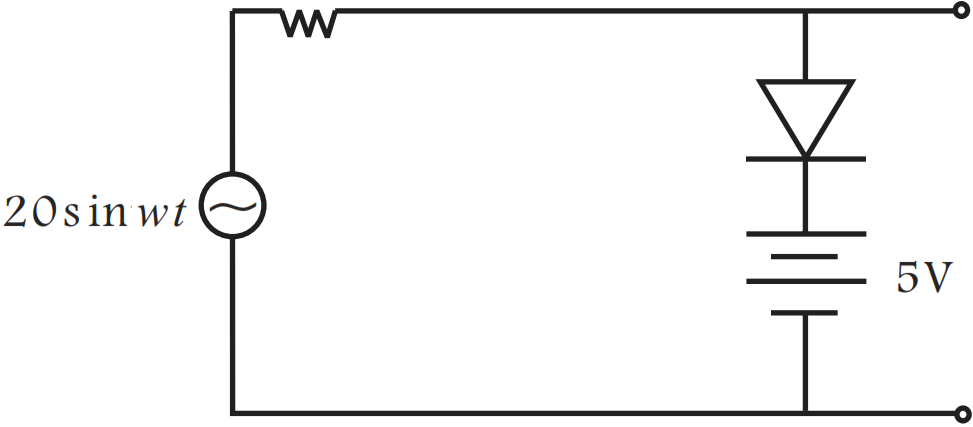
Assuming the ideal diode, draw the output waveform for the circuit given in Fig. Explain the waveform.
A solenoid is connected to a battery so that a steady current flows through it. If an iron core is inserted into the solenoid, will the current increase or decrease? Explain.
An electron makes $3 \times 10^5$ revolutions per second in a circle of radius 0.5 angstrom. Find the magnetic field B at the centre of the circle.