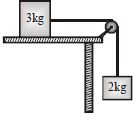
Consider a body of mass $3\,kg$ at rest on a smooth horizontal table. This body is connected by a light string, which passes over a smooth pulley at the edge of the table, to another body of mass $2\, kg$ hanging freely. This $2\, kg$ mass is released from rest. Now consider the following statements :-
$(A)$ The masses remains at rest
$(B)$ The $3\,kg$ mass moves uniformly while $2\, kg$ mass moves with acceleration $\frac{2}{5}\, g \,m/s^2$
$(C)$ Both bodies move with acceleration $\frac{2}{5} \,g \,m/s^2$
$(D)$ The tension in the string near the first body is more than that near the second body
$(E)$ The tension in the string is $\frac{6g}{5}\, N $
Then the correct statements are