There is $10$ units of charge at the centre of a circle of radius $10\,m$. The work done in moving $1\, unit$ of charge around the circle once is...........$units$
AIIMS 2000, Easy


Download our appand get started for free
Experience the future of education. Simply download our apps or reach out to us for more information. Let's shape the future of learning together!No signup needed.*
Similar Questions
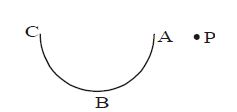
- 1In the following diagram the work done in moving a point charge from point $P$ to point $A, B$ and $C$ is respectively as $W_A,\, W_B$ and $W_C$, then (there is no charge nearby)View Solution
- 2The magnitude of electric field $E$ in the annular region of a charged cylindrical capacitorView Solution
- 3A parallel plate capacitor has $1\,\mu F$ capacitance. One of its two plates is given $+2\,\mu C$ charge and the other plate, $+4\,\mu C$ charge. The potential difference developed across the capacitor is......$V$View Solution
- 4$125$ identical drops each charged to the same potential of $50\;volts$ are combined to form a single drop. The potential of the new drop will be......$V$View Solution
- 5Three capacitors are connected as shown in fig. Then the charge on capacitor $C_1$ is.....$\mu C$View Solution
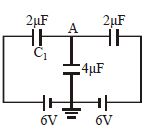
- 6In the adjoining figure, four capacitors are shown with their respective capacities and the $P.D.$ applied. The charge and the $P.D.$ across the $4\,\mu F$ capacitor will beView Solution
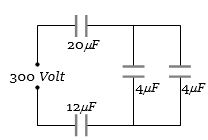
- 7A particle has a mass $400$ times than that of the electron and charge is double than that of a electron. It is accelerated by $5\,V$ of potential difference. Initially the particle was at rest, then its final kinetic energy will be......$eV$View Solution
- 8Assertion : If the distance between parallel plates of a capacitor is halved and dielectric constant is three times, then the capacitance becomes $6\,times$.View Solution
Reason : Capacity of the capacitor does not depend upon the nature of the material.
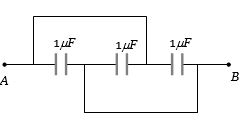
- 9The equivalent capacitance in the circuit between $A$ and $B$ will be.....$\mu \,F$View Solution
- 10If $q$ is the charge per unit area on the surface of a conductor, then the electric field intensity at a point on the surface isView Solution