MCQ
At nodes in stationary waves:
  • A
    Change in pressure and density are maximum.
  • B
    Change in pressure and density are minimum.
  • C
    Strain is zero.
  • D
    Energy is maximum.

Need a full question paper?

Generate a complete, print-ready paper with questions like this in minutes — across 16+ boards, with answer keys.
Start Generating Free

Similar questions

A force of $50$ dynes is acted on a body of mass $5$ g which is at rest for an interval of $3$ seconds, then impulse is
If T is the surface tension of soap solution, the amount of work done in blowing a soap bubble from a diameter D to a diameter 2D is:
A cylindrical block of wood of base area $30\ cm^2$ , floats in a liquid of density $900\ kg/m^3$ . The block is depressed lightly and then released. The time period of the resulting oscillations of the block is equal to that of spring with block of same mass, then spring constant is equal to ........ $N/m$
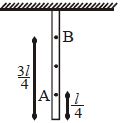
A string of mass $m$ and length $l$ hangs from ceiling as shown in the figure. Wave in string moves upward. $v_A$ and $v_B$ are the speeds of wave at $A$ and $B$ respectively. Then $v_B$ is
Speed of sound wave in air:
  1. Is independent of temperature.
  2. Increases with pressure.
  3. Increases with increase in humidity.
  4. Decreases with increase in humidity.
Density of antinodes in stationary wave is:
A block of mass $m = 0.1\,kg$ is connected to a spring of unknown spring constant $k.$ It is compressed to a distance $x$ from its equilibrium. position and released from rest . After approaching half the distance $(\frac {x}{2})$ from equilibrium position, it hits another block and comes to rest momentarily, while the other block moves with a velocity $3\,ms^{-1}.$ The total initial energy of the spring is ................ $\mathrm{J}$
One mole of an ideal gas goes from an initial state $A$ to final state $B$ via two processes : It first undergoes isothermal expansion from volume $V$ to $3\, V$ and then its volume is reduced from $3\, V$ to $V$ at constant pressure. The correct $P-V$ diagram representing the two processes is
You lift a suitcase from the floor and keep it on a table. The work done by you on the suitcase does not depend on:
  1. The path taken by the suitcase.
  2. The time taken by you in doing so.
  3. The weight of the suitcase.
  4. Your weight.
A body of mass $5\, kg$ moving with a velocity $10\,m/s$ collides with another body of the mass $20 \,kg$ at, rest and comes to rest. The velocity of the second body due to collision is ......... $m/s$