At time $t = 0$, a simple harmonic oscillator is at its extreme position. If it covers half of the amplitude distance in $1\, second$, then the time period of oscillation is ..... $s$
Medium
Download our app for free and get started
$\cos \alpha=\frac{A / 2}{A}=\frac{1}{2}$
$\alpha=60^{\circ}$
$60^{\circ}$ angle travelled in $1\, sec.$
$360^{\circ}$ angle travelled in $1\, sec.$ $\frac{360}{60} \times 1=6$ sec.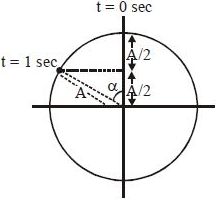

Download our appand get started for free
Experience the future of education. Simply download our apps or reach out to us for more information. Let's shape the future of learning together!No signup needed.*
Similar Questions
- 1View SolutionThe phase difference between the instantaneous velocity and acceleration of a particle executing simple harmonic motion is
- 2A body is executing simple harmonic motion with frequency $'n',$ the frequency of its potential energy is :View Solution
- 3View SolutionTwo mutually perpendicular simple harmonic vibrations have same amplitude, frequency and phase. When they superimpose, the resultant form of vibration will be
- 4The periodic time of a body executing simple harmonic motion is $3\, sec$. After how much interval from time $t = 0$, its displacement will be half of its amplitude ..... $\sec$View Solution
- 5A body performs $S.H.M.$ Its kinetic energy $K$ varies with time $t$ as indicated by graphView Solution
- 6The motion of a particle represented by $y\ =$ $\sin \omega t - \cos \omega t$ isView Solution
- 7A pendulum has time period $T$. If it is taken on to another planet having acceleration due to gravity half and mass $ 9 $ times that of the earth then its time period on the other planet will beView Solution
- 8View SolutionIn forced oscillations, a particle oscillates simple harmonically with frequency equal to
- 9The function $sin^2\,(\omega t)$ representsView Solution
- 10A uniform spring of force constant $k$ is cut into two pieces, the lengths of which are in the ratio $1 : 2$. The ratio of the force constants of the shorter and the longer pieces isView Solution