MCQ
At time $t = 0$, a simple harmonic oscillator is at its extreme position. If it covers half of  the amplitude distance in $1\, second$, then the time period of oscillation is ..... $s$
  • A
    $2$
  • B
    $4$
  • $6$
  • D
    $12$

Answer

Correct option: C.
$6$
c
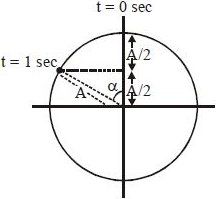
$\cos \alpha=\frac{A / 2}{A}=\frac{1}{2}$

$\alpha=60^{\circ}$

$60^{\circ}$ angle travelled in $1\, sec.$

$360^{\circ}$ angle travelled in $1\, sec.$ $\frac{360}{60} \times 1=6$ sec.
Need a full question paper?

Generate a complete, print-ready paper with questions like this in minutes — across 16+ boards, with answer keys.

Start Generating Free

Similar questions

A function is represented by equation

$y = A\,\cos \,\omega t\,\cos \,2\omega t + A\,\sin \,\omega t\,\sin \,2\omega t$.

Than the nature of the function is

A glass flask contains some mercury at room temperature. It is found that at different temperatures the volume of air inside the flask remains the same. If the volume of mercury in the flask is $300 \,\,cm^3$, then volume of the flask is ........ $cm^3$. (given that coefficient of volume expansion of mercury and coefficient of linear expansion of glass are $1.8 × 10^{-4} (^o C)^{-1}$ and $9 × 10^{-6} (^o C)^{-1}$ respectively)
If acceleration due to gravity at distance $d[ < R]$ from the centre of earth is $\beta$, then its value at distance $d$ above the surface of earth will be [where $R$ is radius of earth]
The equation of a sound wave is $y = 0.0015\sin (62.4x + 316\,t)$ The wavelength of this wave is ..... $unit$
A $100 \,g$ of iron nail is hit by a $1.5\, kg$ hammer striking at a velocity of $60\, ms ^{-1}$. $............^{\circ}C$ will be the rise in the temperature of the nail if one fourth of energy of the hammer goes into heating the nail .

[Specific heat capacity of iron  $=0.42\, Jg ^{-1}{ }\,^{\circ}C ^{-1}$ ]

Figure shows a siphon. Choose the wrong statement:

($P_0$ = atmospheric pressure)

The particles $A$ and $B$ of mass $m$ each are separated by a distance $r$. Another particle $C$ of mass $M$ is placed at the midpoint of $A$ and $B$. Find the work done in taking $C$ to a point equidistant $r$ from $A$ and $B$ without acceleration $(G=$ Gravitational constant and only gravitational interaction between $A, B$ and $C$ is considered) 
Boyls law is applicable in:
The height at which the acceleration due to gravity becomes $\frac{g}{9}$ (where $g$ = the acceleration due to gravity on the surface of the earth) in terms of $R$, the radius of the earth, is
Which of the following is not the characteristic of turbulent flow