At what distance for a long straight wire carrying a current of $12\, A$ will the magnetic field be equal to $3 \times 10^{-5} Wb / m ^{2}$ ?
AIIMS 2019, Medium
Download our app for free and get started
The magnetic field is calculated as,
$B=\frac{\mu_{0} I}{2 \pi r}$
The radius is calculated as,
$r=\frac{\mu_{0} I}{2 \pi B}$
$=\frac{\left(4 \pi \times 10^{-7}\right)(12 A )}{2 \pi\left(3 \times 10^{-5} Wb / m ^{2}\right)}$
$=8 \times 10^{-2} m$

Download our appand get started for free
Experience the future of education. Simply download our apps or reach out to us for more information. Let's shape the future of learning together!No signup needed.*
Similar Questions
- 1Two identical conducting wires $AOB$ and $COD$ are placed at right angles to each other. The wire $AOB$ carries an electric current $I_1$ and $COD$ carries a current $I_2$ . The magnetic field on a point lying at a distance $d$ from $O$, in a direction perpendicular to the plane of the wires $AOB$ and $COD$, will be given byView Solution
- 2View SolutionIn a cyclotron experiment, if we assume that maximum radius attained by any charged particle is equal to radius of dees, then minimum kinetic energy gained by the particles will be for
- 3View SolutionMagnetic dipole moment of a rectangular loop is
- 4At a distance of $10\, cm $ from a long straight wire carrying current, the magnetic field is $0.04\, T$. At the distance of $40\, cm$, the magnetic field will be....$T$View Solution
- 5View SolutionA charged particle is released from rest in a region of steady uniform electric and magnetic fields which are parallel to each other the particle will move in a
- 6View SolutionIf two streams of protons move parallel to each other in the same direction, then they
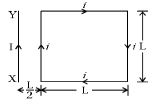
- 7A square loop $ABCD$ carrying a current $i,$ is placed near and coplanar with a long straight conductor $XY$ carrying a current $I,$ the net force on the loop will beView Solution
- 8View SolutionWhich of the following particle will experience maximum acceleration when projected with same speed in transverse magnetic field
- 9A homogeneous electric field $E$ and a uniform magnetic field $\mathop B\limits^ \to $ are pointing in the same direction. A proton is projected with its velocity parallel to $\mathop E\limits^ \to $. It willView Solution
- 10A galvanometer of resistance $25\,\Omega $ gives full scale deflection for a current of $10$ milliampere, is to be changed into a voltmeter of range $100\, V$ by connecting a resistance of $‘R’$ in series with galvanometer. The value of resistance $R$ in $\Omega $ isView Solution