MCQ
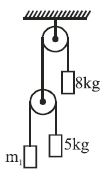
At what value of $m_1$ will $8\, kg$ mass be at rest
- A$3\,kg$
- ✓$\frac{{10}}{3}\,kg$
- C$4\,kg$
- D$5\,kg$
$\mathrm{Also}, \mathrm{T}_{0}=2 \mathrm{T}$
$\therefore \mathrm{T}=40 \mathrm{N}$
From force diagram of $5 \mathrm{kg}$ block,
$50-T=5 a$
$50-40=5 a$
$a=2 m / s^{2}$
From force diagram of $m_{1}$
$\mathrm{T}-\mathrm{m}_{1} \mathrm{g}=\mathrm{m}_{1} \mathrm{a}$
or $40-m_{1} g=m_{1} \times 2$
or $40=10 \mathrm{m}_{1}+2 \mathrm{m}_{1}=12 \mathrm{m}_{1}$
$\therefore m_{1}=\frac{40}{12}=\frac{10}{3} \mathrm{kg}$.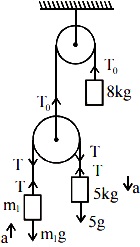
Generate a complete, print-ready paper with questions like this in minutes — across 16+ boards, with answer keys.
(image)
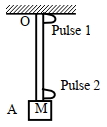
[$A$] The time $\mathrm{T}_{A 0}=\mathrm{T}_{\mathrm{OA}}$
[$B$] The velocities of the two pulses (Pulse $1$ and Pulse $2$) are the same at the midpoint of rope.
[$C$] The wavelength of Pulse $1$ becomes longer when it reaches point $A$.
[$D$] The velocity of any pulse along the rope is independent of its frequency and wavelength.