Question
Attempt any five of the following:
1. Why are Alkenes called olefins?
2. Convert 1-bromopropane to 2-bromopropane.
3. If Qc < Kc, when we continuously remove the product, what would be the direction of the reaction?
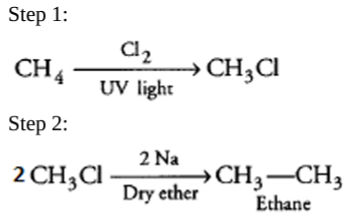
4. Convert methane into ethane.
5. What are cycloalkanes?
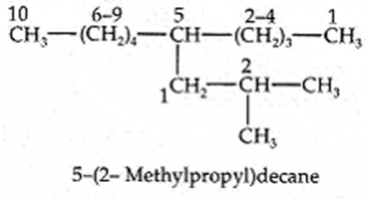
6. Write IUPAC name of following:
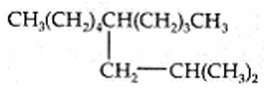
Image
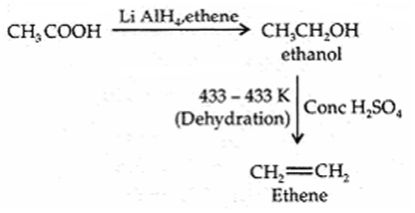
7. How will you convert ethanoic acid into ethene?

Answer

1. Alkenes are commonly known as olefins because the lower members form oily products on treatment with chlorine or bromine.
2. We can convert 1-Bromopropne into 2-Bromopropane in two steps. In the first step, the dehydrohalogenation of 1-bromo propane with alcoholic KOH gives propene which on reacting with HBr gives 2-bromo propane due to Markovnikov's rule for addition.
Image
3. Continuous removal of a product maintains Qc at a value less than Kc and reaction continues to move in the forward direction.
4. Conversion of methane into ethane:
Image
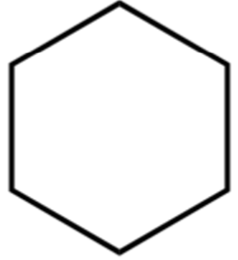
5. Cycloalkanes: When carbon atoms form a closed chain or ring structures, they are known as cycloalkanes.
Example: Cyclohexane
Image
6.
Image
7. 
Image

Need a full question paper?

Generate a complete, print-ready paper with questions like this in minutes — across 16+ boards, with answer keys.

Start Generating Free

Similar questions

Account for the following:
i. Ozone layer is necessary for life.
ii. The temperature of thermosphere is $1500^{\circ} \mathrm{C}$ but a person would not feel warm in it.
iii. Increased $\mathrm{SO}_2$ concentration causes chlorosis.
iv. $\mathrm{CO}_2$ keeps the earth warm.
v. The pH of normal rain water is 5.6 .
What will be the pressure exerted by a mixture of $3.2g$ of methane and $4.4g$ of carbon dioxide contained in a $9dm^3$ flask at $27^\circ C$?
Pay load is defined as the difference between the mass of displaced air and the mass of the balloon. Calculate the pay load when a balloon of radius $10 \ m$ , mass $100 \ kg$ is filled with helium at 1.66 bar at $27^{\circ} C$. (Density of air $=1.2 kg$ $m ^{-3}$ and $R =0.083 bar dm ^3 K^{-1} mol^{-1}$ ).
Addition of HBr to propene yields 2-bromopropane, while in the presence of benzoyl peroxide, the same reaction yields 1-bromopropane. Explain and give mechanism.
What are electron deficient compounds? Are $\mathrm{BCl}_3$ and $\mathrm{SiCl}_4$ electron deficient species? Explain.
Give one method for industrial preparation and one for laboratory preparation of $CO$ and $CO_2$ each.
Aluminium trifluoride is insoluble in anhydrous HF but dissolves on addition of NaF. Aluminium trifluoride precipitates out of the resulting solution when gaseous $BF_3$ is bubbled through. Give reasons.
What is the equilibrium concentration of each of the substances in the equilibrium when the initial concentration of ICl was 0.78M?
$2\text{ICI (g)}\rightleftharpoons\text{I}_2\text{ (g) + Cl}_2\text{ (g)};\text{ K}_{\text{c}}=0.14$
What will be the pressure of the gaseous mixture when 0.5 L of $\mathrm{H}_2$ at 0.8 bar and 2.0 L of dioxygen at 0.7 bar are introduced in a 1 L vessel at $27^{\circ} \mathrm{C}$ ?
Write a relation between $\triangle G$ and Q and define the meaning of each term and answer the following:
a. Why a reaction proceeds forward when $Q < K$ and no net reaction occurs when $Q = K$.
b. Explain the effect of an increase in pressure in terms of reaction quotient Q for the reaction:
$
CO(g)+3 H_2(g) \rightleftharpoons CH_4(g)+H_2 O(g)
$