Question
$B _1, B_2$ and $B _3$ are three identical bulbs connected as shown in Figure. When all the three bulbs glow, a current of 3 A is recorded by the ammeter A .
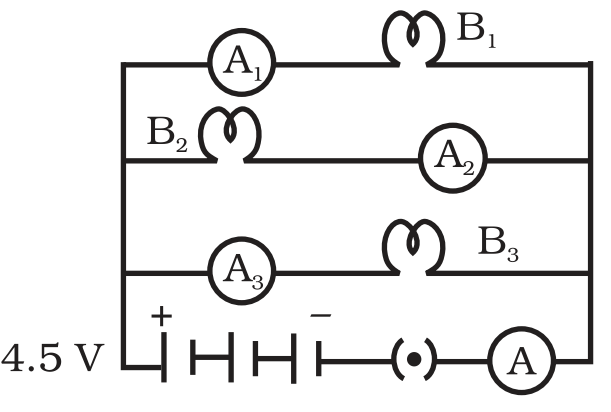
  1. What happens to the glow of the other two bulbs when the bulb gets fused?
  2. What happens to the reading of $A_1, A_2, A_3$ and $A$ when the bulb $B_2$ gets fused?
  3. How much power is dissipated in the circuit when all the three bulbs glow together?

Answer

i. The glow of bulb depends upon the energy disspated per second i.e. $P=\frac{V^2}{R}$. Since $V$ and $R$ of both the bulbs $B_2$ and $B_3$ remain the same even if bulb $B$, gets fused so glow of $B_2$ and $B_3$ remain the same.
ii. Since bulbs are identical, so their resistance is equal (i.e. resistance of each bulb $=R \Omega$ ).
When all bulbs glow, net resistnace of the circuit is given by,

$\frac{1}{\text{R}'}=\frac{1}{\text{R}}+\frac{1}{\text{R}}+\frac{1}{\text{R}}=\frac{3}{\text{R}}$

Or, $\text{R}'=\frac{\text{R}}{3}$

I = 3A, V = 4.5V

Using, V = IR', we get

$4.5=3\times\frac{\text{R}}{3}\ \text{or R }=4.5\Omega$

When $B_2$ gets fused, only two bulbs $B_1$ and $B_2$ in parallel are in the circuit.

$\therefore$ Net resistance of the circuit is given by,

$\frac{1}{\text{R}}=\frac{1}{4.5}+\frac{1}{4.5}=\frac{2}{4.5}\ \text{or R }=\frac{4.5}{2}\Omega$

$\therefore\ \text{I}=\frac{\text{V}}{\text{R}}=\frac{4.5\times2}{4.5}=2\text{A}$

Thus, reading of ammeter A = 2A

Since $B_1$ and $B_3$ are in parallel and have same resistance, so 2 A current will be equally distributed between $B _1$ and $B_3$. Therefore, reading of ammeter $A_1=1 A$ Reading of ammeter $A_3=1 A$ Circuit containing $B_2$ is broken, so no current flows through this circuit. Hence reading of ammeter $A _2=$ zero.
  1. Power dissipated in the circuit,
P = V × I

= 4.5 × 3 = 13.5W

Need a full question paper?

Generate a complete, print-ready paper with questions like this in minutes — across 16+ boards, with answer keys.

Start Generating Free

Similar questions

Write down the following activities in the correct order for a simple reflex arc:
  1. Impulse travels in the motor fibre.
  2. Impulse travels in the sensory fibre.
  3. Effector organ stimulated.
  4. Impulse crosses the synapse.
  1. With the help of a suitable circuit diagram prove that the reciprocal of the equivalent resistance of a group of resistances joined in parallel is equal to the sum of the reciprocals of the individual resistances.
  2. In an electric circuit, two resistors of $12\Omega$ each are joined in parallel to a 6V battery. Find the current drawn from the battery.
Two metals X and $Y$ form the salts $XSO _4$ and $Y _2 SO _4$, respectively. The solution of salt $XSO _4$ is blue in colour whereas that of $Y _2 SO _4$ is colourless. When barium chloride solution is added to $XSO _4$ solution, then a white precipitate Z is formed alongwith a salt which turns the solution green. And when barium chloride solution is added to $Y _2 SO _4$ solution, then the same white precipitate Z is formed alongwith colourless common salt solution.
a. What could the metals $X$ and $Y$ be?
b. Write the name and formula of salt $XSO _4$.
c. Write the name and formula of salt $Y _2 SO _4$.
d. What is the name and formula of white precipitate Z ?
e. Write the name and formula of the salt which turns the solution green in the first case.
Explain the following in terms of gain or loss of oxygen with two examples each.
  1. Oxidation
  2. Reduction
Derive the expression for the heat produced due to a current ‘I’ flowing for a time interval ‘t’ through a resistor ‘R’ having a potential difference ‘V’ across its ends. With which name is the relation known? How much heat will an instrument of 12W produce in one minute if it is connected to a battery of 12V?
Differentiate between nuclear fission and nuclear fusion.
Draw the labelled diagram of an A.C. generator. With the help of this diagram, explain the construction and working of an A.C. generator.
A nuclear reaction is represented by the following equation:
$^{235}_{\ \ 92}\text{U}+{^{1}_{0}\text{n}}\rightarrow{^{139}_{\ \ 56}\text{Ba}}+{^{94}_{36}\text{Kr}}+\text{xc}+\text{E}$
  1. Name the process represented by this equation and describe what takes place
  2. Identify the particle c and the number x of such particles produced in the reaction.
  3. What does E represent?
  4. Name one installation where the above nuclear reaction is utilised.
  5. What type of bomb is based on similar type of reaction?
There are four organisms A, B, C and D. The organism A eats only the flesh of other animals as food. The organism B can eat grains, fruits and vegetables as well as meat and fish. The organism C can make the food itself from simple inorganic substances present in the environment by utilising sunlight energy. On the other hand, organism D eats only plants and their products as food.
  1. Which organism is
  1. Omnivore,
  2. Herbivore,
  3. Carnivore?
  1. Which organism is an autotroph?
  2. Which organism is/ are heterotroph (s)?
  3. Which organism can be a producer?
  4. Which organism is/ are consumer (s)?
Give one example each of organisms which could be like A, B, C and D.
Draw an appropriate schematic diagram showing common domestic circuits and discuss the importance of fuse. Why is it that a burnt out fuse should be replaced by another fuse of identical rating?