Question
Write down the following activities in the correct order for a simple reflex arc:
  1. Impulse travels in the motor fibre.
  2. Impulse travels in the sensory fibre.
  3. Effector organ stimulated.
  4. Impulse crosses the synapse.

Answer

The pathway taken by nerve impulses in a reflex action is called a reflex arc. It is an automatic response to a stimulus. When a stimulus is given to a receptor, the receptors produce an impulse in the sensory fibre. The sensory fibre carries this message in the form of an electrical stimulus across the synapse. From the synapse, the impulse travels in the motor fibre and stimulates the effector organ to produce the desired response. The correct order for a simple reflex arc is:
(b) → (d) → (a) → (c).

Need a full question paper?

Generate a complete, print-ready paper with questions like this in minutes — across 16+ boards, with answer keys.

Start Generating Free

Similar questions

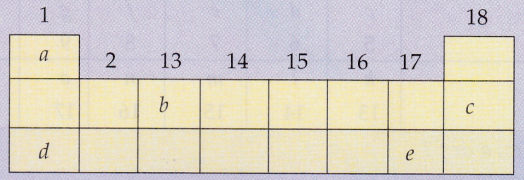
The following diagram shows a part of the periodic table containing first three periods in which five elements have been represented by the letters a, b, c, d and e (which are not their chemical symbols):
  1. Select the letter which represents an alkali metal.
  2. Select the letter which represents a noble gas.
  3. Select the letter which represents a halogen.
  4. What type of bond is formed between a and e?
  5. What type of bond is formed between d and e?
a. Why is the use of iodised salt advisable? Name the disease caused due to deficiency of iodine in our diet and state its one symptom.
b. How do nerve impulses travel in the body? Explain.
Underground water is very essential component of water conservation programme. Mention an advantage of conserving underground water.
  1. Explain the following terms related to spherical lenses:
  1. Optical centre.
  2. Centres of curvature.
  3. Principal axis.
  4. Aperture.
  5. Principal focus.
  6. Focal length.
  1. A converging lens has focal length of 12 cm. Calculate at what distance should the object be placed from the lens so that it forms an image at 48 cm on the other side of the lens.
Draw a ray diagram in each of the following cases to show the formation of image, when the object is placed:
  1. Between optical centre and principal focus of a convex lens.
  2. Anywhere in front of a concave lens.
  3. At 2F of a convex lens. State the signs and values of magnifications in the above mentioned cases (i) and (ii).
The white solid compound A decomposes quite rapidly on heating in the presence of a black substance X to form a solid compound B and a gas C. When an aqueous solution of compound B is reacted with silver nitrate solution, then a white precipitate of silver chloride is obtained along with potassium nitrate solution. Gas C does not burn itself but helps burn other things.
  1. What is compound A?
  2. What is compound B?
  3. What is gas C?
  4. What do you think is the black substance X? What is its function?
  5. What is the general name of substances like X?
Explain the following terms related to spherical lenses:
  1. Centres of curvature.
  2. Principal axis.
  3. Optical centre.
  4. Principal focus.
At what distance from a concave lens of focal length 20 cm, should a 6 cm tall object be placed so that it forms an image at 15 cm from the lens? Also determine the size of the image formed.
Two resistors, with resistances $ 5 Ω$ and $10 Ω$ respectively are to be connected to a battery of emf 6V so as to obtain:
  1. Minimum current flowing.
  2. Maximum current flowing.
  1. How will you connect the resistances in each case?
  2. Calculate the strength of the total current in the circuit in the two cases.
What happens when zinc granules are treated with dilute solution of $H _2 SO _4, HCl , HNO _3, NaCl$ and NaOH , also write the chemical equations if reaction occurs.
  1. Which two criteria did Mendeleev use to classify the elements in his periodic table?
  2. State Mendeleev’s periodic law.
  3. Why could no fixed position be given to hydrogen in Mendeleev’s periodic table?
  4. How and why does the atomic size vary as you go:
  1. From left to right along a period?
  2. Down a group?