Questions

case /data -based (4 Marks)

🎯

Test yourself on this topic

11 questions · timed · auto-graded

Question 14 Marks
Read the following and answer any three questions from (i) to (iv).Bleaching powder is also known as chloride of lime. It is a solid and yellowish white in colour. Bleaching powder can be easily identified by the strong smell of chlorine. When calcium hydroxide (slaked lime) reacts with chlorine, it gives calcium oxychloride (bleaching powder) and water is formed. Aqueous solution of bleaching powder is basic in nature. The material to be bleached is first passed through solution of Na OH to remove greasy matter. Then it is passed through aqueous solution of bleaching powder and very dil. HCl solution. HCl reacts with bleaching powder to liberate nascent oxygen which bleaches material.
  1. Write two uses of Bleaching powder?
     
  2. Bleaching powder is also known as?
     
  3. A) Why does Bleaching powder gives smell of chlorine?
    B) What happens when calcium hydroxide reacts with chlorine?

    OR
    What happens when HCl reacts with bleaching powder?
Answer
  1. (d) All of these.
  2. (d) All of these.
  3. (b) Gives chlorine on exposure to atmosphere.
Explanation:

Bleaching powder gives chlorine on exposure to air by reacting with $CO _2$.

$\text{CaClO}_2\ \ +\ \ \text{CO}\ \ \ \ \xrightarrow{\ \ \ \ \ \ \ \ \ \ }\ \ \text{CaCO}\ \ +\ \ \text{Cl}_2$
  1. (d) All of these.
  2. (a) $CaOCl_2$
Explanation:

$\text{Ca(OH)}_2\ \ +\ \ \text{Cl}_2\ \ \ \ \xrightarrow{\ \ \ \ \ \ \ \ \ \ }\ \ \text{CaOCl}_2\ \ +\ \ \text{H}_2\text{O}$
View full question & answer
Question 24 Marks
Read the following and answer any three questions from (i) to (iv).Sodium chloride obtained from sea water or from lakes contains many impurities such as sulphates of sodium and magnesium, along with chlorides of calcium and magnesium. The chlorides of calcium and magnesium are particularly undesirable on account of their deliquescent nature.
For its purification, common salt is dissolved in minimum quantity of water to get a saturated solution from which insoluble impurities are filtered off. Then hydrogen chloride gas is passed through the saturated solution and the crystals of pure NaCl separate out. The soluble impurities remain in the mother liquor. The crystals are filtered, washed and dried.
  1. From were Sodium chloride is obtained?
     
  2. What is the nature of a common salt?
     
  3. Which compounds are alkaline in aqueous medium with example?

    OR
    A) What happens to hydrogen cholride in water?
    B) Hydrogen chloride gas is soluble in?
Answer
  1. (c) Pure NaCl is not hygroscopic, it shows hygroscopic nature due to impurities.
Explanation:

NaCl is insoluble in alcohol and it is a white crystalline solid. Pure NaCl is not hygroscopic in nature.
  1. (d) Neutral.
Explanation:

Aqueous solution of common salt is neutral in nature.

$\begin{matrix}\text{NaCl}&+&\text{H}_2\text{O}&\xrightarrow{\ \ \ \ \ \ \ }&\text{NaOH}&+&\text{HCl}\\&&&&\text{Strong base}&&\text{Strong acid}\end{matrix}$
  1.  (b) $NH _4 Cl , Na _2 CO _3$
  1. (a) $Na _2 CO _3$
Explanation:

When $Na_2CO_3$(sodium carbonate) is dissolved in water then it forms alkaline aqueous solution due to the formation of NaOH which is a strong alkali.
  1. (d) II, III and IV only.
Explanation:

Sodium hydroxide (NaOH) is prepared by chlor-alkali process.
View full question & answer
Question 34 Marks
Acids, bases and salts are three main categories of chemical compounds. These have certain definite properties which distinguish one class from the other.
The acids are sour in taste while bases are bitter in taste. Tasting a substance is not a good way of finding out if it is an acid or a base! Acids and bases can be better distinguished with the help of indicators. Indicators are substances that undergo a change of colour with a change of acidic, neutral or basic medium. Many of these indicators are derived from natural substances such as extracts from flower petals and barrier. Litmus, a purple dye is extracted from the lichen plant. Some indicators are prepared artificially. For example, methyl orange and phenolphthalein. Given below is a table of indicators and their colour change in acidic and basic medium.

IndicatorColour in AcidColour in Alkali
LitmusRedBlue
MethylPinkish redYellow
PhenolphthaleinColourlessPink

(i) Give two examples each of natural and artificial indicators.
(ii) An aqueous solution turns red litmus solution blue. Excess addition of which solution would reverse the change-ammonium hydroxide solution or hydrochloric acid?
(iii) What will be the change in colour when a few drops of phenolphthalein is added to a solution having pH 8.5.
or
(iv) What is universal indicator?

Answer
(i) Natural Indicators : Turmeric and red cabbage, Artificial Indicators : Methyl red and methyl orange
(ii) Hydrochloric acid because adding excess acid to the base would turn blue litmus solution red.
(iii) It changes into pink.
(iv) Universal indicator is a mixture of dyes that changes colour gradually over a range of $pH$ and is used in testing for acids and alkalis.
View full question & answer
Question 44 Marks
Study the table related to colour change with indicators and answer the questions that follow.
SolutionsColour change with phenolphthalein indicatorColour change with methyl orange indicator
PPinkYellow
QColourlessOrange
RColourlessRed

(i) Name the solution which is acidic.
(ii) Arrange the given solutions in increasing order of their $pH$ value.
(iii) What is the name of solution $P$ and $Q$ ?
or
(iv) When solution $P$ added to the china rose indicator, what is the colour of solution $P$ ?

Answer
COMING SOON
View full question & answer
Question 54 Marks
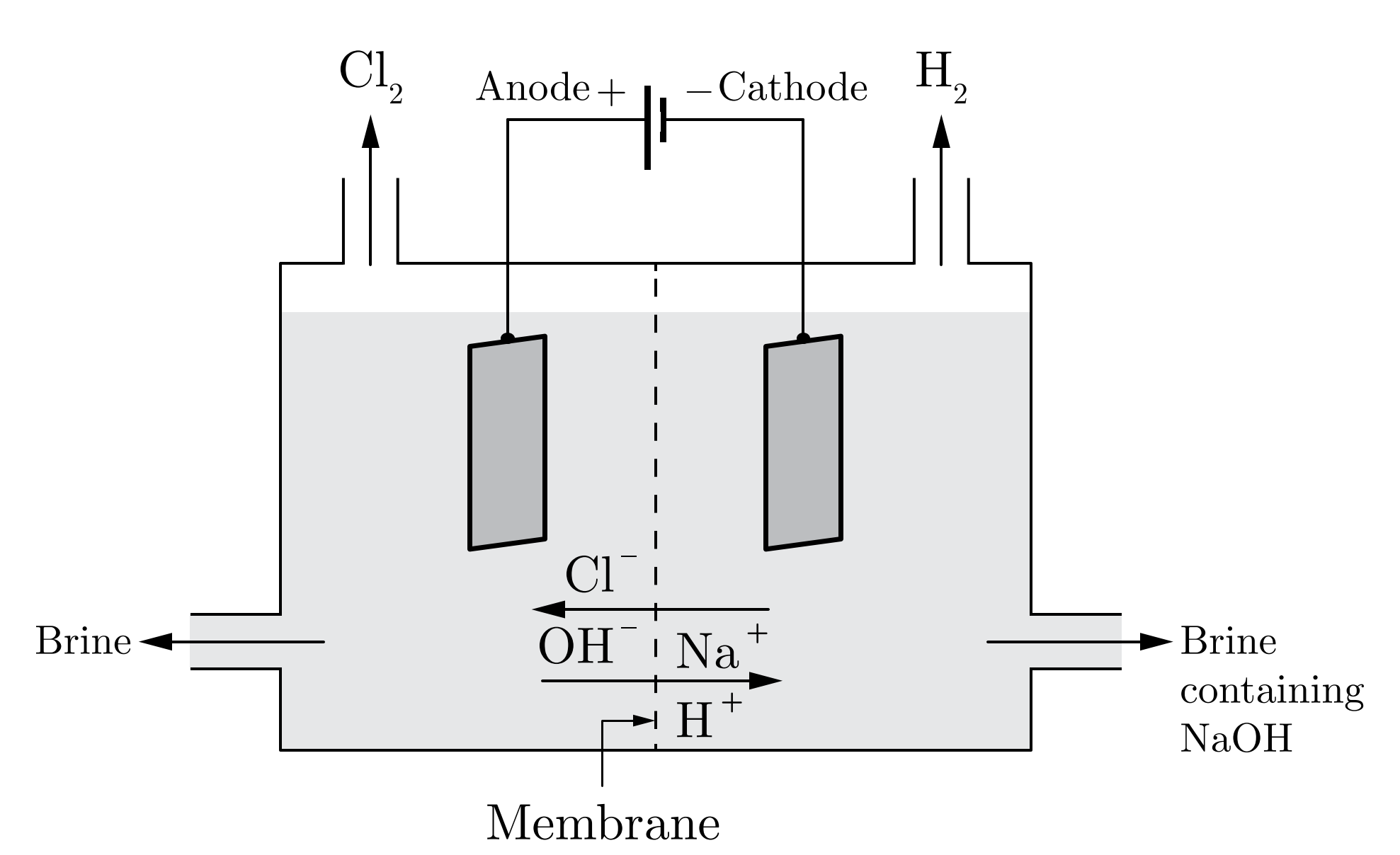
A metal carbonate $X$ on heating with an acid gives a gas which when passed through a solution $Y$ gives the carbonate back. On the other hand, a gas $G$ that is obtained at anode during electrolysis of brine is passed on dry $Y$, it gives a compound $Z$, used for disinfecting drinking water.
(i) Identify $X, Y, G$ and $Z$.
(ii) What is the nature of the gas evolved when $X$ is heated ?
(iii) Write the reaction involved in the formation of $G$ ?
or
(iv) Write the reaction involved when $G$ reacts with $Y$.
Answer
(i) $X$ is calcium carbonate $\left( CaCO _3\right)$.
$Y$ is slaked lime $\left[ Ca ( OH )_2\right]$.
$G$ is chlorine $\left( Cl _2\right)$ gas.
$Z$ is bleaching powder $\left( CaOCl _2\right)$.
(ii) $CaCO _{3(S)} \stackrel{\Delta}{\longrightarrow} CaO _{(S)}+ CO _{2(g)}$
$(X) \stackrel{ }{(A c i d i c}$ gas)
The gas $CO _2$ is acidic in nature.
(iii) $2 NaCl ( aq )+2 H _2 O (l)$
$\longrightarrow 2 NaOH ( aq )+ Cl _2( g )+ H _2( g )$
(iv) $Cl _2( g )+ Ca ( OH )_2( s ) \stackrel{\text { or }}{\longrightarrow} CaOCl _2( s )+ H _2 O (l)$
$\begin{array}{ll}\text { (G) } & \text { (Dry) } \\ (Y)\end{array}$
(Z)
View full question & answer
Question 64 Marks
Baking soda is used in small amounts for making bread and cakes. It helps to make these soft and spongy. An aqueous solution of baking soda turns red litmus blue. It is also used in soda acid fire extinguisher. Use this information to answer the following questions.
(i) Write the equation for the reaction between baking soda and acid.
(ii) How does it help in extinguishing fire?
(iii) What is the reaction involved when it is heated?
or
(iv) Is the $pH$ value of baking soda solution lower than or higher than 7 ?
Answer
(i) The equation for the reaction is
$2 NaHCO _3( s )+ H _2 SO _4( aq )$
(Baking soda)
$\longrightarrow Na _2 SO _4( s )+2 H _2 O (l)+2 CO _2(g)$
(ii) The $CO _2$ gas produced by the reaction of baking soda and acid in the soda-acid fire extinguisher, helps in extinguishing fire.
(iii) The reaction involved is
$2 NaHCO _3( s ) \stackrel{\Delta}{\longrightarrow} Na _2 CO _3( s )+ H _2 O (l)+ CO _2( g ) \uparrow$
or
(iv) The $pH$ value of baking soda solution in higher than 7, i.e. it is alkaline.
View full question & answer
Question 74 Marks
'Salts' refer to the compound formed when an acid reacts with a base. These reactions are known as neutralisation reactions. These reactions are often used in the laboratories to calculate the exact concentration of an acid or an alkali when the other is known. The familiar example of salt is sodium chloride (NaCl), which we use in our food on daily basis and is known as rock salt. It is prepared by the reaction of hydrochloric acid and sodium hydroxide solution. This salt is used to prepare various compounds. When electricity is pass through an aqueous solution of sodium chloride (called brine), it decomposes to form sodium hydroxide. The process is called the chlor-alkali process because of the products formed-chlor and alkali for sodium hydroxide.

(i) Write the chemical reaction of chlor-alkali process.
(ii) Name the gases formed at the anode and the cathode.
(iii) Write one use each of chlorine and hydrogen gas.
or
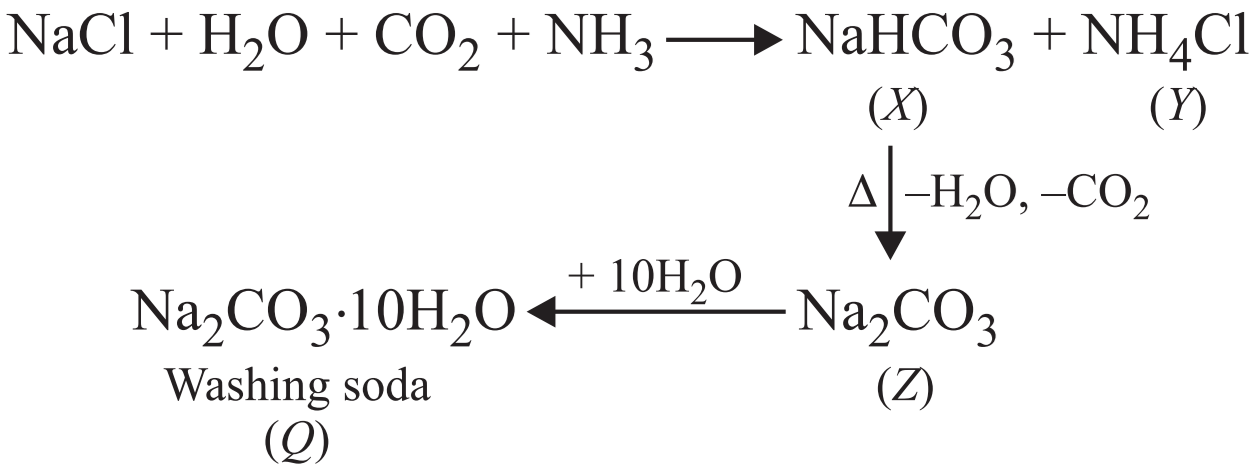
(iv) How will you prepare baking soda from sodium chloride?

Answer
COMING SOON
View full question & answer
Question 84 Marks
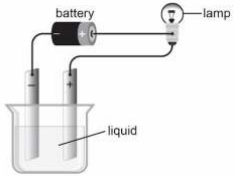
Mike placed an electric circuit separately in a dilute acid and a dilute base.

Image
Mike observed whether the lamp in the circuit glowed or not for each liquid.
8. Which property of acids and bases was Mike trying to test through his experiment?
9. Will the lamp glow if the circuit is placed in distilled water?
Explain your answer.
10. Acid + Metal →Salt + X
What is X in the equation?

Answer
8. Mentions that Mike was trying to ind out whether acids and bases are good conductors of electricity.
For example:
● Are acids and bases good conductors of electricity?
9. Mentions that the lamp will not glow if the circuit is placed in distilled water as distilled water does not contain free H⁺ or free OH ions.
10. Mentions hydrogen as the response
View full question & answer
Question 94 Marks
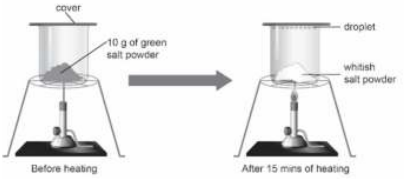
Madhav took 10 g of a green salt powder in a covered beaker.
He heated the beaker for 15 minutes.
Madhav noticed that the salt powder turned whitish after 15 minutes.
He also found some droplets on the inner surface of the beaker cover.

Image

Madhav added a few drops of water to the whitish powder.
The powder turned green.
6. What can be concluded about the green salt powder from Madhav’s activity?
Circle ‘Yes’ or ‘No’ to mark your responses.

Is the reason correct?

Yes or No

It contains moisture.

Yes/No

It changes colour on heating.

Yes/No

It changes to a new chemical on heating.

Yes/No

7. Madhav repeated the same activity but kept the beaker uncovered.
Will the results remain the same? Explain your answer.

Answer
6. Yes
Yes
No
7. Mentions any one of the two responses of full credit.
For example:
● The green salt powder will turn whitish.
OR
● There will be no droplets formed.
View full question & answer
Question 104 Marks
The equation below shows a chemical reaction.
X is a non-metal, but Y is a metal.
$H ^{(+)} X + YOH ^{(-)} \rightarrow YX + HOH YOH \rightarrow YX + HOH$
4. What is the chemical nature of YX?
Write your answer in terms of acid/base/salt.
5.Builders use plaster of Paris to make the surface layer of the inner walls of a building.
Which property of plaster of Paris powder makes it a suitable building material?
A. It is lightweight.
B. It is white in colour.
C. It is found readily in nature.
D. It gets hard when mixed with water.
Answer
4. Mentions salt as the response
5. D. It gets hard when mixed with water
View full question & answer
Question 114 Marks
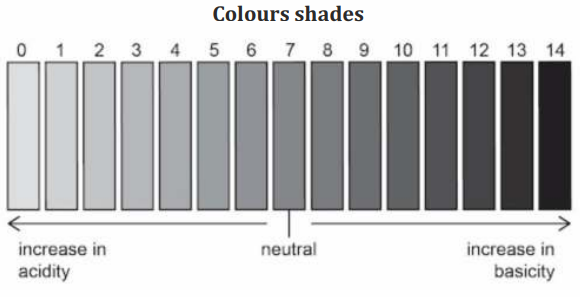
A pH paper changes its colour depending on the pH value of the substance it is dipped in.
The picture shows the different colours of a pH paper.

Image

Leena tested the pH value of four liquids using a pH paper.
The table shows the shade of the pH paper after it is dipped separately in the four liquids.

Liquid 1

Liquid 2

Liquid 3

Liquid 4

Shade of the pH paper

Colour 9

Colour 12

Colour 5

Colour 3

1. Which liquid has the lowest concentration of hydrogen ions?
A. Liquid 1
B. Liquid 2
C. Liquid 3
D. Liquid 4
2. Leena was advised by her teacher to wear gloves and use forceps while dipping the pH paper in the liquids.
What was the reason for this advice?
Circle ‘Yes’ or ‘No’ to mark your responses.

Is the reason correct?

Yes or No

Gloves keep the hands warm.

Yes/No

Forceps provide better grip than bare hands.

Yes/No

Gloves protect hands from corrosive liquids.

Yes/No

3. What should be the colour of a pH paper after it is dipped in distilled water?
Explain your answer.

Answer
1. B. Liquid 2
2. No
Yes
Yes
3. Mentions that the colour will be colour 7 because distilled water is neither acidic nor basic.
For example:
●Colour 7. Distilled water is neither acidic nor basic.
View full question & answer
case /data -based (4 Marks) - Science STD 10 Questions - Vidyadip