Question
Balance the following equations by the oxidation number method.
$\text{Fe}^{2+}+\text{H}^++\text{Cr}_2\text{O}^{2-}_7\xrightarrow{ \ \ \ \ \ \ \ \ \ }\text{Cr}^{3+}+\text{Fe}^{3+}+\text{H}_2 \text{O}$
Answer

$\text{Fe}^{2+}+\text{H}^{+}+\text{Cr}_2\text{O}^{2-}_7\xrightarrow{ \ \ \ \ \ \ \ \ }\text{Cr}^{3+}+\text{Fe}^{3+}+\text{H}_2\text{O}$$\stackrel{+2 \ \ \ \ \ \ \ }{\text{Fe}^{2+}}\text{H}^++\stackrel{+6}{\text{Cr}}_2\stackrel{-2 \ \ \ \ \ \ \ }{\text{O}^{2-}_7}\xrightarrow{ \ \ \ \ \ \ }\stackrel{+3 \ \ \ \ \ \ \ }{\text{Cr}^{3+}}+\stackrel{+3 \ \ \ \ \ \ \ \ \ }{\text{Fe}^{3+}}+\text{H}_2\text{O}$
  1. Balance the increase and decrease in O.N.
$6\stackrel{+2 \ \ \ \ \ \ \ }{\text{Fe}^{2+}}+\text{H}^++\stackrel{+6 \ \ \ }{\text{Cr}_2}\stackrel{-2 \ \ \ \ \ \ }{\text{O}^{2-}_7}\xrightarrow{ \ \ \ \ \ \ \ \ }2\stackrel{+3 \ \ \ \ \ \ }{\text{Cr}^{3+}}+6\stackrel{+3 \ \ \ \ \ \ \ }{\text{Fe}^{3+}}+\text{H}_2\text{O}$
  1. Balancing H and O atoms by adding $\text{H}^+$ and $\text{H}_2\text{O}$ molecules
$6\text{Fe}^{2+}+14\text{H}^++\text{Cr}_2\text{O}^{2-}_7\xrightarrow{ \ \ \ \ \ \ \ \ }2\text{Cr}^{3+}+6\text{Fe}^{3+}+7\text{H}_2\text{O}$

Need a full question paper?

Generate a complete, print-ready paper with questions like this in minutes — across 16+ boards, with answer keys.

Start Generating Free

Similar questions

  1. What is the state of hybridisation of nitrogen in $\text{NH}_4^+$ ion?
  2. Draw the shape of $\mathrm{PH}_3$ and $\mathrm{SF}_6$ according to VSEPR theory.
  3. Which hybrid orbitals are used by carbon atoms in $\text{CH}_3-\text{CHO}?$
Convert:
  1. Ethylene to Nitrobenzene.
  2. Write short note on Markovnikov's Rule.

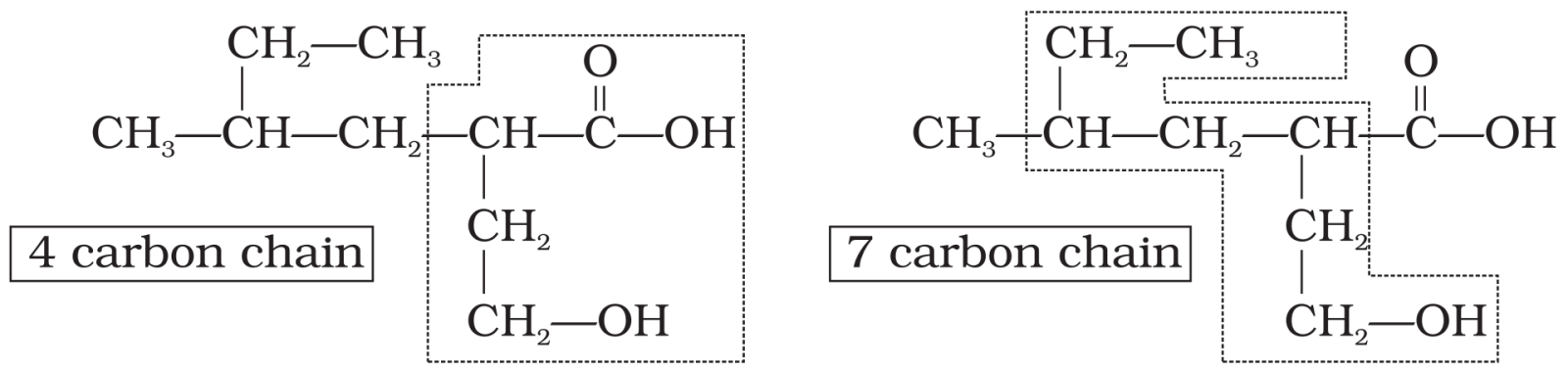
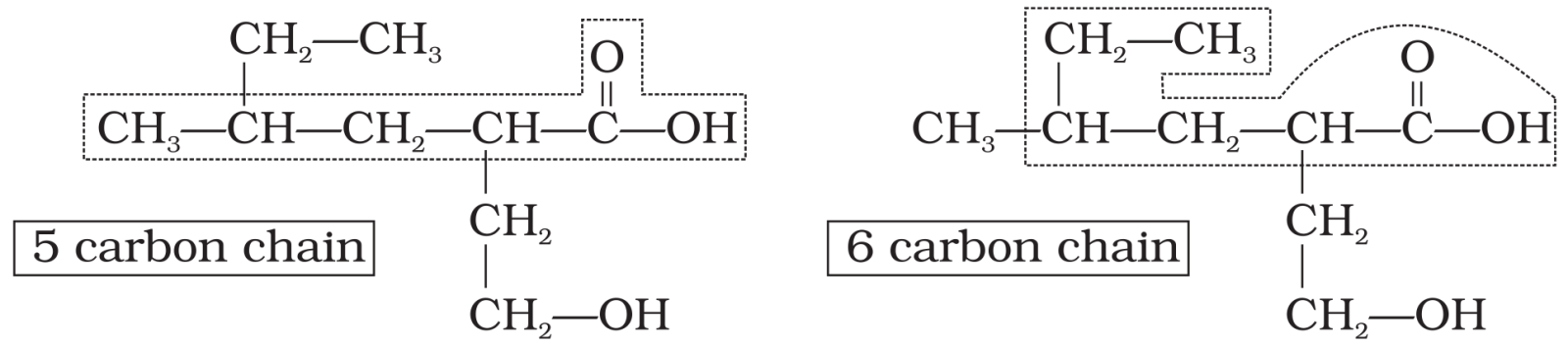
Which of the following selected chains is correct to name the given compound according to IUPAC system.

  1. State Hess's Law of constant heat summation. How does it follow from the first law of thermodynamics.
  2. Determine $\Delta_\text{r}\text{H}^\circ,$ at 298K for reaction:
$\text{C(graphite)}+2\text{H}_2(\text{g})\overrightarrow{\ \ \ \ \ \ \ \ }\ \text{CH}_4(\text{g});\ \Delta_\text{r}\text{H}^\circ=?$
You are given:
  1. $\text{C(graphite)}+\text{O}_2(\text{g})\overrightarrow{\ \ \ \ \ \ \ }\ \text{CO}_2(\text{g});$ $\Delta_\text{r}\text{H}^\circ=-393.51\text{kJ/ mol}$
  2. $\text{H}_2\text{(g)}+\frac{1}{2}\text{O}_2(\text{g})\overrightarrow{ \ \ \ \ \ \ \ }\ \text{H}_2\text{O(l)};$ $\Delta_\text{r}\text{H}^\circ=-285.8\text{kJ/ mol}$
  3. $\text{CO}_2(\text{g})+2\text{H}_2\text{O(l)}\overrightarrow{\ \ \ \ \ \ \ \ \ }\ \text{CH}_4(\text{g})+2\text{O}_2(\text{g});$ $\Delta_\text{r}\text{H}=+890.3\text{kJ/ mol}$
What happen when electricity is passed in aqueous solution of sodium acetate?### Explain Kolbe's electrolysis for formation of alkanes.
How many grams of $KClO_3$ must be decomposed to prepare 3.36 litres of oxygen at STP? (Atomic weight of K = 39, Cl= 35.5, 0 = 16u)
Choose the correct answer.$\Delta\text{U}^\ominus$of combustion of methane is $-\mathrm{X} \mathrm{~kJ} \mathrm{~mol}^{-1}$. The value of $\Delta\text{H}^\ominus$ is:
i. What is de-Broglie wavelength of an electron moving with velocity of light? Mass of electron $=9.1 \times 10^{-31} \mathrm{~kg}$, $\mathrm{h}=6.626 \times 10^{-34} \mathrm{~J} \mathrm{~s}$.
ii. What is angular momentum of electron in the $5^{\text {th }}$ shell?
Justify giving reactions that among halogens, fluorine is the best oxidant and among hydrohalic compounds, hydroiodic acid is the best reductant.
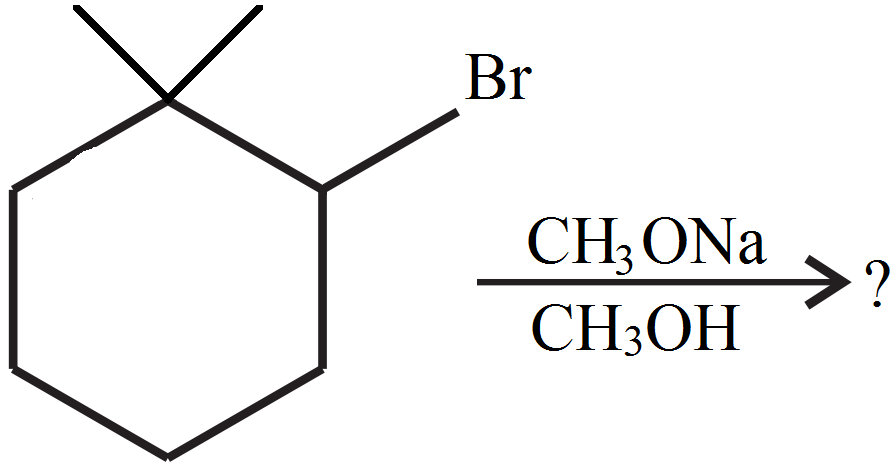
  1. Write the major product of the following reaction.
  1. Arrange the following in increasing order of acidic character.
$\ \ \ \ \ \ \ \ \ \ \ \ \text{CH}_3\ \text{O} \ \ \ \ \ \ \ \ \ \ \ \ \ \ \ \ \ \ \ \ \ \ \ \ \ \ \text{O}\\ \ \ \ \ \ \ \ \ \ \ \ \ \ | \ \ \ \ \ \ \ || \ \ \ \ \ \ \ \ \ \ \ \ \ \ \ \ \ \ \ \ \ \ \ \ \ \ \ ||\\\text{CH}_3-\text{C}-\text{C}-\text{OH},\ \text{CH}_3-\text{C}-\text{OH},\\ \ \ \ \ \ \ \ \ \ \ \ \ \ |\\ \ \ \ \ \ \ \ \ \ \ \ \ \text{CH}_3$ $ \ \ \ \ \ \ \ \ \ \ \ \ \ \ \ \ \ \ \ \ \ \ \ \ \ \text{O}\ \ \ \ \ \ \ \ \ \ \ \ \ \ \ \ \ \ \ \ \ \ \ \ \ \ \text{O}\\ \ \ \ \ \ \ \ \ \ \ \ \ \ \ \ \ \ \ \ \ \ \ \ \ \ || \ \ \ \ \ \ \ \ \ \ \ \ \ \ \ \ \ \ \ \ \ \ \ \ \ \ \ ||\\\text{CH}_3-\text{CH}_2-\text{C}-\text{OH},\ \text{CH}_3-\text{C}-\text{COOH}$
  1. What is the product obtained when but-2-ene reacts with $Br_2$​​​​​​​?