Question
Balance the following ionic equations.
$\text{Cr}_2\text{O}^{2-}_7+\text{Fe}^{2+}+\text{H}^+\xrightarrow{ \ \ \ \ \ \ \ \ }\text{Cr}^{3+}+\text{Fe}^{3+}+\text{H}_2\text{O}$

Answer

Step-1: Separate the equation into two half reactions.

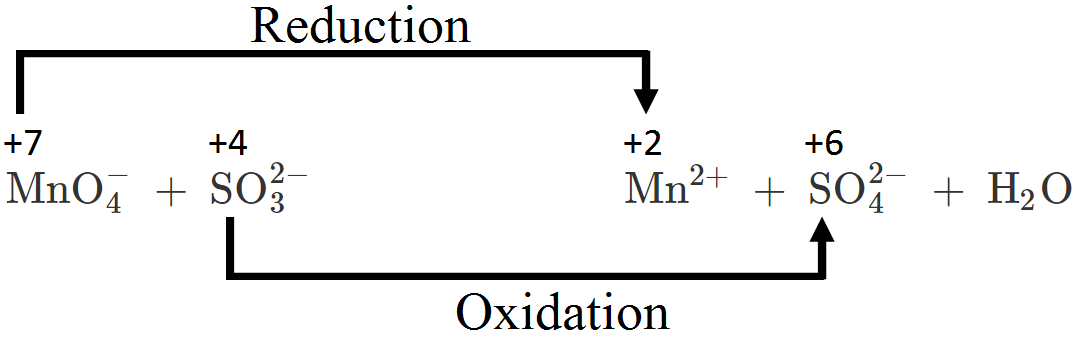
The oxidation number of various atoms are shown below:

$\stackrel{+6 \ \ -2 \ \ \ \ \ \ \ }{\text{Cr}_2\text{O}^{2-}_7}+\stackrel{+2 \ \ \ \ \ \ \ }{\text{Fe}^{2+}}+\stackrel{+1 \ \ \ }{\text{H}^+}\xrightarrow{ \ \ \ \ \ \ \ \ }\stackrel{+3}{\text{Cr}^{3+}}+\stackrel{+3}{\text{Fe}^{3+}}+\stackrel{+1 \ \ -2}{\text{H}_2\text{O}}$

In this case, chromium undergose reduction, oxidation number decreases from $+6(\text{in }\text{Cr}_2\text{O}^{2-}_7)\text{ to}+3(\text{in Cr}^{3+})$

Fe2+ (O.N. = +2) changes to Fe3+ (O.N. = +3). The species undergoing oxidation and reduction are:

Oxidation: $\text{Fe}^{2+}\xrightarrow{ \ \ \ \ \ \ \ }\text{Fe}^{3+}$

reduction: $\text{Cr}_2\text{O}^{2-}_7\xrightarrow{ \ \ \ \ \ \ \ \ }\text{Cr}^{3+}$

Step-2: Balance each half reaction separately as:

  1. $\text{Fe}^{2+}\xrightarrow{ \ \ \ \ \ \ \ \ }\text{Fe}^{3+}$
  1. Balance all atoms other than H and O. This step is not needed, because, it is already balanced.
  2. The oxidation number on left is +2 and on right is +3. To account for the difference, the electron is added to the right as: $\text{Fe}^{2+}\xrightarrow{\ \ \ \ \ \ \ \ }\text{Fe}^{3+}+\text{e}^-$
  3. Charge is already balanced.
  4. No need to add H or O.

The balanced half equation is:

$\text{Fe}^{2+}\xrightarrow{ \ \ \ \ \ \ \ }\text{Fe}^{3+}+\text{e}^-...(\text{i})$

Consider the second half equation

$\text{Cr}_2\text{O}^{2-}_7\xrightarrow{ \ \ \ \ \ \ \ \ }\text{Cr}^{3+}$

  1. Balance the atoms other than H and O.

$\text{Cr}_2\text{O}^{2-}_7\xrightarrow{ \ \ \ \ \ \ \ \ }2\text{Cr}^{3+}$

  1. The oxidation number of chromium on the left is +6 and on the right is +3. Each chromium atom must gain three electrons. Since there are two Cr atoms, add 6e on the left.

$\text{Cr}_2\text{O}^{2-}_7+6\text{e}^-\xrightarrow{ \ \ \ \ \ \ \ \ }2\text{Cr}^{3+}$

  1. Since the reaction takes place in acidic medium add 14H+ on the left to equate the net charge on both sides.

$\text{Cr}_2\text{O}^{2-}_7+6\text{e}^-+14\text{H}^+\xrightarrow{ \ \ \ \ \ \ \ \ \ }2\text{Cr}^{3+}$

  1. To balance FI atoms, add 7H2O molecules on the right.

$\text{Cr}_2\text{O}^{2-}_7+6\text{e}^-+14\text{H}^+\xrightarrow{ \ \ \ \ \ \ \ \ }2\text{Cr}^{3+}+7\text{H}_2\text{O}...(\text{ii})$

This is the balanced half equation.

Step-3: Now add up the two half equations. Multiply eq. (i) by 6 so that electrons are balanced.

$ \ \ \ \ \ \ \ \ \ \ \ \ \ \ \ \ \ \ \ \ \ \ \ \ \ \ \ \ \ \ \ \ \ \ \ \ \text{Fe}^{2+}\xrightarrow{ \ \ \ \ \ \ \ \ \ }\text{Fe}^{3+}+\text{e}^-\times6\\ \ \ \ \ \ \ \ \ \text{Cr}_2\text{O}^{2-}_7+6\text{e}^-+14\text{H}\xrightarrow{ \ \ \ \ \ \ \ \ \ }2\text{Cr}^{3+}+7\text{H}_2\text{O} \ \ \ \ \ \ \ \ \ \ \ \ \ \ \ \ \ \ \ \ \\ \underline{ \ \ \ \ \ \ \ \ \ \ \ \ \ \ \ \ \ \ \ \ \ \ \ \ \ \ \ \ \ \ \ \ \ \ \ \ \ \ \ \ \ \ \ \ \ \ \ \ \ \ \ \ \ \ \ \ \ \ \ \ \ \ \ \ \ \ \ \ \ \ \ \ \ \ \ \ \ \ \ \ \ \ \ \ \ \ \ \ \ \ \ \ \ \ \ \ \ \ \ } \\6\text{Fe}^{2+}+\text{Cr}_2\text{O}^{2-}_7+14\text{H}^+\xrightarrow{ \ \ \ \ \ \ \ \ \ \ \ }6\text{Fe}^{3+}+2\text{Cr}^{3+}+7\text{H}_2\text{O}\ \ \ \ \ \ \ \ \ \ \ \ \ \ \ \ \ \ \ \ \ \ \ \ \ \ \ \ \ \ \ \ \ \ \ \ \ \ \ \ \ \ \ \ \ \ \ \ \ \ \ \ \ \ \ \ \ \ \ \ \ \ \ \ \ $
Need a full question paper?

Generate a complete, print-ready paper with questions like this in minutes — across 16+ boards, with answer keys.

Start Generating Free

Similar questions

Enthalpies of formation of CO(g), CO2(g), N2O(g) and N2O4(g) are –110, – 393, 81 and 9.7kJ mol–1 respectively. Find the value of $\Delta\text{rH}$ for the reaction:

$\text{N}_2\text{O}_4(\text{g}) +3\text{CO} (\text{g})\xrightarrow{ \ \ \ \ \ \ } \text{N}_2\text{O}(\text{g}) + 3\text{CO}_2(\text{g})$

  1. At 473K, equilibrium constant, K for decomposition of PCl5 is 8.3 × 10⁻³. If decomposition is depicted as

$\text{PCl}_5(\text{s})\rightleftharpoons\text{PCl}_3(\text{s})+\text{Cl}_2(\text{g});$

$\Delta_\text{r}\text{H}^\text{o}=124.0\text{kJ mol}^{-1}$

  1. Write an expression for Kc for the reaction.
  2. What is the value of Kc for the reverse reaction at same temperature.
  3. What would be the effect on Kc if:
  1. The pressure is increased?
  2. The temperature is increased?
  1. Write equilibrium constant for the following reactions:
  1. $\text{BaCO}_3(\text{s})\rightleftharpoons\text{BaO(s)}+\text{CO}_2(\text{g})$

  2. $\text{CH}_4(\text{g})+2\text{O}_2(\text{g})\rightleftharpoons\text{CO}_2(\text{g})+2\text{H}_2\text{O(g)}$

The ionization constant of propanoic acid is $1.32 \times 10^{-5}$. Calculate the degree of ionization of the acid in its 0.05 M solution and also its pH . What will be its degree of ionization if the solution is 0.01 M in HCl also?
  1. Define solubility product. Write solubility product expression in terms of molar solubility for FeCl3
  2. What is the effect of temperature on solubility of gases in liquids?
  3. Equilibrium constant for the reaction is 4.0. What will be the equilibrium constant for the reverse reaction.
  4. Calculate the pH of 10-8M HCl solution.
  1. Which of the following are Lewis acids?

$\text{H}_2\text{O},\text{BF}_3,\text{H}^+$ and $\text{NH}^+_4$

  1. The pH of a sample of vinegar is 3.76. Calculate the concentration of hydrogen ion in it.
  2. What is common ion effect? Explain its application in qualitative analysis of II group radicals.
Distinguish between a sigma and a pi bond.
For any gaseous reaction how will you write the equilibrium constant $\left( K _{ p }\right)$ ? What is the relationship between $K_p$ and $K_{ c }$ ? Derive it.
Match the ions given in Column I with their nature given in Column II.
 
Column I
 
Column II
(i)
(a)
Stable due to resonance.
(ii)
$\text{F}_3-\text{C}^\oplus$
(b)
Destabilised due to inductive effect.
(iii)
$\ \ \ \ \ \ \ \ \ \ \ \ \text{CH}_3\\\ \ \ \ \ \ \ \ \ \ \ \ \ |\\\text{CH}_3-\text{C}^\ominus\\\ \ \ \ \ \ \ \ \ \ \ \ \ \ |\\\ \ \ \ \ \ \ \ \ \ \ \ \ \text{CH}_3$
(c)
Stabilised by hyperconjugation.
(iv)
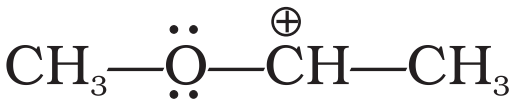
$\ \ \ \ \ \ \ \ \ \ \ \ \ _\oplus\\\text{CH}_3-\text{CH}-\text{CH}_3$
(d)
A secondary carbocation.
  1. A beam of helium atoms move with a velocity of 2.0 × 10³ms-1. Find the wavelength of the particle constituting the beam, (h = 6.626 × 10⁻³⁴Js).
  2. An electron is moving with a kinetic energy of 2.275 × 10⁻²⁵J. Calculate its de-Broglie wavelength. (Mass of electron = 9.1 × 10⁻³¹kg, h = 6.6 × 10⁻³⁴Js)
Balance the following equations in basic medium by ion-electron method and oxidation number methods and identify the oxidising agent and the reducing agent.

$\text{P}_4(\text{s})+\text{OH}^{-}(\text{aq})\rightarrow\text{PH}_3(\text{g})+\text{HPO}_2^-(\text{aq})$