MCQ
Basicity of $H_3BO_3$ is :
- ✓$1$
- B$2$
- C$3$
- D$4$
Although Boric acid contains 3 OH groups yet it can act as monobasic acid rather than tribasic acid. This is because boric acid does not act as a proton donor rather it accepts a pair of
electrons from $\mathrm{OH}^{-}$ ions.
It does not donate $\mathrm{H}^{+}$ rather it accepts an electron pair from the solution or the donor i.e. $\mathrm{OH}^{-}$
Thus, Boric acid is an aprotic acid (like lewis acid) and monobasic acid.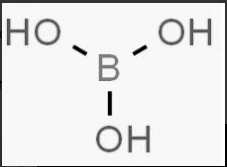
Generate a complete, print-ready paper with questions like this in minutes — across 16+ boards, with answer keys.
$C{S_2}(g) + 4{H_2}(g) \to C{H_4}(g) + 2{H_2}S(g)$
$SO_2Cl_2(g) \rightleftharpoons SO_2(g) + Cl_2(g)$ , what is the temperature at which $\frac{{{K_p}(atm)}}{{{K_c}(M)\,}} = \frac{1}{3}$ ? ......$K$
|
Column $I$ |
Column $II$ |
| $A$. Inert-gas elements | $1.\left( {n - 1} \right){d^{1 - 10}}\,n{s^{1 - 2}}$ |
| $B$. Transition elements | $2\,. ns^2\,np^6$ |
| $C$. Inner-transition elements | $3.\left( {n - 2} \right){f^{1 - 14}}\,\left( {n - 1} \right){s^2}{p^6}{d^{0 - 1}}\,n{s^2}$ |