Question
$\mathrm{BeF}_2$ molecule is linear while $\mathrm{SF}_2$ is angular through both are triatomic?

Answer

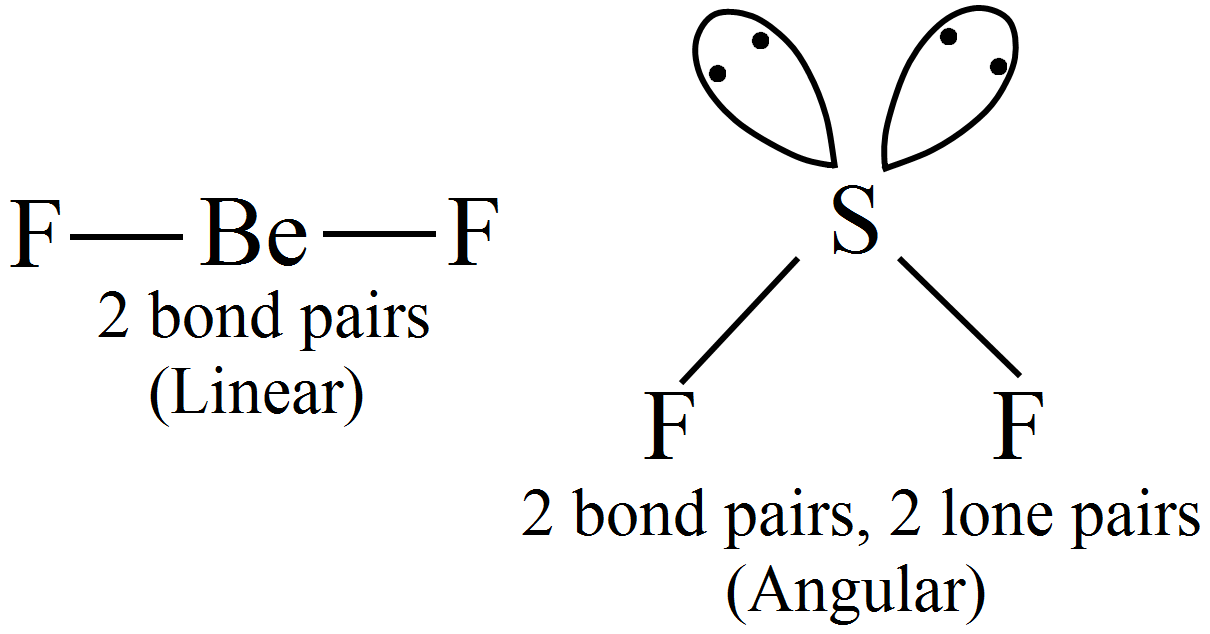
In $\mathrm{BeF}_2$, Be is the central atom and is surrounded by 2 bond pairs only therefore, the molecule is linear. On the other hand, in $\mathrm{SF}_2$, the central atom S is surrounded by 2 bond pairs and 2 lone pairs. Since at is surrounded by 4 electron pairs, the geometry is expected to be tetrahedral with two position occupied by lone pairs.

Need a full question paper?

Generate a complete, print-ready paper with questions like this in minutes — across 16+ boards, with answer keys.

Start Generating Free

Similar questions

  1. Write IUPAC name of the following:
  1. $\text{CH}_2\text{CH}_2\text{CHO}\text{ and }\text{CH}_3\text{C}-\text{CH}_3\\ \ \ \ \ \ \ \ \ \ \ \ \ \ \ \ \ \ \ \ \ \ \ \ \ \ \ \ \ \ \ \ \ \ \ \ \ \ \ \ \ \ ||\\ \ \ \ \ \ \ \ \ \ \ \ \ \ \ \ \ \ \ \ \ \ \ \ \ \ \ \ \ \ \ \ \ \ \ \ \ \ \ \ \ \ \text{O}$
  2. Draw the structure of 3-oxopentanal.
The compression factor (compressibility factor) for one mole of a van der Waals gas at 0°C and 100 atm pressure is found to be 0.5. Assuming that the volume of a gas molecule is negligible, calculate the van der Waals' constant a.
Justify giving reactions that among halogens, fluorine is the best oxidant and among hydrohalic compounds, hydroiodic acid is the best reductant.
An element with mass number 81 contains 31.7% more neutrons as compared to protons. Assign the atomic symbol.
Among the elements of second period Li to Ne, pick out element:
  1. With the highest first ionisation energy.
  2. With highest electronegativity.
  3. With largest atomic radius.
  4. That is most reactive non-metal.
  5. That is most reactive metal.
  6. With valency equal to 4.
Arrange the elements N, P, O and S in the order of:
  1. Increasing first ionisation enthalpy.
  2. Increasing non metallic character. Give reason for the arrangement assigned.
Describe the hybridization scheme in case of $\mathrm{PCl}_5$. Why are the axial bonds longer as compared to equitorial bonds.
In a hydrogen atom, the energy of an electron in first Bohr's orbit is $E _{ n }=-\frac{2 \pi^2 me ^4}{ n ^2 h^2}$.
What is the energy required for its excitation to Bohr's second orbit?
How many moles of $CO _2$ are obtained from complete combustion of 21 gm propene?
  1. Show the difference of ortho and para hydrogen by a diagram.
  2. Difference in chemical behaviour of compound of hydrogen with elements of atomic number 17 and 20