Question
Before the neutrino hypothesis, the beta decay process was throught to be the transition,
$\text{n}\rightarrow\ \text{p}+\overline{\text{e}}$
If this was true, show that if the neutron was at rest, the proton and electron would emerge with fixed energies and calculate them.Experimentally, the electron energy was found to have a large range.
Answer

Let us consider the cases before and after $\beta-\text{decay}$
Before $\beta-\text{decay};$ if the neutron was at rest.
Hence $, E_n = m_nc^2, p_n = 0$
After $\beta-\text{decay};\text{p}_\text{n}=\text{p}_\text{p}+\text{p}_\text{e}$
or, $0=\text{p}_\text{p}+\text{p}_\text{e}$
$\Rightarrow\ |\text{p}_\text{p}|=|\text{p}_\text{e}|=\text{p}$
Also, $\text{E}_\text{p}=\big(\text{m}_\text{p}^2\text{c}^4+\text{p}_\text{p}^2\text{c}^2\big)^\frac{1}{2}$
$\text{E}_\text{e}=\big(\text{m}_\text{e}^2\text{c}^4+\text{p}_\text{p}^2\text{c}^2\big)^\frac{1}{2}=\big(\text{m}_\text{e}^2\text{c}^4+\text{p}_\text{e}^2\text{c}^2\big)^\frac{1}{2}$
Now applying conservation of energy,
$\big(\text{m}_\text{e}^2\text{c}^4+\text{p}^2\text{c}^2\big)^\frac{1}{2}=\big(\text{m}_\text{e}^2\text{c}^4+\text{p}^2\text{c}^2\big)^\frac{1}{2}=\text{m}_\text{n}\text{c}^2$
$\text{m}_\text{p}\text{c}^2\approx936\ \text{MeV},\text{m}_\text{e}\text{c}^2\approx938\ \text{MeV}$ and $\text{m}_\text{e}\text{c}^2=0.51\ \text{MeV}$
Since, the energy difference between $n$ and $p$ is small $, pc$ will be small $, pc < < < m_pc^2,$ while pc may be greater than $m_ec^2.$
$\Rightarrow\ \text{m}_\text{p}\text{c}^2+\frac{\text{p}^2\text{c}^2}{2\text{m}^2_\text{p}\text{c}^4}\simeq\text{m}_\text{n}\text{c}^2-\text{pc}$
To first otder $pc = m_nc^2 - m_pc^2 = 938\ \text{MeV} - 936\ \text{MeV} = 2\ \text{MeV}.$
This given the momentum of proton or neutron. Then,
$\text{E}_\text{p}=\big(\text{m}_\text{p}^2\text{c}^4+\text{p}^2\text{c}^2\big)^\frac{1}{2}=\sqrt{936^2+2^2}\approx936\ \text{MeV}$
$\text{E}_\text{e}=\big(\text{m}_\text{e}^2\text{c}^4+\text{p}^2\text{c}^2\big)^\frac{1}{2}=\sqrt{(0.51)^2+2^2}= 2.06\ \text{MeV}$

Need a full question paper?

Generate a complete, print-ready paper with questions like this in minutes — across 16+ boards, with answer keys.

Start Generating Free

Similar questions

A gun is mounted on a railroad car. The mass of the car, the gun, the shells and the operator is $50m$ where m is the mass of one shell. If the velocity of the shell with respect to the gun $($in its state before firing$)$ is $200m/s,$ what is the recoil speed of the car after the second shot? Neglect friction.
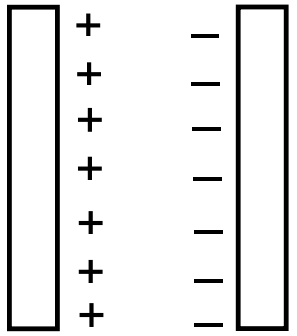
Two large conducting plates are placed parallel to each other and they carry equal and opposite charges with surface density $\sigma$ as shown in figure. Find the electric field:
  1. At the left of the plates.
  2. In between the plates.
  3. At the right of the plates.
A block of mass m slips on a rough horizontal table under the action of a horizontal force applied to it. The coefficient of friction between the block and the table is $\mu.$ The table does not move on the floor. Find the total frictional force applied by the floor on the legs of the table. Do you need the friction coefficient between the table and the floor or the mass of the table?
Shiv had a high tension tower erected on his farm land. He kept complaining to the authorities to remove it since it occupied a large portion of his land. His uncle, who was a teacher, explained to him the need for erecting these towers for efficient transmission of power. As Shiv got convinced and realised significance, he stopped complaining.
Based on the above paragraph, answer the following questions:
  1. Why is it necessary to transport power at high voltages?
  2. ‘A low power factor implies large power loss'. Explain.
  3. Write the two values displayed by Shiv and his Uncle.
What is a voltmeter? How can a galvanometer be converted into a voltmeter of given range? Explain.
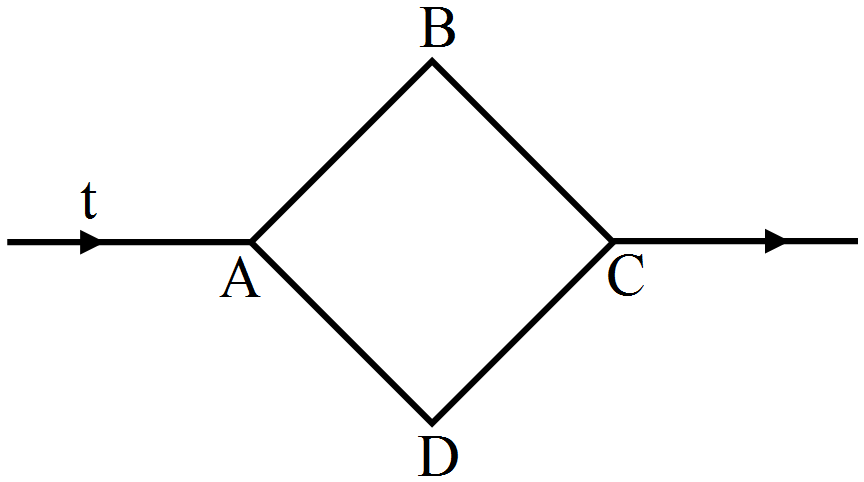
Figure shows a square loop ABCD with edgelength a. The resistance of the wire ABC is r and that of ADC is 2r. Find the magnetic field B at the centre of the loop assuming uniform wires.
A converging lens of focal length $15\ cm$ and a converging mirror of focal length $10\ cm$ are placed $50\ cm$ apart. If a pin of length $2.0\ cm$ is placed $30\ cm$ from the lens farther away from the mirror, where will the final image form and what will be the size of the final image?
A parallel-plate capacitor of plate area A and plate separation d is charged to a potential difference V and then the battery is disconnected. A slab of dielectric constant K is then inserted between the plates of the capacitor so as to fill the space between the plates. Find the work done on the system in the process of inserting the slab.
$i$. Draw a ray diagram showing the image formation by a compound microscope. Hence obtain the expression for total magnification when the image is formed at least distance of distinct vision.
$ii$. A compound microscope consists of an objective lens of focal length $2.0 \ cm$ and an eyepiece of focal length $6.0 \ cm$. If they are separated by a distance of $24 \ cm,$ find the total magnification when the image is formed at infinity.
A glass tube, sealed at both ends, is 100cm long. It lies horizontally with the middle 10cm containing mercury. The two ends of the tube contain air at 27°C and at a pressure 76cm of mercury. The air column on one side is maintained at 0°C and the other side is maintained at 127°C. Calculate the length of the air column on the cooler side. Neglect the changes in the volume of mercury and of the glass.