MCQ
Before using the tangent galvanometer, its coil is set in
  • Magnetic meridian (or vertically north south)
  • B
    Perpendicular to magnetic meridian
  • C
    At angle of ${45^o}$ to magnetic meridian
  • D
    It does not require any setting

Answer

Correct option: A.
Magnetic meridian (or vertically north south)
a
(a) The tangent magnetometer, works on the tangent law, which in mathematical form states,

$F=H \tan \theta$

where,

$F$, and $H$ are two uniform magnetic fields. Of the two uniform magnetic fields, one is the horizontal component of the earth's magnetic field, the other field is produced by a bar magnet The horizontal component of the earth's magnetic field is along the magnetic meridian i.e. the north south direction. So we first mark the magnetic meridian at the place where we are to do the experiment. We then place the magnetometer box such that the magnetic needle is also $g$ $N-S$ direction. The magnetometer is used in two positions $\tan A$ and $\tan B$

In the tan $A$ position the magnetometer arm is in the east west direction. And the needles points in the $N-S$ direction. The bar magnet is placed on the magnetometer arms with its axis along the $E-W$ direction.

In the tan $B$ position of the magnetometer, the arms are along $N-S$ direction. The bar magnet is placed on the arms of the instrument with its axis along $E-W$ direction.

Need a full question paper?

Generate a complete, print-ready paper with questions like this in minutes — across 16+ boards, with answer keys.
Start Generating Free

Similar questions

A block $A$ of mass $4\, kg$ is placed on another block $B$ of mass $5\, kg$, and the block $B$ rests on a smooth horizontal table. If the minimum force that can be applied on $A$ so that both the blocks move together is $12\, N$, the maximum force that can be applied to $B$ for the blocks to move together will be $..... N$
During charging and discharging of a capacitor
A convex refracting surface of radius of curvature $20\,cm$ separates two media of refractive indices $\frac {4}{3}$ and $1.6$. An object is placed in the first medium $(μ = 4/3)$ at a distance of $200\,cm$ from the refracting surface. The position of the image formed is.....$cm$
Resistance of a given wire is obtained by measuring the current flowing in it and the voltage difference applied across it. If the percentage errors in the measurement of the current and the voltage difference are $3\%$ each, then error in the value of resistance of the wire is ........ $\%$
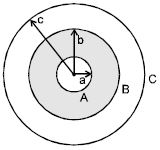
$A$ and $C$ are concentric conducting spherical shells of radius $a$ and $c$ respectively. $A$ is surrounded by a concentric dielectric of inner radius $a$, outer radius $b$ and dielectric constant $k$. If sphere $A$ is given a charge $Q$, the potential at the outer surface of the dielectric is.
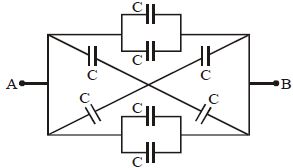
Eight capacitors each of capacitance of $C$ are connected as shown in the figure. The effective capacitance between $A$ and $B$ is
For production of characteristic ${K_\beta }\,$ $X-$ rays, the electron transition is
Sound waves have the following frequencies that are audible to human beings  .... $c/s$
The maximum speed of a car on a road-turn of radius $30\, m$, if the coefficient of friction between the tyres and the road is $0.4$, will be .......... $m/sec$
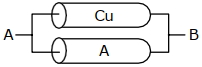
A Copper $(Cu)$ rod of length $25\, {cm}$ and cross- sectional area $3\, {mm}^{2}$ is joined with a similar Aluminium $(Al)$ rod as shown in figure. Find the resistance of the combination between the ends $A$ and $B$ (in ${m} \Omega$)

(Take Resistivity of Copper $=1.7 \times 10^{-8}\, \Omega \,{m}$, Resistivity of Aluminium $=2.6 \times 10^{-8}\, \Omega \,{m}$ )