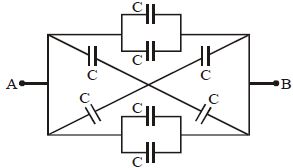
Eight capacitors each of capacitance of $C$ are connected as shown in the figure. The effective capacitance between $A$ and $B$ is
Medium
Download our app for free and get started

Download our appand get started for free
Experience the future of education. Simply download our apps or reach out to us for more information. Let's shape the future of learning together!No signup needed.*
Similar Questions
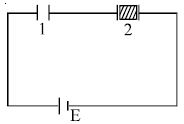
- 1Two identical capacitors $1$ and $2$ are connected in series to a battery as shown in figure. Capacitor $2$ contains a dielectric slab of dielectric constant k as shown. $Q_1$ and $Q_2$ are the charges stored in the capacitors. Now the dielectric slab is removed and the corresponding charges are $Q’_1$ and $Q’_2$. ThenView Solution
- 2A uniform electric field of $20\, N/C$ exists along the $x$ -axis in a space. The potential difference $(V_B -V_A)$ for the point $A(4\,m, 2\,m)$ and $B(6\,m, 5\,m)$ is.....$V$View Solution
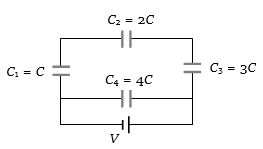
- 3A network of four capacitors of capacity equal to ${C_1} = C,\,\,{C_2} = 2C,\,{C_3} = 3C$ and ${C_4} = 4C$ are conducted in a battery as shown in the figure. The ratio of the charges on ${C_2}$ and ${C_4}$ isView Solution
- 4Assume that an electric field $\vec E = 30{x^2}\hat i$ exists in space. Then the potential difference $V_A-V_O$ where $V_O$ is the potential at the origin and $V_A$ the potential at $x = 2\ m$ is....$V$View Solution
- 5View SolutionA non uniformly shaped conductor is charged then at it's sharpest point
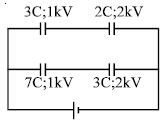
- 6The diagram shows four capacitors with capacitances and break down voltages as mentioned. What should be the maximum value of the external emf source such that no capacitor breaks down ? .......$kV$View Solution
- 7View SolutionA table tennis ball which has been covered with conducting paint is suspended by a silk thread so that it hang between two plates, out of which one is earthed and other is connected to a high voltage generator. This ball
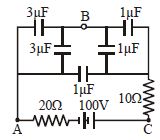
- 8In the figure below, what is the potential difference between the points $A$ and $B$ and between $B$ and $C$ respectively in steady stateView Solution
- 9Two capacitors of capacitances $1\ \mu F$ and $3\ \mu F$ are charged to the same voltages $5\,V$. They are connected in parallel with oppositely charged plates connected together. Then:View Solution
- 10Positive and negative point charges of equal magnitude are kept at $\left(0,0, \frac{a}{2}\right)$ and $\left(0,0, \frac{-a}{2}\right)$, respectively. The work done by the electric field when another positive point charge is moved from $(-a, 0,0)$ to $(0, a, 0)$ isView Solution