MCQ
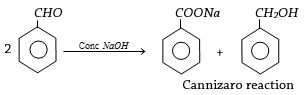
Benzaldehyde and acetaldehyde can be differentiated by
  • A
    $HCN$
  • B
    $N{H_2}OH$
  • C
    $Hydrazine$
  • $NaOH$ solution

Answer

Correct option: D.
$NaOH$ solution
d
(d)Benzaldehyde gives cannizaro’s reaction whereas acetaldehyde gives aldol condensation.$2C{H_3}CHO\mathop {\xrightarrow{{{\text{dil}}\,NaOH}}}\limits_{} \mathop {C{H_3} - \mathop {\mathop {CH}\limits_{|\,\,\,\,\,} }\limits_{OH}  - C{H_2} - CHO}\limits_{({\text{Aldol}})\,\,\,\,\,\,\,\,\,\,\,\,\,\,} $

Need a full question paper?

Generate a complete, print-ready paper with questions like this in minutes — across 16+ boards, with answer keys.
Start Generating Free

Similar questions

If the water falls from a dam into a turbine wheel $19.6\, m$ below, then the velocity of water at the turbines, is ..................  $\mathrm{m} / \mathrm{s}$ (take $g = 9.8\, m/s^2$)
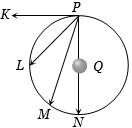
In the figure the charge $Q$ is at the centre of the circle. Work done is maximum when another charge is taken from point $P$ to
Carbon, silicon and germanium have four valence electrons each. At room temperature which one of the following statements is most appropriate ?
A spherical body of mass $m$ and radius $r$ is allowed to fall in a medium of viscosity $\eta $. The time in which the velocity of the body increases from zero to $0.63$ times the terminal velocity $(v)$ is called time constant $(\tau )$. Dimensionally $\tau $ can be represented by
An object is taken to a height above the surface of earth at a distance $\frac{5}{4} R$ from the centre of the earth. Where radius of earth, $R=6400\,km$. The percentage decrease in the weight of the object will be $....\%$
Two particles of equal mass $m$ go around a circle of radius $R$ under the action of their mutual gravitational attraction. The speed of each partial with respect to their centre of mass is
$A$ block of mass $m$ moving with a velocity $v_0$ on a smooth horizontal surface strikes and compresses a spring of stiffness $k$ till mass comes to rest as shown in the figure. This phenomenon is observed by two observers:

$A$: standing on the horizontal surface

$B$: standing on the block 

To an observer $A$, the work done by spring force is 

Three particles, each having a charge of $10\,\mu C$ are placed at the corners of an equilateral triangle of side $10\,cm$. The electrostatic potential energy of the system is.....$J$ (Given $\frac{1}{{4\pi {\varepsilon _0}}} = 9 \times {10^9}\,N - {m^2}/{C^2}$)
A particle moves in a circle of radius $25\, cm$ at two revolutions per second. The acceleration of the particle in $meter/second^2$ is
An initially uncharged capacitor $C$ is being charged by a battery of emf $E$ through a resistance $R$ upto the instant, when the capacitor is charged to the potential $E / 2$, then the ratio of the work done by the battery to the heat dissipated by the resistor is given by