Question
Bernoulli's theorem is based on conservation of:
  1. Momentum.
  2. Mass.
  3. Energy.
  4. Angular momentum.

Answer

  1. Energy.

Explanation:

The principle behind the Bernoulli theorem is the law of conservation of energy. It states that energy can be neither created nor destroyed; it merely changes from One form to another. 

Need a full question paper?

Generate a complete, print-ready paper with questions like this in minutes — across 16+ boards, with answer keys.
Start Generating Free

Similar questions

The motion of a particle represented by $y\ =$ $\sin \omega t - \cos \omega t$ is
The speeds of $5$ molecules of a gas (in arbitrary units) are as follows : $2, 3, 4, 5, 6.$ The root mean square speed for these molecules is
A body projected vertically from the earth reaches a height equal to earth's radius before returning to the earth. The power exerted by the gravitational force is greatest
Two putty balls of equal mass moving with equal velocity in mutually perpendicular directions, stick together after collision. If the balls were initially moving with a velocity of $45\sqrt 2 \,m{s^{ - 1}}$ each, the velocity of their combined mass after collision is .................. $\mathrm{m} / \mathrm{s}^{-1}$
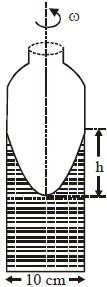
A cylindrical vessel containing a liquid is rotated about its axis so that the liquid rises at its sides as shown in the figure. The radius of vessel is $5\, cm$ and the angular speed of rotation is  $\omega\; rad \,s^{-1}$. The difference in the height, $h($ in $cm )$ of liquid at the centre of vessel and at the side will be
A satellite of mass $M$ is in a circular orbit of radius $R$ about the centre of the earth. A meteorite of the same mass, falling towards the earth collides with the satellite completely inelastically. The speeds of the satellite and the meteorite are the same, just before the collision. The subsequent motion of the combined body will be
The kinetic energy of one gm-mole of a gas at normal temperature and pressure is $(R = 8.31 J/Mole-K)$
Two tuning forks $A\,\, \& \,\,B$ produce notes of frequencies $256 Hz \,\,\& \,\,262 Hz$ respectively. An unknown note sounded at the same time as $A$ produces beats . When the same note is sounded with $B$, beat frequency is twice as large . The unknown frequency could be  ... $Hz$
A man is carrying a block of a certain substance (of density $1000 \,kg{m^{ - 3}}$) weighing $1 \,kg$ in his left hand and a bucket filled with water and weighing $10 \,kg$ in his right hand. He drops the block into the bucket. How much load does he carry in his right hand now  ........... $kg$
The displacement is given by $x = 2{t^2} + t + 5$, the acceleration at $t = 2\;s$ is.........$m/{s^2}$