Between the plates of a parallel plate condenser, a plate of thickness ${t_1}$ and dielectric constant ${k_1}$ is placed. In the rest of the space, there is another plate of thickness ${t_2}$ and dielectric constant ${k_2}$. The potential difference across the condenser will be
Medium
Download our app for free and get started
(a) Potential difference across the condenser
$V = {V_1} + {V_2} = {E_1}{t_1} + {E_2}{t_2} = \frac{\sigma }{{{K_1}{\varepsilon _0}}}{t_1} + \frac{\sigma }{{{K_2}{\varepsilon _0}}}{t_2}$
$==>$ $V = \frac{\sigma }{{{\varepsilon _0}}}\left( {\frac{{{t_1}}}{{{K_1}}} + \frac{{{t_2}}}{{{K_2}}}} \right) = \frac{Q}{{A{\varepsilon _0}}}\left( {\frac{{{t_1}}}{{{K_1}}} + \frac{{{t_2}}}{{{K_2}}}} \right)$
$V = {V_1} + {V_2} = {E_1}{t_1} + {E_2}{t_2} = \frac{\sigma }{{{K_1}{\varepsilon _0}}}{t_1} + \frac{\sigma }{{{K_2}{\varepsilon _0}}}{t_2}$
$==>$ $V = \frac{\sigma }{{{\varepsilon _0}}}\left( {\frac{{{t_1}}}{{{K_1}}} + \frac{{{t_2}}}{{{K_2}}}} \right) = \frac{Q}{{A{\varepsilon _0}}}\left( {\frac{{{t_1}}}{{{K_1}}} + \frac{{{t_2}}}{{{K_2}}}} \right)$

Download our appand get started for free
Experience the future of education. Simply download our apps or reach out to us for more information. Let's shape the future of learning together!No signup needed.*
Similar Questions
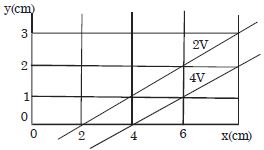
- 1Figure shows two equipotential lines in $x, y$ plane for an electric field. The scales are marked. The $x-$ component $E_x$ and $y$ -component $E_y$ of the electric field in the space between these equipotential lines are respectively :-View Solution
- 2A parallel plate capacitor of capacitance $12.5 \mathrm{pF}$ is charged by a battery connected between its plates to potential difference of $12.0 \mathrm{~V}$. The battery is now disconnected and a dielectric slab $\left(\epsilon_{\mathrm{r}}=6\right)$ is inserted between the plates. The change in its potential energy after inserting the dielectric slab is_______.$\times 10^{-12} \mathrm{~J}$.View Solution
- 3The capacity of a parallel plate condenser is $10\,\mu \,F$, when the distance between its plates is $8 \,cm$. If the distance between the plates is reduced to $4\, cm$, then the capacity of this parallel plate condenser will be.........$\mu \,F$View Solution
- 4Consider three concentric metallic spheres $A, B$ and $C$ of radii $a , b, c$, respectively where $a < b < c$. $A$ and $B$ are connected, whereas $C$ is grounded. The potential of the middle sphere $B$ is raised to $V$, then the charge on the sphere $C$ isView Solution
- 5Let $C$ be the capacitance of a capacitor discharging through a resistor $R$. Suppose $t_{1}$ is the time taken for the energy stored in the capacitor to reduce to half its initial value and $t_{2}$ is the time taken for the charge to reduce to one-fourth its initial value. The the ratio $t _{1} / t _{2}$ will beView Solution
- 6$STATEMENT-1$ For practical purposes, the earth is used as a reference at zero potential in electrical circuits.andView Solution
$STATEMENT-2$ The electrical potential of a sphere of radius $R$ with charge $\mathrm{Q}$ uniformly distributed on the surface is given by $\frac{\mathrm{Q}}{4 \pi \varepsilon_0 R}$.
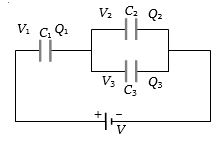
- 7In an adjoining figure are shown three capacitors ${C_1}$,${C_2}$ and ${C_3}$ joined to a battery. The correct condition will be (Symbols have their usual meanings)View Solution
- 8Equipotential surfaces associated with an electric field which is increasing in magnitude along the $x$-direction areView Solution
- 9Given below are two statements: one is labelled aView Solution
Assertion $(A)$ and the other is labelled as Reason$(R)$
$Assertion$ $(A)$ : Work done by electric field on moving a positive charge on an equipotential surface is always zero.
$Reason$ $(R)$ : Electric lines of forces are always perpendicular to equipotential surfaces.
In the light of the above statements, choose the most appropriate answer from the options given below
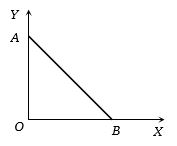
- 10As per this diagram a point charge $ + q$ is placed at the origin $O$. Work done in taking another point charge $ - Q$ from the point $A$ [co-ordinates $(0,\,a)$] to another point $B$ [co-ordinates $(a, 0)$] along the straight path $AB$ isView Solution