The capacities of two conductors are ${C_1}$ and ${C_2}$ and their respective potentials are ${V_1}$ and${V_2}$. If they are connected by a thin wire, then the loss of energy will be given by
Medium
Download our app for free and get started
(c) Initial energy ${U_i} = \frac{1}{2}{C_1}V_1^2 + \frac{1}{2}{C_2}V_2^2$, Final energy ${U_f} = \frac{1}{2}({C_1} + {C_2}){V^2}$ (where $V = \frac{{{C_1}{V_1} + {C_2}{V_2}}}{{{C_1}{C_2}}})$
Hence energy loss $\Delta U = {U_i} - {U_f} = \frac{{{C_1}{C_2}}}{{2({C_1} + {C_2})}}{({V_1} - {V_2})^2}$
Hence energy loss $\Delta U = {U_i} - {U_f} = \frac{{{C_1}{C_2}}}{{2({C_1} + {C_2})}}{({V_1} - {V_2})^2}$

Download our appand get started for free
Experience the future of education. Simply download our apps or reach out to us for more information. Let's shape the future of learning together!No signup needed.*
Similar Questions
- 1A parallel plate capacitor has plate area $40\,cm ^2$ and plates separation $2\,mm$. The space between the plates is filled with a dielectric medium of a thickness $1\,mm$ and dielectric constant $5$ . The capacitance of the system is :View Solution
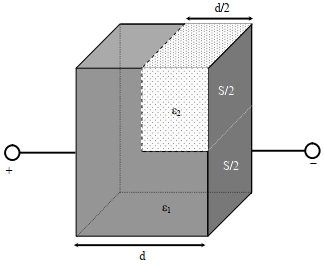
- 2A parallel plate capacitor having plates of area $S$ and plate separation $d$, has capacitance $C _1$ in air. When two dielectrics of different relative permittivities $\left(\varepsilon_1=2\right.$ and $\left.\varepsilon_2=4\right)$ are introduced between the two plates as shown in the figure, the capacitance becomes $C _2$. The ratio $\frac{ C _2}{ C _1}$ isView Solution
- 3The capacity of a condenser in which a dielectric of dielectric constant $5$ has been used, is $C$. If the dielectric is replaced by another with dielectric constant $20$, the capacity will becomeView Solution
- 4View SolutionAssertion : In the absence of an external electric field, the dipole moment per unit volume of a polar dielectric is zero.
Reason : The dipoles of a polar dielectric are randomly oriented.
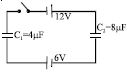
- 5In the circuit shown initially $C_1, C_2$ are uncharged. After closing the switchView Solution
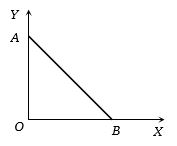
- 6As per this diagram a point charge $ + q$ is placed at the origin $O$. Work done in taking another point charge $ - Q$ from the point $A$ [co-ordinates $(0,\,a)$] to another point $B$ [co-ordinates $(a, 0)$] along the straight path $AB$ isView Solution
- 7View SolutionOne plate of parallel plate capacitor is smaller than other, then charge on smaller plate will be
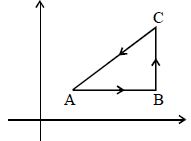
- 8As shown in figure, on bringing a charge $Q$ from point $A$ to $B$ and from $B$ to $C$, the work done are $2\, joule$ and $-3\, joule$ respectively. The work done to bring the charge from $C$ to $A$ isView Solution
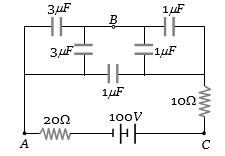
- 9In the figure below, what is the potential difference between the point $A$ and $B$ and between $B$ and $C$ respectively in steady stateView Solution
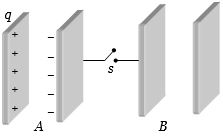
- 10Consider the situation shown in the figure. The capacitor $A$ has a charge $q$ on it whereas $B$ is uncharged. The charge appearing on the capacitor $B$ a long time after the switch is closed isView Solution