Question
Beyond which frequency, the ionosphere bands any incident electromagnetic radiation but do not reflect it back towards the earth?

Answer

  1. 40MHz
Explanation:
The ionosphere can reflect electromagnetic waves of frequency less than 40MHz but not of frequency more than 40MHz.

Need a full question paper?

Generate a complete, print-ready paper with questions like this in minutes — across 16+ boards, with answer keys.
Start Generating Free

Similar questions

We have two wires A and B of same mass and same material.  The diameter of the wire A is half of that B.  If the resistance of wire A is 24 ohm then the resistance of wire B will be(a) 12 Ohm(b) 3.0 Ohm(c) 1.5 Ohm(d) None of the above
       
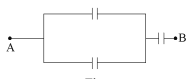
The capacitance of each capacitor is $x$ in the given figure. Equivalence between points A and B will Image
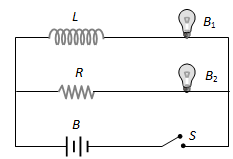
An inductor, $L$ a resistance $R$ and two identical bulbs $,\mathrm{B}_1$ and $\mathrm{B}_2$ are connected to a battery through a switch $S$ as shown in the figure. The resistance $R$ is the same as that of the coil that makes $L .$ Which of the following statements gives the correct description of the happenings when the switch $S$ is closed
The value of angle of dip at the earth's magnetic pole is :
A charge $q_1$ exerts some force on a second charge $q_2$. If third charge $q_3$ is brought near, the force of $q_1$ exerted on $q_2$
A semiconductor is cooled from $\mathrm{T}_1 \mathrm{~K}$ to $\mathrm{T}_2 \mathrm{~K}$ Its resistance
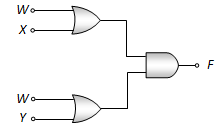
The diagram of a logic circuit is given below. The output $F$ of the circuit is represented by
Magnetic fields at two points on the axis of a circular coil at a distance of 0.05m and 0.2m from the centre are in the ratio 8 : 1. The radius of the coil is(a) 1.0 m (b) 0.1 m(c) 0.15 m(d) 0.2 m
       
In a P-type semiconductor(a) Current is mainly carried by holes(b) Current is mainly carried by electrons(c) The material is always positively charged(d) Doping is done by pentavalent material


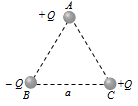
Three charges are placed at the vertices of an equilateral triangle of side $'a\ '$ as shown in the following figure. The force experienced by the charge placed at the vertex $A$ in a direction normal to $BC$ is