MCQ
Boric acid is an acid because its molecule
- Acontains replaceable $H^+$ ion
- Bgives up a proton
- ✓accepts $OH^-$ from water releasing proton.
- Dcombines with proton from water molecule.
$\mathrm{B}(\mathrm{OH})_{3}+\mathrm{H}_{2} \mathrm{O} \longrightarrow\left[\mathrm{B}(\mathrm{OH})_{4}\right]^{(-)}(\mathrm{aq})+\mathrm{H}^{(-)}(\mathrm{aq})$
Generate a complete, print-ready paper with questions like this in minutes — across 16+ boards, with answer keys.

$A.$Reaction is spontaneous at $(a)$ and $(b)$
$B.$Reaction is at equilibrium at point $(b)$ and nonspontaneous at point $(c)$
$C.$Reaction is spontaneous at $(a)$ and nonspontaneous at $(c)$
$D.$Reaction is non-spontaneous at $(a)$ and $(b)$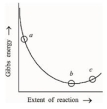
${H_2}O\left( g \right) + C\left( s \right) \to CO\left( g \right) + {H_2}\left( g \right);\Delta H = 131\,kJ$
$CO\left( g \right) + \frac{1}{2}{O_2}\left( s \right) \to C{O_2}\left( g \right);\Delta H = - 282\,kJ$
${H_2}\left( g \right) + \frac{1}{2}{O_2}\left( s \right) \to {H_2}O\left( g \right);\Delta H = - 242\,kJ$
$C(s) + O_2(g) \to CO_2(g); \Delta H = X\,kJ$
The value of $X$ will be......$kJ$