MCQ
Boyle’s law is applicable for an:
  • A
    Diabatic process.
  • B
    Isothermal process.
  • C
    Isobaric process.
  • D
    Isochoric process.

Answer

  1. Isothermal process.

Explanation:

Boyle’s law is applicable at constant temperature, and temperature remains constant in isothermal process,

PV = nRT (n, R and T are constant)

$\therefore$ PV = constant

$\text{P}\alpha\frac{1}{\text{V}}$ (where constant = nRT)

Need a full question paper?

Generate a complete, print-ready paper with questions like this in minutes — across 16+ boards, with answer keys.
Start Generating Free

Similar questions

A set of defective observation of weights is used by a student to find the mass of an object using a physical balance. A large number of readings will reduce
The excess pressure in a soap bubble is thrice that in other one. Then the ratio of their volume is
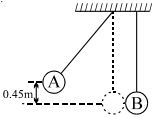
Two massless string of length $5\, m$ hang from the ceiling very near to each other as shown in the figure. Two balls $A$ and $B$ of masses $0.25 \,kg$ and $0.5 \,kg$ are attached to the string. The ball $A$ is released from rest at $a$ height $0.45\, m$ as shown in the figure. The collision between two balls is completely elastic. Immediately after the collision, the kinetic energy of ball $B$ is $1\, J$. The velocity of ball $A$ just after the collision is
Two different wires having lengths $L _{1}$ and $L _{2}$ and respective temperature coefficient of linear expansion $\alpha_{1}$ and $\alpha_{2},$ are joined end-to-end. Then the effective temperature coefficient of linear expansion is
Pressure inside two soap bubbles are $1.02 \,atm$ and $1.05 \,atm$ respectively. The ratio of their surface area is .........
$100 \,gm$ of ice at $0°C$ is mixed with $100\, g$ of water at $100°C.$ What will be the final temperature of the mixture .......... $^oC$
Mark the correct statements about the friction between two bodies:
  1. Static friction is always greater than the kinetic friction.
  2. Coefficient of static friction is always greater than the coefficient of kinetic friction.
  3. Limiting friction is always greater than the kinetic friction.
  4. Limiting friction is never less than static friction.
Two discs of moment of inertia $I_1=4 \mathrm{~kg} \mathrm{~m}^2$ and $\mathrm{I}_2=2 \mathrm{~kg} \mathrm{~m}^2$ about their central axes & normal to their planes, rotating with angular speeds $10 \mathrm\ {rad} / \mathrm{s}$ & $4  \mathrm\ {rad} / \mathrm{s}$ respectively are brought into contact face to face with their axe of rotation coincident. The loss in kinetic energy of the system in the process is____ $\mathrm{J}$.
$A$ man of mass $M$ stands at one end of a plank of length $L$ which lies at rest on a frictionless surface. The man walks to other end of the plank. If the mass of the plank is $\frac{M}{3}$ , then the distance that the man moves  relative to ground is :
Two bullets are fired simultaneously, horizontally and with different speeds from the same place. Which bullet will hit the ground first?
  1. The faster one.
  2. The slower one.
  3. Both will reach simultaneously.
  4. Depends on the masses.