Questions · Page 1 of 5

M.C.Q (1 Marks)

Take a timed test

50 questions · self-marked practice — reveal the answer and mark yourself.

MCQ 11 Mark
A rigid container of negligible heat capacity contains one mole of an ideal gas. The temperature of the gas increases by 1°C if 3.0cal of heat is added to it. The gas may be:
  • A
    Helium.
  • B
    Argon.
  • C
    Oxygen.
  • D
    Carbon dioxide.
Answer
  1. Helium.
  2. Argon.

Explanation:

The temperature of one mole of a gas kept in a container of fixed volume is increased by 1 degree Celsius if 3 calories, i.e. 12.54J of heat is added to it. So, its molar heat capacity, C​v = 12.54J-JK-1mol-1, as molar heat capacity at fixed volume is the heat supplied to a mole of gas to increase its temperature by a degree. For a monatomic gas, ​$\text{C}_\text{v}\simeq\frac{3}{2}\text{R}=1.5\times8.314=12.54\text{JK}^{-1}\text{mol}^{-1}.$

Among the given gases, only helium and argon are inert and hence, monoatomic. Therefore, the gas may be helium or argon.
View full question & answer
MCQ 21 Mark
The quantity $\frac{\text{PV}}{\text{kT}}$ represents:
  • A
    Mass of the gas.
  • B
    Kinetic energy of the gas.
  • C
    Number of moles of the gas.
  • D
    Number of molecules in the gas.
Answer
  1. Number of molecules in the gas.

Explanation:

Here,

PV = nRT ...(1)

Also,

$\text{k}=\frac{\text{R}}{\text{N}}$

$\Rightarrow\text{R}=\text{kN}\ ...(2)$

Now,

PV = nkNT [From eq. (1) and eq. (2)]

$\Rightarrow\text{nN}=\frac{\text{PV}}{\text{kT}}$

nN = Number of molecules

$\frac{\text{PV}}{\text{kT}}$ = Number of molecules.

View full question & answer
MCQ 31 Mark
The value of $\gamma$ for a diatomic molecule (vibrational mode) is:
  • A
    $\frac{9}{7}$
  • B
    $\frac{7}{9}$
  • C
    $\frac{7}{5}$
  • D
    $\frac{5}{7}$
Answer
  1. $\frac{9}{7}$
View full question & answer
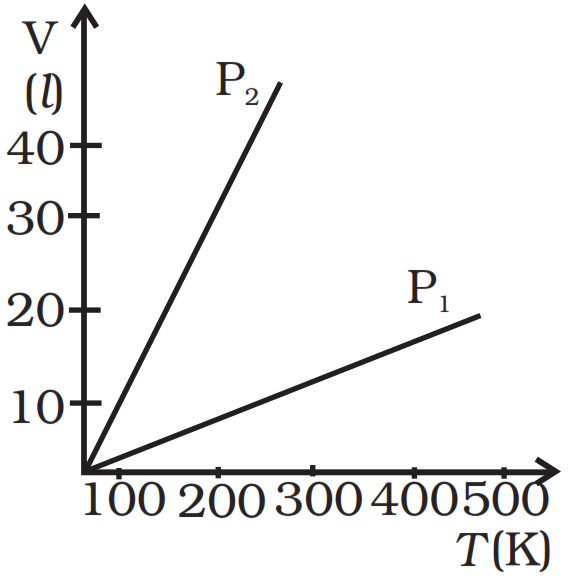
MCQ 41 Mark
  • A
    P1 > P2
  • B
    P1 = P2
  • C
    P< P2
  • D
    Data is insufficient.
Answer
  1. P1 > P2

Explanation:

$\text{V}\propto\text{T}$ as n, R and P are constant

$\frac{\text{V}_1}{\text{T}_1}$ = constant or slope of graph is constant

$\text{V}=\frac{\text{nRT}}{\text{P}}$

$\frac{\text{dv}}{\text{dt}}=\frac{\text{nR}}{\text{P}}\text{ so }\frac{\text{dV}}{\text{dT}}$ increase when P decreases

$\frac{\text{dV}}{\text{dT}}\alpha\frac{1}{\text{P}}$ as slope of P1 is smaller than P2.

Hence, P1 > P2 verifies option (a).

View full question & answer
MCQ 51 Mark
Diatomic molecules like hydrogen have energies due to both translational as well as rotational motion. From the equation in kinetic theory $\text{PV} = \frac{2}{3}$ E,E is:
  • A
    The total energy per unit volume.
  • B
    Only the translational part of energy because rotational energy is very small compared to the translational energy.
  • C
    Only the translational part of the energy because during collisions with the wall pressure relates to change in linear momentum.
  • D
    The translational part of the energy because rotational energies of molecules can be of either sign and its average over all the molecules is zero.
Answer
  1. Only the translational part of the energy because during collisions with the wall pressure relates to change in linear momentum.

Explanation:

According to kinetic theory equation, $\text{PV} = \frac{2}{3}$ E [where P= Pressure V = volume]

E is representing only translational part of energy.

Internal energy contains all types of energies like translational, rotational, vibrational etc.

But the molecules of an ideal gas is treated as point masses in kinetic theory, so its kinetic energy is only due to translational motion.

Point mass does not have rotational or vibrational motion.

Here, we assumed that the walls only exert perpendicular forces on molecules.

They do not exert any parallel force, hence there will not be any type of rotation present.

The wall produces only change in translational motion.

View full question & answer
MCQ 61 Mark
In a diatomic molecule, the rotational energy at a given temperature.
  • A
    Obeys Maxwell’s distribution.
  • B
    Have the same value for all molecules.
  • C
    Equals the translational kinetic energy for each molecule.
  • D
    Is (2/3)rd the translational kinetic energy for each molecule.
Answer
  1. Obeys Maxwell’s distribution.
  1. Is (2/3)rd the translational kinetic energy for each molecule.

Explanation:

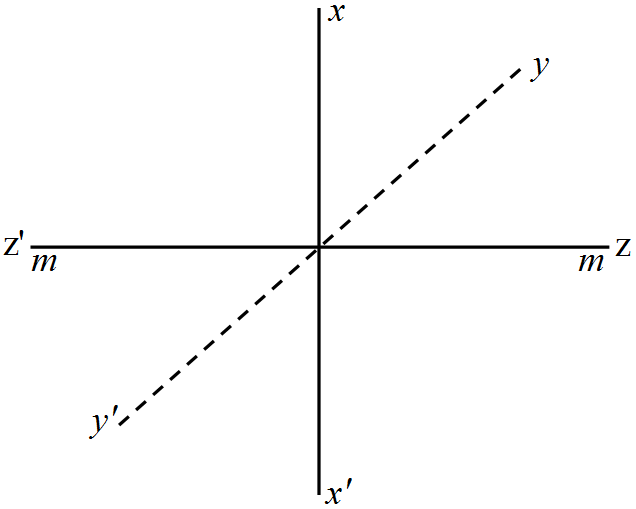
Consider a diatomic molecule along z-axis so its rotational energy about z-axis is zero. So energy of diatomic molecule,

$\text{E}=\frac{1}{2}\text{mv}_\text{x}^2+\frac{1}{2}\text{mv}_\text{y}^2+\frac{1}{2}\text{mv}_\text{z}^2+\frac{1}{2}\text{I}_\text{x}\omega_\text{x}^2+\frac{1}{2}\text{I}_\text{y}\omega_\text{y}^2$ (as moment of inertia along z axis is zero)

The independent terms in the above expression is 5.

As we can predict velocities of molecules by Maxwell’s distribution.

Hence the above expression also obeys Maxwell’s distribution.

As 2 rotational and 3 translational energies are associated with each molecule.

So the rotational energy at given temperature is 2/3 of its translational Kinetic energy of each molecule.

View full question & answer
MCQ 71 Mark
The rms speed of oxygen at room temperature is about 500m/ s. The rms speed of hydrogen at the same temperature is about:
  • A
    125ms-1
  • B
    2000ms-1
  • C
    8000ms-1
  • D
    31ms-1
Answer
  1. 2000ms-1

Explanation:

Given,

Molecular mass of hydrogen, MH = 2

Molecular mass of oxygen, MO = 32

RMS speed is given by,

$\text{v}_\text{rms}=\sqrt{\frac{3\text{RT}}{\text{M}}}$

$\Rightarrow\sqrt{\frac{3\text{RT}}{\text{M}_\text{O}}}=500$

Now,

$\Rightarrow\frac{\text{v}_\text{Orms}}{\text{v}_\text{Hrms}}=\frac{\sqrt{\frac{3\text{RT}}{\text{M}_\text{O}}}}{\sqrt{\frac{3\text{RT}}{\text{M}_\text{H}}}}$

$\Rightarrow\frac{\text{v}_\text{Orms}}{\text{v}_\text{Hrms}}=\frac{\sqrt{\frac{3\text{RT}}{32}}}{\sqrt{\frac{3\text{RT}}{2}}}$

$\Rightarrow\frac{\text{v}_\text{Orms}}{\text{v}_\text{Hrms}}=\frac{1}{4}$

$\Rightarrow\frac{500}{\text{v}_\text{Hrms}}=\frac{1}{4}$

$\Rightarrow\text{v}_\text{Hrms}=4\times500=2000\text{ms}^{-1}$

View full question & answer
MCQ 81 Mark
When 20 cal of heat is supplied to a system, the increase in internal energy is 50J. If the external work done is 35J, the mechanical equivalent of heat is:
  • A
    4.25J/ cal
  • B
    1.26J/ cal
  • C
    4.92J/ cal
  • D
    2.1J/ cal
Answer
  1. 4.25J/ cal

Explanation:

According to first law of thermodynamics $\text{J}\triangle\text{Q}=\triangle\text{W}+\triangle\text{U},$ where J is the mechanical equivalent of heat.

J × 20 = 50 + 35

J = 4.25J/ cal

View full question & answer
MCQ 91 Mark
If CP, CV are molar specific heats of a solid and R is universal gas constant, then:
  • A
    CP - C= R
  • B
    CP - CV, = 0
  • C
    CP - CV is negative
  • D
    (CP - CV) << R
Answer
  1. (CP - CV) << R

Explanation:

In case of solides, CP = CV

$\therefore$ CP - CV << R

View full question & answer
MCQ 131 Mark
Keeping the number of moles, volume and temperature the same, which of the following are the same for all ideal gases?
  • A
    Rms speed of a molecule.
  • B
    Density.
  • C
    Pressure.
  • D
    Average magnitude of momentum.
Answer
  1. Pressure.

Explanation:

Pressure of an ideal gas is given by $\text{PV}=\frac{1}{3}\text{mnu}^2.$

We know that pressure depends on volume, number of molecules and root mean square velocity. Also, root mean square velocity depends on the temperature of the gas. Since the number of molecules, volume and temperature are constant, pressure of the gas will not change.

View full question & answer
MCQ 151 Mark
What is the number of molecules in 3 cubic metre of a gas at 3atm & 27°C?
  • A
    2.17×10⁻²⁰
  • B
    6.38×10⁻²⁰
  • C
    3.86×10⁻²⁰
  • D
    4.58×10⁻²⁰
Answer
  1. 2.17×10⁻²⁰

Explanation:

Using, PV = NkT

we get: $\text{N}=\frac{\text{PV}}{\text{KT}}$

$\frac{(3\times3\times105)}{(1.38\times10^{-23}\times300)}$

= 2.17×10⁻²⁰

View full question & answer
MCQ 161 Mark
Consider the quantity $\frac{\text{MkT}}{\text{pV}}$ of an ideal gas where M is the mass of the gas. It depends on the,
  • A
    Temperature of the gas.
  • B
    Volume of the gas.
  • C
    Pressure of the gas.
  • D
    Nature of the gas.
Answer
  1. Nature of the gas.

Explanation:

In an ideal gas, the equation of state is given by

$\text{PV}=\text{nRT}$

$\Rightarrow\text{PV}=\text{nN}_\text{A}\frac{\text{R}}{\text{N}_\text{A}}\text{T}$

$\Rightarrow\text{PV}=\text{nN}_\text{A}\text{kT}$

$\Rightarrow\frac{1}{\text{nN}_\text{A}}=\frac{\text{kT}}{\text{PV}}$

Multiplying both sides by mass of the gas M, we get

$\frac{\text{M}}{\text{nN}_\text{A}}=\frac{\text{MkT}}{\text{PV}}$

Now, nNA gives the total number of molecules of the gas.

Also, $\frac{\text{M}}{\text{nN}_\text{A}}$ gives the mass of a single molecule.

Hence, $\frac{\text{MkT}}{\text{PV}}$ is the mass of a single molecule of the gas,

Molecular mass is a property of the gas.

View full question & answer
MCQ 171 Mark
The mean free path for air molecule with average speed 18.5ms-1 at STP is (Take, d = 2 × 10⁻¹⁰m and n = 2.7 × 1025m-3)
  • A
    3.5 × 10-7m
  • B
    4 × 10-7m
  • C
    2.9 × 10-7m
  • D
    5 × 10-7m
Answer
  1. 2.9 × 10-7m

Explanation:

For air at STP, n = 2.7 × 1025m-3

d = 2 × 10-10m

$\Rightarrow\text{l}=\frac{1}{\sqrt{2}\text{n}\pi\text{d}^2}$

On putting values, l = 2.9 × 10-7m

View full question & answer
MCQ 201 Mark
 A container has 3 gases whose mass ratio is 1:3:5. What is the ratio of mean square speed of the molecules of two gases? Their atomic masses are 20u, 30u & 40u corresponding to the order in which the ratios are given.
Answer
  1. 4:3:2.

Explanation:

Their average kinetic energies will be the same. Thus, $\frac{1}{2}$mvwill be the same.

$\text{v}_1^2:\text{v}_2^2:\text{v}_3^2$

 = m3:m2:m1

= 40:30:20

= 4:3:2.

View full question & answer
MCQ 211 Mark
What is the ratio of densities of 2 gases, O2 & N2, having partial pressures in the ratio 2:3?
Answer
  1. $\frac{16}{21}$

Explanation:

The ratio of moles is the same as the ratio of partial pressures.

The ratio of densities:

$\frac{\text{d}_1}{\text{d}_2}= \frac{\Big(\frac{\text{m}_1}{\text{V}}\Big)}{\Big(\frac{\text{m}_2}{\text{V}}\Big)}$

$=\frac{\text{m}_1}{\text{m}_2}= \frac{\Big(\frac{\text{n}_1}{\text{M}_1}\Big)}{\Big(\frac{\text{n}_1}{\text{M}_2}\Big)}$

where n is the number of moles and M is the molecular mass.

$\frac{\text{d}_1}{\text{d}_2}=\Big(\frac{2}{3}\Big)\times\Big(\frac{16}{14}\Big)$

$\frac{16}{21}$

View full question & answer
MCQ 221 Mark
For a gas, $\frac{\text{R}}{\text{C}_{\text{V}}}=0.67$ The gas is made up of molecules, which are:
  • A
    Monoatomic.
  • B
    Diatomic.
  • C
    Triatomic.
  • D
    Polyatomic.
Answer
  1. Monoatomic.

Explanation:

$\frac{\text{R}}{\text{C}_{\text{V}}}=0.67=\frac{2}{3}$

$\text{C}_{\text{V}}=\frac{3}{2}\text{R}$

View full question & answer
MCQ 231 Mark
Two vessels having equal volume contain molecular hydrogen at one atmosphere and helium at two atmosphere pressure respectively. If both samples are at the same temperature the mean velocity of hydrogen molecule is:
Answer
  1. $\sqrt{2}$ times that of helium.

View full question & answer
MCQ 241 Mark
The rms speed of oxygen molecules in a gas is v. If the temperature is doubled and the oxygen molecules dissociate into oxygen atoms, the rms speed will become:
Answer
  1. $2\text{v}$

Explanation:

Given, $\text{v}=\sqrt{\frac{3\text{RT}}{32}}$

Let the new rms speed be v'.

Molecule dissociate, M = 16

$\text{v}'=\sqrt{\frac{3\text{R}(2\text{T})}{16}}$

$=\sqrt{\frac{3\text{R}(4\text{T})}{32}}$

$=2\sqrt{\frac{3\text{R}\text{T}}{32}}=2\text{v}$

View full question & answer
MCQ 251 Mark
What is the number of molecules in 2.24L of SO2 at STP?
  • A
    6.023 × 1023
  • B
    6.023 × 10²²
  • C
    6.023 × 10²⁰
  • D
    6.023 × 10²¹
Answer
  1. 6.023 × 10²²

Explanation:

According to Avogadro’s law 22.4L of any gas at STP is 6.023 × 1023.

So, in 2.24L there will be $\frac{6.023\times10^{23}}{10}$

= 6.023 × 1022.

View full question & answer
MCQ 261 Mark
The number of molecules per unit volume in the sample is 20. The mass of each molecule is 10-20kg. The mean of speed squared is 4m2/s2. What is the value of internal energy of the gas? Assume volume of container is 0.02m3.
  • A
    0.8×10⁻²⁰J
  • B
    0.53×10⁻²⁰J
  • C
    0.01×10⁻²⁰J
  • D
    0.45×10⁻²⁰J
Answer
  1. 0.8×10⁻²⁰J

Explanation:

Internal energy is given by: E = $\Big(\frac{1}{2}\Big)$Nmv2,

where N is the total number of molecules = nV.

E = 0.5×20×0.02×10-20×4

= 0.8×10⁻²⁰J.

View full question & answer
MCQ 271 Mark
The energy of a given sample of an ideal gas depends only on its:
  • A
    Volume.
  • B
    Pressure.
  • C
    Temperature.
  • D
    Mass.
Answer
  1. Temperature.

Explanation:

The energy of a given sample of an ideal gas depends only on temperature as average energy/ molecule/ degree of freedom $=\frac{1}{2}\text{k}_{\text{B}}\text{T}$

View full question & answer
MCQ 281 Mark
An inflated rubber balloon contains one mole of an ideal gas, has a pressure P. volume V and temperature T. If the temperature rises to 1.1 T, and the volume is increased to 1.05V, the final pressure will be:
  • A
    1.1 P
  • B
    P
  • C
    Less than P
  • D
    Between P and 1.1
Answer
  1. Between P and 1.1

Explanation:

PV = nRT n and R are constant for the system here

$\frac{\text{PV}}{\text{T}}$ = constant

or

$\frac{\text{P}_1\text{V}_1}{\text{T}_1}=\frac{\text{P}_2\text{V}_2}{\text{T}_2}$

$\text{P}_2=\frac{\text{P}_1\text{V}_1}{\text{T}_1}\times\frac{\text{T}_2}{\text{V}_2}$

$=\frac{\text{p}\text{V1.1T}}{\text{T1.05V}}=\frac{1.1}{1.05}\text{p}$

$=(1.0476)\text{p}$

i.e. P2 is between P and 1.1p.

So option (d) verifies.

View full question & answer
MCQ 291 Mark
A perfect gas at 27°C is heated at constant pressure so as to double its volume. The temperature of the gas will be:
  • A
    300°C
  • B
    54°C
  • C
    600°C
  • D
    327°C
Answer
  1. 327°C

Explanation:

According to Charle's law, when P is constant, $\text{T}\propto\text{V}$ As V is doubled, T becomes twice i.e.,

T = 2 × (17 + 273)K = 600K

= 600 - 273 = 327°C

View full question & answer
MCQ 301 Mark
A vessel A baa volume V and a vessel B has volume 2V. Both contain some water which has a constant volume. The pressure in the space above water is pa for veesel A and pb for vessel B.
  • A
    pa = pb
  • B
    pa = 2pb
  • C
    pb = 2pa
  • D
    pb = 4pa
Answer
  1. pa = pb

Explanation:

The maximum pressure attainable above the water will be saturated vapour pressure at that temperature. Since saturated vapour pressure does not depend upon volume, both the vessels will have same pressure.

View full question & answer
MCQ 311 Mark
The mean square speed of the molecules of a gas at absolute temperature T is proportional to:
  • A
    $\frac{1}{\text{T}}$
  • B
    $\sqrt{\text{T}}$
  • C
    $\text{T}$
  • D
    $\text{T}^2$
Answer
  1. T

Explanation:

Root mean squared velocity is given by,

$\text{v}_\text{rms}=\sqrt{\frac{3\text{RT}}{\text{M}}}$

$\Rightarrow(\text{v}_\text{rms})^2=\frac{3\text{RT}}{\text{M}}$

$\Rightarrow(\text{v}_\text{rms})^2\alpha\text{T}$

View full question & answer
MCQ 321 Mark
Oxygen and hydrogen gases are at same temperature and pressure. And the oxygen molecule has 16 times the mass of hydrogen molecule. Then the ratio of their r.m.s. speed is:
  • A
    2
  • B
    $\frac{1}{4}$
  • C
    4
  • D
    16
Answer
  1. $\frac{1}{4}$

Explanation:

$\frac{\text{C}_{\text{oxy}}}{\text{C}_{\text{H}}}=\sqrt{\frac{\text{m}_{\text{H}}}{\text{m}_{\text{oxy}}}}=\sqrt{\frac{1}{16}}=\frac{1}{4}$

View full question & answer
MCQ 331 Mark
Answer
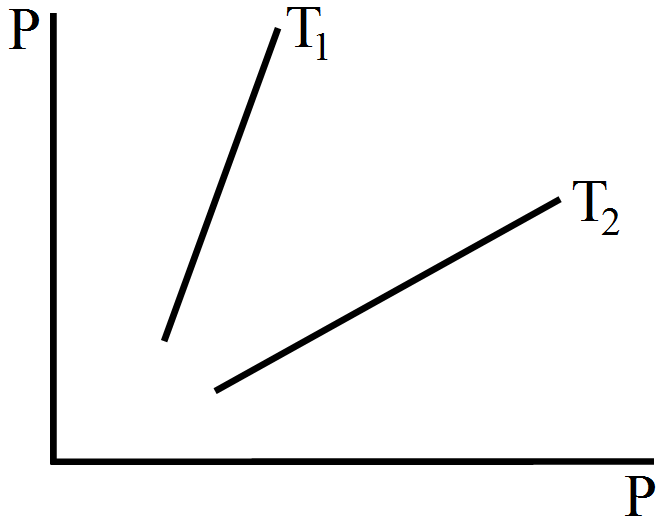
  1. T1 > T2.

Explanation:

The straight line T1 has greater slope than T​2. This means $\frac{\text{P}}{\rho}$ ratio is greater for T1 than T2. Now, rms velocity of a gas is given by $\sqrt{\frac{3\text{P}}{\rho}}.$ This means rms velocity of gas with Tmolecules is greater than T2 molecules. Again, gas with higher temperature has higher rms velocity.

View full question & answer
MCQ 341 Mark
Answer
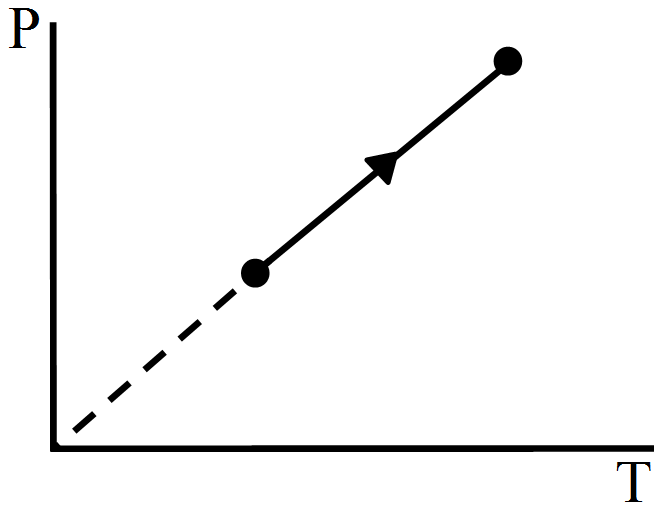
  1. Isochoric.

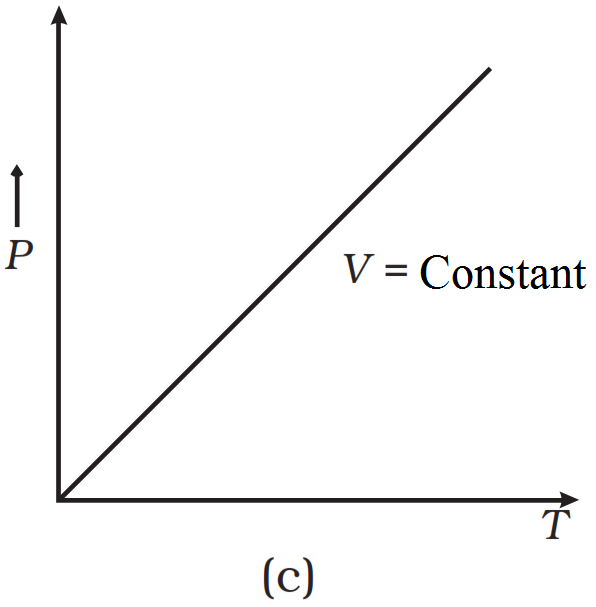
Explanation:

According to the graph, P is directly proportional to T.

Applying the equation of state, we get,

PV = nRT

$=\frac{\text{nR}}{\text{V}}\text{T}$

Given: $\text{P}\propto\text{T}$

This means $\frac{\text{nR}}{\text{V}}$ is a constant. So, V is also a constant.

Constant V implies the process is isochoric.

View full question & answer
MCQ 361 Mark
Boyle’s law is applicable for an:
  • A
    Diabatic process.
  • B
    Isothermal process.
  • C
    Isobaric process.
  • D
    Isochoric process.
Answer
  1. Isothermal process.

Explanation:

Boyle’s law is applicable at constant temperature, and temperature remains constant in isothermal process,

PV = nRT (n, R and T are constant)

$\therefore$ PV = constant

$\text{P}\alpha\frac{1}{\text{V}}$ (where constant = nRT)

View full question & answer
MCQ 371 Mark
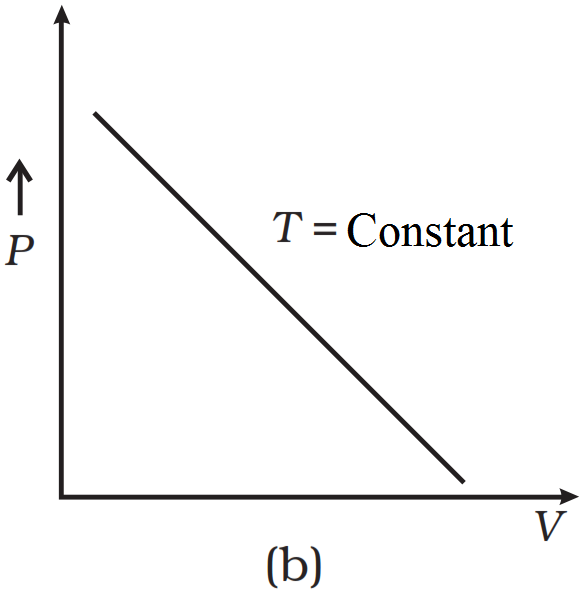
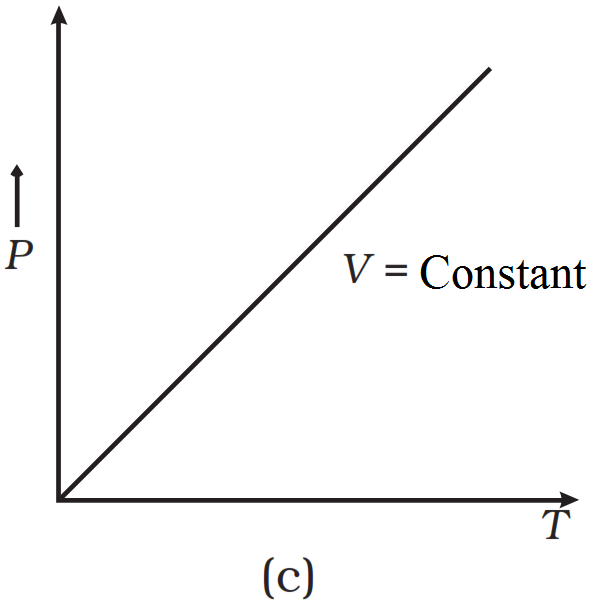
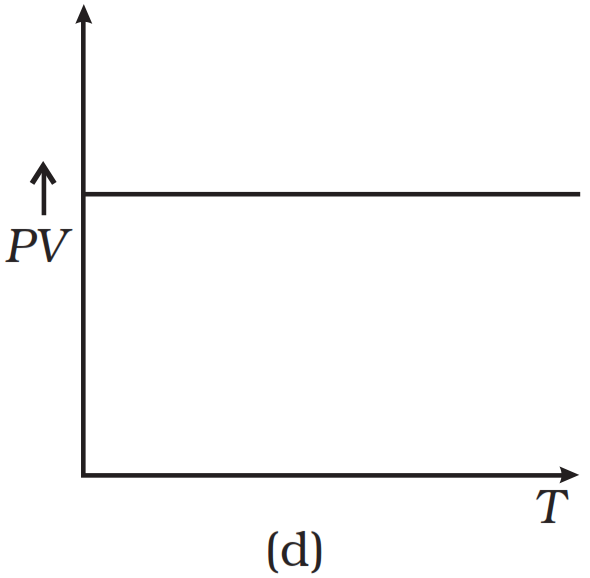
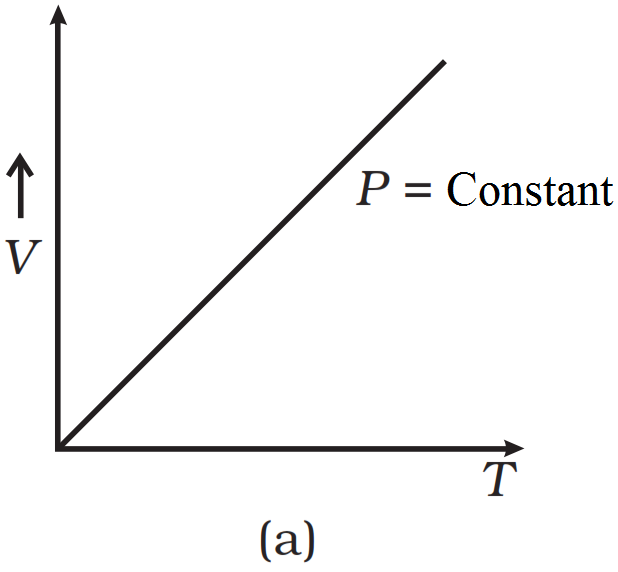
Which of the following diagrams (figure) depicts ideal gas behaviour?
  • A
  • B
  • C
  • D
Answer


Explanation:

For ideal gas behaviour,

PV = nRT

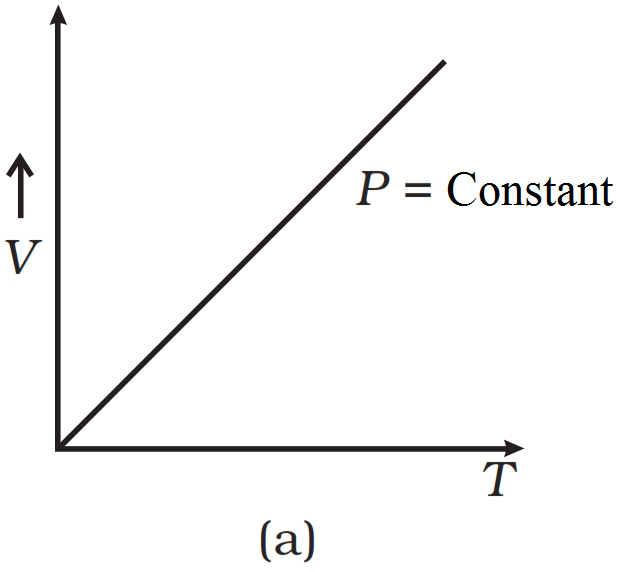
  1. When pressure, P = constant.

From (i) Volume V $\propto$ Temperature T

Graph of V versus T will be straight line.

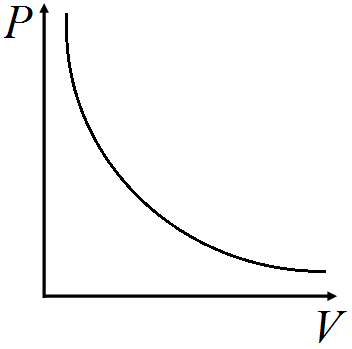
  1. When T = constant.

So, graph of P versus V will be a rectangular hyperbola.

Hence this graph is wrong.

The correct graph is shown below:

  1. When V = constant.

From (i) $\text{P}\propto\text{T}$

So, graph is a straight line passing throught the origin.

  1. From (i) $\text{PV}\propto\text{T}$

$\Rightarrow\frac{\text{PV}}{\text{T}}$ = constant

So, graph of PV versus T will be a straight line parallel to the temperature axis (x-axis).

i.e., slope of this graph will be zero.

So, (d) is not correct.

View full question & answer
MCQ 381 Mark
The molar specific heat at constant pressure of an ideal gas is $\Big(\frac{7}{2}\text{R}\Big).$ The ratio of specific heat at constant pressure to that at constant volume is:
  • A
    $\frac{9}{7}$
  • B
    $\frac{7}{5}$
  • C
    $\frac{5}{7}$
  • D
    $\frac{8}{7}$
Answer
  1. $\frac{7}{5}$

Explanation:

$\text{C}_{\text{P}}=\frac{7}{2}\text{R}$

$\text{C}_{\text{V}}=\text{C}_{\text{P}}-\text{R}=\frac{7}{2}\text{R}-\text{R}=\frac{5}{2}\text{R}$

$\gamma=\frac{\text{C}_{\text{P}}}{\text{C}_{\text{V}}}=\frac{\frac{7}{2}\text{P}}{\frac{5}{2}\text{R}}=\frac{7}{5}$​​​​​​​

View full question & answer
MCQ 391 Mark
The ratio of the molar heat capacities of a diatomic gas at constant pressure to that at constant volume is:
  • A
    $\frac{7}{2}$
  • B
    $\frac{3}{2}$
  • C
    $\frac{3}{5}$
  • D
    $\frac{7}{5}$
Answer
  1. $\frac{7}{5}$
View full question & answer
MCQ 401 Mark
 What is the ratio of specific heats for a monatomic gas?
  • A
    $\frac{5}{3}$
  • B
    $\frac{5}{2}$
  • C
    $\frac{7}{5}$
  • D
    $\frac{9}{5}$
Answer
  1. $\frac{5}{3}$

Explanation:

The value of Cv for a monatomic gas is $\frac{3}{2}$ R and

CP is $\frac{5}{2}$ R.

Thus the value of γ is:

$\frac{\text{C}_\text{p}}{\text{C}_\text{V}}=\frac{5}{3}$

View full question & answer
MCQ 411 Mark
During an adiabatic process, the pressure of a gas is proportional to the cube of its absolute temperature. The value of $\frac{\text{C}_{\text{p}}}{\text{C}_\text{v}}$ for that gas is:
  • A
    $\frac{3}{5}$
  • B
    $\frac{4}{3}$
  • C
    $\frac{5}{3}$
  • D
    $\frac{3}{2}$
Answer
  1. $\frac{4}{3}$

View full question & answer
MCQ 421 Mark
Answer
  1. The pressure on EFGH would be half that on ABCD.

Explanation:

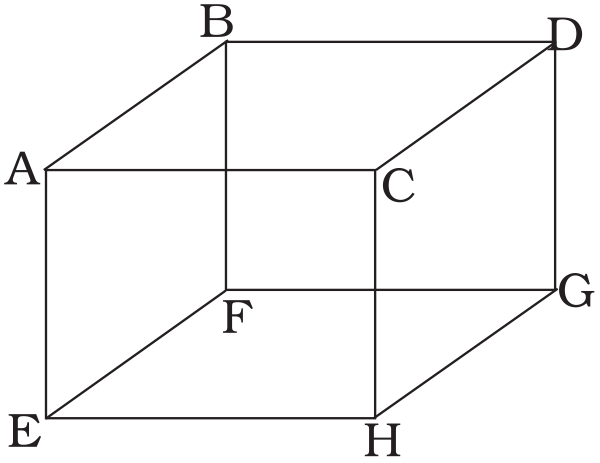
Pressure on the wall due to force exerted by molecule on walls due to its rate of transfer of momentum to the wall. The molecule bounces back due to elastic collision and magnitude of momentum transferred to wall by each molecule is 2mv but wall EFGH absorbs those molecule which strikes to it. Therefore rate of change in momentum to it become only mv so the pressure of EFGH would be half of ABCD.

View full question & answer
MCQ 431 Mark
  • A
    Both P and V of the gas will change.
  • B
    Only P will increase according to Charles’ law.
  • C
    V will change but not P.
  • D
    P will change but not V.
Answer
  1. V will change but not P.

Explanation:

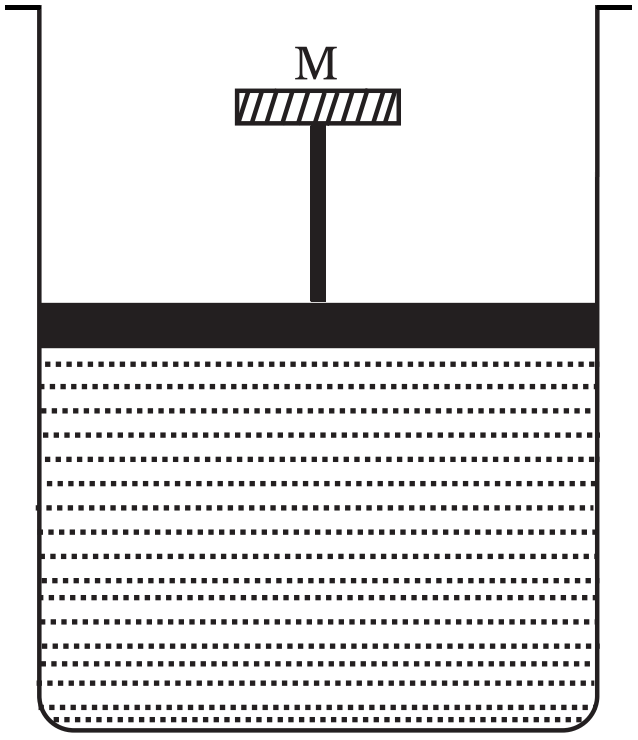
The pressure on the ideal gas does not changes from initial to final position. According to the given arrangement P = Mg/ A which shows that pressure is constant. As piston and cylinder is frictionless so by ideal gas equation, PV = nRT.

View full question & answer
MCQ 441 Mark
In a diatomic molecules, the rotational energy at a given temperature:
  • A
    Obeys Maxwell’s distribution
  • B
    Have the same volue for all molecules
  • C
    Equals the translational kinetic energy for each molecule
  • D
    None of these
Answer
  1. Obeys Maxwell’s distribution
View full question & answer
MCQ 451 Mark
The average kinetic energy of gas molecules depends upon which of the following factor?
  • A
    Temperature of the gas
  • B
    Nature of the gas
  • C
    Volume of the gas
  • D
    None of these
Answer
  1. Temperature of the gas
View full question & answer
MCQ 461 Mark
At change of state the kinetic energy of the molecules of a substances increases greatly.
  • A
    True
  • B
    False
  • C
    Either
  • D
    Neither
Answer
  1. False

Explanation

If heat is coming into a substance during a phase change, then this energy is used to break the bonds between the molecules of the substance.

An example we will use here is ice melting into water.

View full question & answer
MCQ 471 Mark
The pressure of a gas kept in an isothermal container is 200kPa. If half the gas is removed from it, the pressure will be:
  • A
    100kPa.
  • B
    200kPa.
  • C
    400kPa.
  • D
    800kPa.
Answer
  1. 100kPa.

Explanation:

Let the number of moles in the gas be n.

Applying equation of state, we get,

$\text{PV}=\text{nRT}$

$\Rightarrow\text{P}=\frac{\text{nRT}}{\text{V}}$

$\Rightarrow2\times10^5=\frac{\text{nRT}}{\text{V}}\ ...(1)$

When half of the gas is removed, number of moles left behind $=\frac{\text{n}}{2}$

Let the pressure be P'.

$\text{P}'=\frac{\text{n}}{2}\frac{\text{RT}}{\text{V}}$

Now,

$\text{P}'=\frac{1}{2}\times2\times10^5=10^5$ [From eq. (1)]

$=100\text{kPa}$

View full question & answer
MCQ 481 Mark
If r.m.s. speed of a gas increases, then its pressure:
  • A
    Increases
  • B
    Decreases
  • C
    Remains same
  • D
    May increase or decrease
Answer
  1. Increases
View full question & answer
MCQ 491 Mark
When we cool a gas below its condensation point, the K.E. of its molecules:
  • A
    Increases
  • B
    Decreases
  • C
    Remains the same
  • D
    First decreases then increases
Answer
  1. Decreases

Explanation:

As we know kinetic energy of molecules of a gas is a function of Temperature So, As we decrease its temperature or say cool it, its kinetic energy gradually decrease.

At a certain point which decreasing kinetic energy it starts bonding up whit molecules and thus condensation starts.

View full question & answer
MCQ 501 Mark
According to kinetic theory of gases, at absolute zero temperature:
  • A
    Molecular motion stops
  • B
    Liquid hydrogen freezes
  • C
    Liquid helium freezes
  • D
    Water freezes
Answer
  1. Molecular motion stops
View full question & answer
M.C.Q (1 Marks) - Physics STD 11 Science Questions - Vidyadip