MCQ
Bulk modulus was first defined by
  • A
    Young
  • B
    Bulk
  • Maxwell
  • D
    None of the above

Answer

Correct option: C.
Maxwell
c
(c) Bulk modulus was first defined by maxwell

Need a full question paper?

Generate a complete, print-ready paper with questions like this in minutes — across 16+ boards, with answer keys.
Start Generating Free

Similar questions

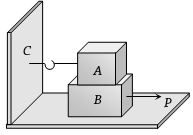
Block $A$ weighing $100$ kg rests on a block $B$ and is tied with a horizontal string to the wall at $C$. Block $B$ weighs $200 \,kg$. The coefficient of friction between $A$ and $B$ is $0.25$ and between $B$ and the surface is $1/3$. The horizontal force $P$ necessary to move the block $B$ should be  ........ $N$ $(g = 10\,m/{s^2})$
A rubber pipe of density $1.5 \times {10^3}\,N/{m^2}$ and Young's modulus $5 \times {10^6}\,N/{m^2}$ is suspended from the roof. The length of the pipe is $8 \,m$. What will be the change in length due to its own weight
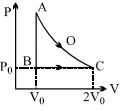
An ideal gas is taken from point $A$ to point $C$ on $P-V$ diagram through two process $AOC$ and $ABC$ as shown in the figure. Process $AOC$ is isothermal
Apiece of steel has a weight $W$ in air, $W_1$ when completely immersed in water and $W_2$ when completely immersed in an unknown liquid. The relative density (specific gravity)of liquid is
In an elastic collision:
Three moles of an ideal gas $\left( {{C_P} = \frac{7}{2}R} \right)$ at pressure ${P_A}$ and temperature ${T_A}0$ is isothermally expanded to twice its initial volume. It is then compressed at constant pressure to its original volume. Finally the gas is compressed at constant volume to its original pressure ${P_A}.$ The correct $P-V$ and $P-T$ diagrams indicating the process are
Particle $A$ makes a perfectly elastic collision with another particle $B$ at rest. They fly apart in opposite direction with equal speeds. If their masses are $m_A$ and $m_B$ respectively, then
An object is projected with a velocity of $20 m/s$ making an angle of $45^o$ with horizontal. The equation for the trajectory is $h = Ax -Bx^2$ where $h$ is height, $x$ is horizontal distance, $A$ and $B$ are constants. The ratio $A : B$ is ($g = 10 ms^{-2}$)
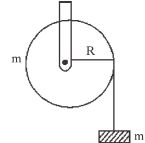
A mass $'m'$ is supported by a massless string wound around a uniform hollow cylinder of mass $m$ and radius $R$. If the string does not slip on the cylinder, with what acceleration will the mass fall on release?
In the following figures heat is absorbed by the gas