Question
By giving one example each, define
1. variable velocity.
2. average velocity.
3. uniform velocity.

Answer

(i) Variable velocity: When a body covers unequal distances in equal intervals of time in a specified direction, the body is said to be moving with a variable velocity.
Example: A rotating fan at a constant speed has variable velocity, because of continuous change in direction.
(ii) Average velocity: The ratio of the total distance travelled in a specified direction to the total time taken by the body to travel the distance is called average velocity.
Example: If you walk to a campsite 1 km away and then back to your starting point with in 1 hour, then your average velocity will be zero because your initial and final position is same.
(iii) Uniform velocity: When a body covers equal distances in equal intervals of time
(however small may be the time interval) in a specified direction, the body is laid to be moving with uniform velocity.
Example: A car moving on a straight road with constant speed has uniform velocity.
Need a full question paper?

Generate a complete, print-ready paper with questions like this in minutes — across 16+ boards, with answer keys.

Start Generating Free

Similar questions

What is a manometer? How does it show whether the pressure inside a vessel connected to one arm of it, is lower or above the atmospheric pressure?
If 2/3rds of a piece of wood submerges in water and 3/4ths of the same piece of wood submerges in oil. Find the density of the oil.
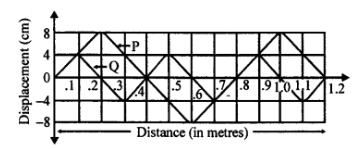
From diagram given below calculate
1. velocity of $P$ and $Q$
2. frequency of $P$, when frequency of $Q$ is 512 Hz .
Assume that both wave are travelling in same medium.
Image
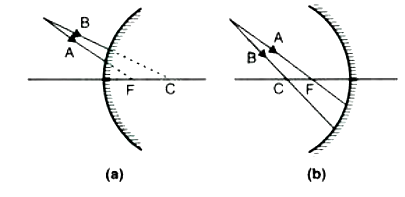
Complete the following diagrams shown in Fig. by drawing the reflected ray for each of the incident ray A and B.
A concave mirror forms a real image of an object placed in front of it at a distance 30 cm, of size three times the size of object. Find (a) the focal length of mirror (b) position of image.
 A bullet of mass $50$ g moving with an initial velocity $100 m s ^{-1}$ strikes a wooden block and comes to rest after penetrating a distance $2$ cm in it. Calculate: (i) Initial momentum of the bullet, (ii) Final momentum of the bullet, (iii) Retardation caused by the wooden block and (iv) Resistive force exerted by the wooden block.
A hollow cylinder of copper of length 25 cm and area of cross-section 15 cm , floats in water with $3 / 5$ of its length inside water. Calculate:
(1) apparent density of hollow copper cylinder.
(2) wt. of cylinder.
(3) extra force required to completely submerge it in water.
Draw two sets of rays of light to show the formation of an image of the letter as shown in figure p.
Image
Two spheres $A$ and $B$, each of volume $100 cm^3$ is placed on water (density $=1.0 g cm ^{-3}$ ). The sphere A is made of wood of density $0.3 g cm ^{-3}$ and sphere B is made of iron of density $8.9 g cm ^{-3}$.
  1. Find:
    1. The weight of each sphere, and
    2. The upthrust on each sphere.
  2. Which sphere will float? Give reason.
What is a barometer? How is a simple barometer constructed?