Questions

[5 Mark Question Answer]

🎯

Test yourself on this topic

18 questions · timed · auto-graded

Question 14 Marks
A spaceship is moving in space with a velocity of $50 kms ^7$. Its engine fires for 10 s , such that its velocity increases to $60 kms ^{-1}$. Calculate the total distance travelled by spaceship in $1 / 2$ minute, from the time of firing its engine
Answer
Initial velocity of spaceship $= u =50 kms ^{-1}$
$
\begin{array}{l}
u-50 \times 1000 ms^{-1} \\
u=50000 ms^{-1}
\end{array}
$
Time $= t =10 s$
Final velocity of spaceship $=v=60 kms ^{-1}$
$
v=60 \times 1000 ms^{-1}=6000 ms^{-1}
$
Acceleration $= a =$ ?
Case - I :
Spaceship acceleration for first 10 S
$
\begin{array}{l}
v=u+a t \\
60000=50000+a(10) \\
10 a=60000-50000=10000 \\
a=\frac{10000}{10}=1000 ms^{-2} \text { or } 1 kms^{-2} \\
\begin{aligned}
S & =u t+\frac{1}{2} a t^2
\end{aligned} \\
\begin{aligned}
S & =50000(10)+\frac{1}{2}(1000)(10)^2 \\
S & =500000+500 \times 100 \\
& =500000+50000=550000 m \\
& =550 km
\end{aligned}
\end{array}
$
Case - II :
Spaceship moves with uniform velocity $60 kms ^{-1}$ for next 20 S Distance covered $=$ Uniform velocity $\times$ Time
$
=60 \times 20=1200 km
$
Total distance travelled by spaceship $=550+1200=1750 km$.

View full question & answer
Question 24 Marks
A motor car slows down from 72 kmh¹ to 36 kmh over at distance of 25 m. If the brakes are applied with the same force calculate
1. total time in which car comes to rest
2. distance travelled by it.
Answer

Image
Take motion of car from A to B :
$
\begin{array}{l}
u=72 kmh^{-1}=72 \times \frac{5}{18} ms^{-1} \\
u=20 ms^{-1} \\
v=36 kmh^{-1}=36 \times \frac{5}{18} ms^{-1} \\
v=10 ms^{-1} \\
\text { (Time) } t_1=? \\
\text { Acceleration }=a=? \\
\text { Distance }=S_1=25 m \\
v^2-u^2=2 a S_1 \\
(10)^2-(20)^2=2 a(25) \\
50 a=100-400=-300 \\
a=-\frac{300}{50}=-6 ms^{-2}
\end{array}
$
Now, $v=u+a t_1$
$
10=20+(-6) t_i
$
$
6 t_1=20-10=10
$
$
t_1=\frac{10}{6}=1.67 s
$
Take motion of car from B to C :
$u=36 kmh ^{-1}=10 ms^{-1}$
$
v=0
$
$a=-6 ms^{-2}$
(Time) $t_2=$ ?
(Distance) $S _2=$ ?
$
\begin{array}{l}
v=u+a t_2 \\
0=10+(-6) t_2 \\
6 t_2=10 \\
t_2=\frac{10}{6}=1.67 S
\end{array}
$
Now, $v^2-u^2=2 a S_2$
$
\begin{array}{l}
(0)^2-(10)^2=2(-6) S_2 \\
-12 S_2=-100 \\
S_2=\frac{100}{12}=8.33 m
\end{array}
$
Total time taken by car from A to $C =t_1+t_2=\frac{10}{6}+\frac{10}{6}$
$
=\frac{10+10}{6}=\frac{20}{6}=3.33 s
$
Total distance covered by car from A to $C = S _1+ S _2$
$
=25+8.33=33.33 m
$
View full question & answer
Question 34 Marks
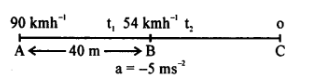
A motor bike running at $90 kmh ^{-1}$, is slowed down to $54 kmh ^{-1}$ by the application of brakes, over a distance of 40 m . If the brakes are applied with the same force, calculate
1. total time in which bike comes to rest
2. total distance travelled by bike.
Answer
$
\begin{array}{l}
\text { Initial velocity }=u=90 kmh^{-1} \\
\qquad=u=90 \times \frac{5}{18} ms^{-1}=25 ms^{-1} \\
\text { Final velocity }=v=54 kmh^{-1}=54 \times \frac{5}{18} ms^{-1} \\
\qquad v=5 ms^{-1} \\
\text { Distance }=S=40 m
\end{array}
$
Image
From A to B :
$
\begin{array}{l}
v^2-u^2=2 a S \\
(15)^2-(25)^2=2 a(40) \\
225-625=80 a \\
80 a=-400 \\
a=-5 ms^{-2}
\end{array}
$
(i)
$
\begin{array}{l}
\text { Time }\left(t_1\right)=? \\
v=u+a t_1 \\
15=25+(-5) t_1 \\
5 t_1=25-15=10 \\
t_1=\frac{10}{5}=2 s
\end{array}
$
From B to C :
$
\begin{array}{l}
\text { Initial velocity }=u=54 kmh^{-1}=54 \times \frac{5}{18} ms^{-1} \\
u=15 ms^{-1} \\
\text { Final velocity }=v=0 \\
\text { Acceleration }=a=-5 ms^{-2} \\
\text { Time }=t_2=? \\
v=u+a t_2 \\
0=15+(-5) t_2 \\
5 t_2=15 \\
t_2=\frac{15}{5}=3 s
\end{array}
$
Distance covered from B to C :
$
\begin{array}{l}
u=54 kmh^{-1}=15 ms^{-1} \\
v=0 \\
a=-5 ms^{-2} \\
S=? \\
v^2-u^2=2 a S \\
(0)^2-(15)^2=2(-5) S \\
-10 S=-225 \\
S=\frac{225}{10}=22.5 m
\end{array}
$
Total distance covered from A to $C =40+22.5=62.5$ Total time taken from A to $C = t _1+ t _2+=+3=5 s$
View full question & answer
Question 44 Marks
A motor bike running at $90 kmh ^{-1}$ is slowed down to $18 kmh ^{-1}$ in 2.5 s . Calculate
1. acceleration
2. distance covered during slow down.
Answer
Initial velocity of motor bike $= u =90 kmh ^{-1}$
$= u =90 \times 5 / 18 ms^{-1}=25 ms^{-1}$
Final velocity of motor bike $= v =18 kmh ^{-1}$
$
\begin{array}{l}
v=18 \times \frac{5}{18} ms^{-1}=5 ms^{-1} \\
\text { Time }=t=2.5 s
\end{array}
$
(i) Acceleration $=a=$ ?
$
\begin{array}{l}
v=u+a t \\
5=25+a(2.5) \\
2.5 a=-25+5=-20 \\
a=\frac{-20}{2.5}=-8 ms^{-2}
\end{array}
$
(ii) Distance covered $= S =$ ?
$
\begin{array}{l}
v^2-u^2=2 a S \\
(5)^2-(25)^2=2(-8) S \\
25-625=-16 S \\
-16 S=-600 \\
S=\frac{600}{16}=37.5 m \\
S=37.5 m
\end{array}
$
View full question & answer
Question 54 Marks
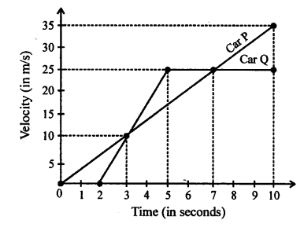
Diagram given below shows velocity - time graphs of car P and Q, starting from same place and in same direction. Calculate:
1. Acceleration of car P.
2. Acceleration of car Q between 2 s5 s.
3. At what time intervals both cars have same velocity?
4. Which car is ahead after 10 s and by how much?
Image
Answer

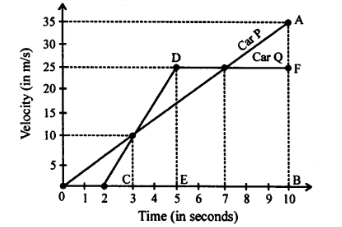
Image
(i) Acceleration of car $P =$ Slope of $v-t$ graph (OA) for car $P$.
$
=\frac{AB}{OB}=\frac{35}{10}=3.5 ms^{-2}
$
(ii) Acceleration of car $Q$ between $2 s-5 s=+$ Slope of $v-t$ graph (CD) for car $Q$
$
=\frac{DE}{CE}-\frac{25}{5-2}=\frac{25}{3}=8.33 ms^{-2}
$
(iii) Both cars have same velocity at $t=3 s$ and at $t=7 s$.
(iv) Distance covered by car $P =$ area of $\triangle OAB$
$
\begin{array}{l}
=\frac{1}{2} \times OB \times AB \\
=\frac{1}{2} \times 10 \times 35=175 m
\end{array}
$
Distance covered by car $Q=$ area of $\triangle C D E+$ area of rectangle DFBE
$
\begin{array}{l}
=\frac{1}{2} \times CE \times DE+EB \times BF \\
=\frac{1}{2} \times(5-2) \times 25+(10-5) \times 25=\frac{75}{2}+125 \\
=37.5+125=162.5 m
\end{array}
$
So, car $P$ is a head of car $Q$ by $(175-162.5) m$ i.e. by 12.5 m
View full question & answer
Question 64 Marks
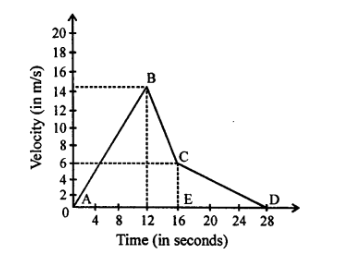
From the velocity - time graph given below, calculate :
1. Acceleration in the region AB.
2. Deceleration in region BC.
3. Distance covered in the region ABCE.
4. Average velocity in region CED.
Image
Answer
(i) Acceleration in the region $AB =$ Slope of $v-t$ graph from A to B
$
=\frac{BF}{AF}=\frac{14}{12}=1.16 ms^{-2}
$
(ii) Deceleration in region $B =+$ Slope of v.t. graph from B to C
$
=\frac{BG}{GC}=\frac{14-6}{16-12}=\frac{8}{4}=2 ms^{-2}
$
(iii) Distance covered in region $ABCE =\operatorname{ar}(\triangle ABF )+$ area of trapezium BCEF
$
\begin{array}{l}
=\frac{1}{2} \times AF \times BF+\frac{1}{2}(BF+CE) \times GC \\
=\frac{1}{2} \times 12 \times 14+\frac{1}{2}(14+6) \times 4 \\
=6 \times 14+10 \times 4=84+40=124 m
\end{array}
$
(iv) Displacement covered in region $\triangle CDE =$ area of $\triangle CDE$
$
\begin{array}{l}
=\frac{1}{2} \times ED \times CE=\frac{1}{2} \times(28-16) \times 6 \\
=\frac{1}{2} \times 12 \times 6=36 m
\end{array}
$
$
\begin{array}{l}
\text { Average velocity in region CED }=\frac{\text { Total displacement }}{\text { Time }} \\
\quad=\frac{36}{12}=3 ms^{-1}
\end{array}
$
View full question & answer
Question 74 Marks
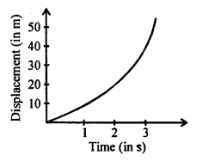
A body at rest is thrown downward from the top of tower. Draw a distance - time graph of its free fall under gravity during first 3 seconds. Show your table of values starting $t=$ 0 with an interval of 1 second, $\left( g =10 ms^{-2}\right)$.
Answer
Initial velocity $= M =0$
Acceleration $= a =+ g =10 ms^{-2}$
when $t=I s$, then distance travelled $\left( S _{\text {}}\right.$ ) is given by
$
\begin{array}{l}
S_1=u t+\frac{1}{2} a t^2 \\
S_1=0(1)+\frac{1}{2}(10)(1)^2 \\
S_1=5 m
\end{array}
$
When $t=2 s$ then $S _2=u t+\frac{1}{2} a t^2$
$
\begin{array}{l}
S_2=(0)(2)+\frac{1}{2}(10)(2)^2 \\
S_2=5(4)=20 m
\end{array}
$
When $t=3 s$, then $S _3=u t+\frac{1}{2} a t^2$
$
\begin{array}{l}
S_3=(0)(3)+\frac{1}{2}(10)(3)^2 \\
S=5(9)=45 m
\end{array}
$
Time1s2s3s
Distance covered5 m20 m45m

Image
View full question & answer
Question 84 Marks
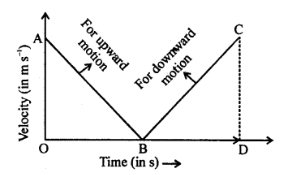
A ball is thrown up vertically, and returns back to thrower in 6 s. Assuming there is no air friction, plot a graph between velocity and time. From the graph calculate
1. deceleration
2. acceleration
3. total distance covered by ball
4. average velocity.
Answer
A ball is thrown up vertically, and returns to thrower in 6s. It means ball takes 3s to reach the highest point and 3s to reach the earth from highest point.
Image
For the upward motion of ball
$
\begin{array}{l}
u=? \\
v=0 \\
a=-g=-10 ms^{-2} \\
t=3 s \\
v=u+a t \\
0=u-10(3) \\
u=30 m / s
\end{array}
$
$\Rightarrow$ In the graph, $OA = CD =30 m / s$
(i) When the ball moves upwards, then it decelerates. From graph, deceleration $=-$ slope of graph $A B$
$
=-\frac{OA}{OB}=-\frac{30}{3}=-10 ms^{-2}
$
(ii) When ball falls downwards then acceleration = Slope of v.t. graph BC
$
=\frac{CD}{BD}=\frac{30}{3}=10 ms^{-2}
$
(iii) Total distance covered = area under v.t. graph
$
\begin{array}{l}
=\operatorname{ar}(\triangle OAB)+\operatorname{ar}(\triangle BCD) \\
=\frac{1}{2} \times OB \times OA+\frac{1}{2} \times BD \times CD
\end{array}
$
$
\begin{array}{l}
=\frac{1}{2} \times 30 \times 3+\frac{1}{2} \times 30 \times 3 \\
=45+45=90 m
\end{array}
$
(iv) Ball returns back to thrower in 6 s .
$\Rightarrow$ Diplacement after $6 s=0$
$
\begin{array}{l}
\text { Average velocity }=\frac{\text { Time displacement }}{\text { Total time taken }}=\frac{0}{6}=0 \\
\text { Average speed }=\frac{\text { Total distance covered }}{\text { Total time taken }}=\frac{90}{6}=15 ms^{-1}
\end{array}
$
View full question & answer
Question 94 Marks
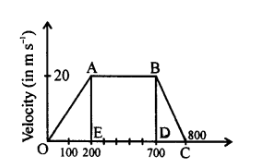
A train starting from rest, picks up a speed of $20 ms-1$ in 200 s . It continues to move at the same rate for next 500 s , and is then brought to rest in another 100 s .
(i) Plot a speed-time graph.
(ii) From graph calculate
(a) uniform rate of acceleration
(b) uniform rate of retardation
(c) total distance covered before stopping
(d) average speed.
Answer
(i)
Image
(ii) (a) Uniform rate of acceleration = Slope of v.t. graph from O to A .
$
=\frac{AE}{OE}=\frac{20}{200}=0.1 ms^{-2}
$
(b) Uniform rate of retardation $=$ Slope of v.t. graph from BC
$
=\frac{B D}{C D}=\frac{20}{100}=0.2 ms^{-2}
$
(c) Total distance covered before stopping
$
\begin{array}{l}
=\operatorname{ar}(\triangle OAE)+\operatorname{ar}(\triangle ABDE)+\operatorname{ar}(\triangle BCD) \\
=\frac{1}{2} \times OE \times AE+AE \times ED+\frac{1}{2} \times BD \times DC \\
=\frac{1}{2} \times 200 \times 20+20 \times 500+\frac{1}{2} \times 20 \times 100 \\
=2000+10000+1000 \\
=13000 m=13 km
\end{array}
$
(d) Average speed $=\frac{\text { Total distance covered }}{\text { Total time taken }}=\frac{13000}{800}$
$
=\frac{130}{8}=16.25 ms^{-1}
$
View full question & answer
Question 104 Marks
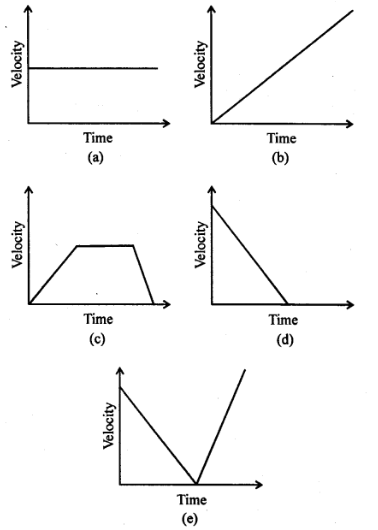
Can you suggest real life examples about the motion of a body from the following velocity - time graphs?
Image
Answer
(a) A car running on a road at constant velocity. Then $v$-f graph will be same as shown by (a).
(b) Figure (b) shows that car is moving with uniform acceleration. i.e. when velocity of car increases equally in equal intervals of time.
(c) Suppose a train starts from rest and accelerates uniformly for some time and then moves with a constant velocity for certain time interval. Then on applying the brakes, train is uniformly retarded and comes to rest after sometime in this situation, velocity time graph of the train will be same as showin in figure (c).
(d) When you come home at activa from market and stops in front of your home. Then velocity of active decreases with time and its $v$ - f graph will be same as shown on figure (d).
(e) A ball is thrown vertically upward and it returns back to earth after sometime. In this situation, graph will same as that shown in figure (e).
View full question & answer
Question 114 Marks
What do you understand by the term acceleration due to gravity? What is its value in C.G.S. and S.I. systems?
Answer
Acceleration due to gravity: The acceleration of a freely falling body, under the action of gravity of earth, is called acceleration due to gravity. It is represented by ' $g$ '.
In S.I. system, g = $9.8 ms^{-2}$; In C.G.S. system, g = $980 cms ^{-2}$
If a body falls towards the earth, then value of acceleration due to gravity is positive.
If the body rises vertically upwards, then value of acceleration due to gravity is negative.
View full question & answer
Question 124 Marks
How can you find the following?
1. Velocity from a displacement - time graph.
2. Acceleration from velocity - time graph.
3. Displacement from velocity - time graph.
4. Velocity from acceleration - time graph.
Answer
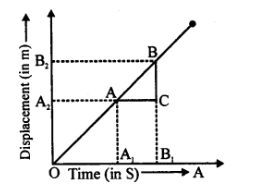
(i) Velocity from a displacement - time graph : Displacement time graph for uniform motion is a straight line (OP) inclined to time axis. Take any two points $A$ and $B$ on this graph OP. From $A$ and $B$, draw perpendiculars on time axis as well as displacement axis. So, by knowing the slope of displacement - time graph. We can find the velocity of the body.
Image
Such that,
$OA_1=t_1, OB_1=t_2, OA_2=x_1 \text { and } OB_2=x_2$
Slope of displacement - time graph $=\frac{ BC }{ AC }$
$=\frac{x_2-x_1}{t_2-t_1}=\frac{\Delta x}{\Delta t}=$ Velocity of the body.
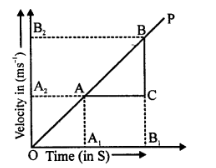
(ii) Acceleration from velocity –time graph : Velocity –time graph for uniform motion is a straight line (OP) inclined to time axis.
Image
Take any two points A and B on this graph. From A and B draw perpendicular on time axis as well as velocity axis in such a way that
$
OA_1=t_1, OB_1=t_2, OA_2=v_1 \text { and } OB_2=v_2$
Slope of $v-t$ graph $=\frac{B C}{A C}$
$=\frac{v_2-v_1}{t_2-t_1}=\frac{\Delta v}{\Delta t}$
$=$ Acceleration of the body
So, by knowing the slope of velocity -time graph for uniform motion, we can find the acceleration of the body.
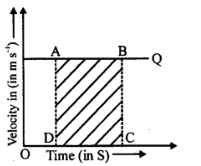
(iii) Displacement from velocity-time graph: Displacement covered by a body is equal to the area under velocity - time graph. When object moves with a uniform velocity, then velocity - time graph is a straight line (PQ) parallel to time axis.
Image
Take any two points $A$ and $B$ on velocity time graph.
From A and B , draw two perpendiculars AD and BC on time axis such that
$
OD=t_1 \text { and } OC=t_2
$
Let $OP = AD = BC =v=$ Velocity of the body.
Area under velocity - time graph = Area of rectangle ABCD .
$= AD \times DC =v \times( OC - OD )=v\left(t_2-t_1\right)$
$=$ Displacement covered by the body.
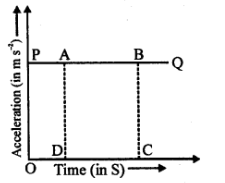
(iv) Velocity from acceleration - time graph : Area under the acceleration - time graph gives the velocity of the body. When the body moves with variable velocity but uniform acceleration, then acceleration - time graph is a straight line $(P Q)$ parallel to time axis.
Image
Take any two points A and B on PQ. From P and Q, draw perpendiculars ( $B C$ and $A D$ ) on time axis. Such that,
$
OD=t_1 \text { and } OC=t_2
$
Let $OP = AD = BC =a=$ acceleration of the body.
Area under acceleration - time graph = area of rectangle
ABCD .
$
\begin{array}{l}
=AD \times DC=AD \times(OC-OD) \\
=a\left(t_2-t_1\right) \\
=\frac{v-u}{\left(t_2-t_1\right)}\left(t_2-t_1\right)=v-u
\end{array}
$
If initial velocity of the body $= u =0$ Then area under acceleration - time graph $= v -0=$ $v=$ velocity of the body.

View full question & answer
Question 134 Marks
Draw velocity - time graphs for the following situations:
1. When a body, is moving with uniform velocity.
2. When a body is moving with variable velocity, but uniform acceleration.
3. When a body is moving with variable velocity, but uniform retardation.
4. When a body is moving with variable velocity and variable acceleration.
Answer
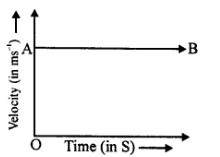
Following are the velocity - time graph :<br>(i) When a body is moving with uniform velocity : Then velocity time graph is $A B$ is a straight line parallel to time axis.
Image
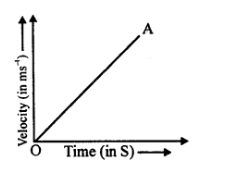
(ii) When a body is moving with variable velocity, but uniform acceleration : Then velocity-time graph $O A$ is a straight line inclined to time axis.
Image
(iii)
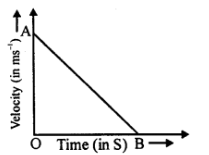
(a) When a body is moving with variable velocity, but uniform retardation :
Image
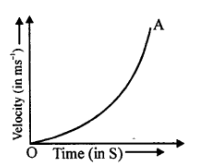
(b) When a body is moving with variable velocity and variable acceleration :
Image
View full question & answer
Question 144 Marks
Draw displacement - time graphs f.or the following situations:
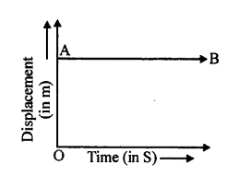
1. When a body is stationary.
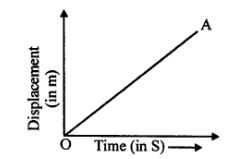
2. When a body is moving with uniform velocity.
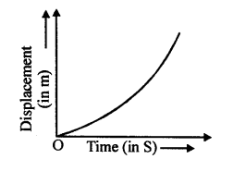
3. When a body is moving with variable velocity.
Answer
(i) Displacement - time graph when body is stationary.
Image
(ii) Displacement - time graph when body is moving with uniform velocity.
Image
(iii) Displacement - time graph when body is moving with variable velocity.
Image
View full question & answer
Question 154 Marks
By giving one example each, define
1. variable velocity.
2. average velocity.
3. uniform velocity.
Answer
(i) Variable velocity: When a body covers unequal distances in equal intervals of time in a specified direction, the body is said to be moving with a variable velocity.
Example: A rotating fan at a constant speed has variable velocity, because of continuous change in direction.
(ii) Average velocity: The ratio of the total distance travelled in a specified direction to the total time taken by the body to travel the distance is called average velocity.
Example: If you walk to a campsite 1 km away and then back to your starting point with in 1 hour, then your average velocity will be zero because your initial and final position is same.
(iii) Uniform velocity: When a body covers equal distances in equal intervals of time
(however small may be the time interval) in a specified direction, the body is laid to be moving with uniform velocity.
Example: A car moving on a straight road with constant speed has uniform velocity.
View full question & answer
Question 164 Marks
Define (i) Distance (ii) Displacement. Give two differences between displacement and distance.
Answer
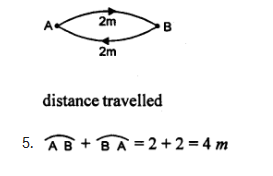
(i) Distance: The length of path travelled by a body in certain interval of time is called distance.
(ii) Displacement: of an object between two points is the shortest distance between these two points.
"It is the unique path which can take the body from its initial to final position."
Differences between displacement and distance.
Distance:
1. It is a scalar quantity.
2. Distance travelled is always positive.
3. The distance travelled by a moving body is the actual length of path.
Image
Displacement:
1. It is a vector quantity.
2. Displacement may be positive negative or zero.
3. The displacement of a body is the shortest distance between the initial and final positions of the body..
4. Displacement is always less than or equal to the distance travelled.
Displacement is zero.
Image
View full question & answer
Question 174 Marks
Define:
(i) Speed (ii) Velocity. Give two differences between speed and velocity.
Answer
(i) Speed: The distance covered by a body in a unit time is called its speed. It is also defined as the rate of change position of a body in any direction.
speed = distance/time
(ii) Velocity: "Rate of change of displacement with time" is called velocity, or "The time rate of change of displacement of an object" is called the velocity.
V = distance/time
Differences between speed and velocity
Speed:
1. The rate of change of position of a body in any direction is known as its speed.
2. It is a scalar quantity.
3. It can be positive or zero.
Velocity:
1. The rate of change of position of a body in a particular direction is known velocity.
2. It is a vector quantity.
3. It can be positive, negative or zero.
View full question & answer
Question 184 Marks
Define
1. Scalar quantities.
2. Vector quantities. Give two differences between scalar and vector quantities.
Answer
(i) Scalar quantities: The physical quantities which are expressed in magnitude only are called scalar quantities.
For example: Mass, length, time, distance, density, energy etc.
(ii) Vector quantities: The physical quantities which are 'expressed in magnitude as well as direction are called vector quantities.
For example: Displacement, velocity, acceleration, momentum, force etc. Differences between scalar and vector quantities.
SCALARS:
1. Scalars are specified by one quantity only i.e. magnitude.
2. Scalars change by change in magnitude along.
3. Scalars are written or represented by ordinary letters.
4. Scalars are added by just algebraic addition or subtraction.
5. Mass, length, time, speed, etc. are some example of scalars.
VECTORS:
1. Vectors are specified by two quantities (i) magnitude and (ii) direction.
2. Vectors change when there is change in either magnitude or direction or both.
3. Vectors are written (shown) in bold face letters or letters having arrows heads on them.
4. Vectors are added or subtracted by using triangle law, parallelogram law or polygon law.
5. Displacement, velocity acceleration are some examples of vectors.
View full question & answer
[5 Mark Question Answer] - PHYSICS STD 9 Questions - Vidyadip