MCQ
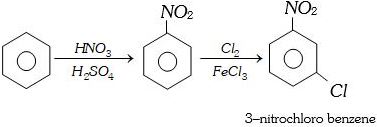
${C_6}{H_6}\mathop {\xrightarrow{{HN{O_3}}}}\limits_{{H_2}S{O_4}} X\mathop {\xrightarrow{{C{l_2}}}}\limits_{FeC{l_3}} Y$. In the above sequence  $ Y$  is
  • A
    $1-$nitrochloro benzene
  • $3-$nitrochlorobenzene
  • C
    $4-$nitrochlorobenzene
  • D
    $1,2-$nitrochlorobenzene

Answer

Correct option: B.
$3-$nitrochlorobenzene
b
(b)

Need a full question paper?

Generate a complete, print-ready paper with questions like this in minutes — across 16+ boards, with answer keys.

Start Generating Free

Similar questions

The volume of the water needed to dissolve $1\,g$ of $BaSO_4\, (K_{sp} = 1.1\times10^{-10})$ at $25\,^oC$ is .....$ litre$
Solid $Ba(NO_3)_2$ is gradually dissolved in $1\times10^{-4}\, M\, Na_2CO_3$ solution. At what concentration of $Ba^{+2}$ the precipitation of $BaCO_3$ will start? (If $K_{sp}$ of $BaCO_3 = 5.1\times10^{-9}$)
The lowest energy conformer of is
Consider titration of $NaOH$ solution versus $1.25\, M$ oxalic acid solution. At the end point following burette readings were obtained.

$(i)$ $4.5\, mL$ $\quad (ii)$ $4.5\, mL$ $\quad (iii)$ $4.4\, mL$

$(iv)$ $4.4\, mL$ $\quad (v)$ $4.4\, mL$

If the volume of oxalic acid taken was $10.0 \,mL$ then the molarity of the $NaOH$ solution is .... $M.$ (Rounded-off to the nearest integer)

The compound($s$) which react($s$) with $NH _3$ to give boron nitride ($BN$) is(are)

$(A)$ $B$ $(B)$ $B _2 H _6$ $(C)$ $B _2 O _3$ $(D)$ $HBF _4$

All the hydrocarbons shown are very weak acids. One, however, is far more acidic  than the others. Which one is the strongest acid ?
In the following :

$\begin{gathered}
  {\left[ {Al{{\left( {{H_2}O} \right)}_6}} \right]^{ + 3}} + HCO_3^ -  \rightleftarrows {\left[ {Al{{\left( {{H_2}O} \right)}_5}OH} \right]^{ + 2}} + {H_2}C{O_3} \hfill \\
  \,\,\,\,\,\,\,\,\,\,\,\,(A)\,\,\,\,\,\,\,\,\,\,\,\,\,\,\,\,\,\,\,\,(B)\,\,\,\,\,\,\,\,\,\,\,\,\,\,\,\,\,\,\,\,\,\,\,\,\,\,\,\,\,\,\,\,\,\,\,\,\,(C)\,\,\,\,\,\,\,\,\,\,\,\,\,\,\,\,\,\,\,\,\,\,\,(D) \hfill \\ 
\end{gathered} $

species behaving as bronsted -lowry acid are

The energy of the electron at infinite distance from the nucleus in Bohr’s model is taken as :
In which of the following process, the value of bond order & magnetic nature does not change?
$0.1$ $mole$ of $CH_3NH_2 (K_b = $ $5 \times 10^{-4} $ $)$ is mixed with $0.08 $ $mole$ of $ HCl $ and diluted to one litre. What will be the $H^+ $ concentration in the solution?