Question
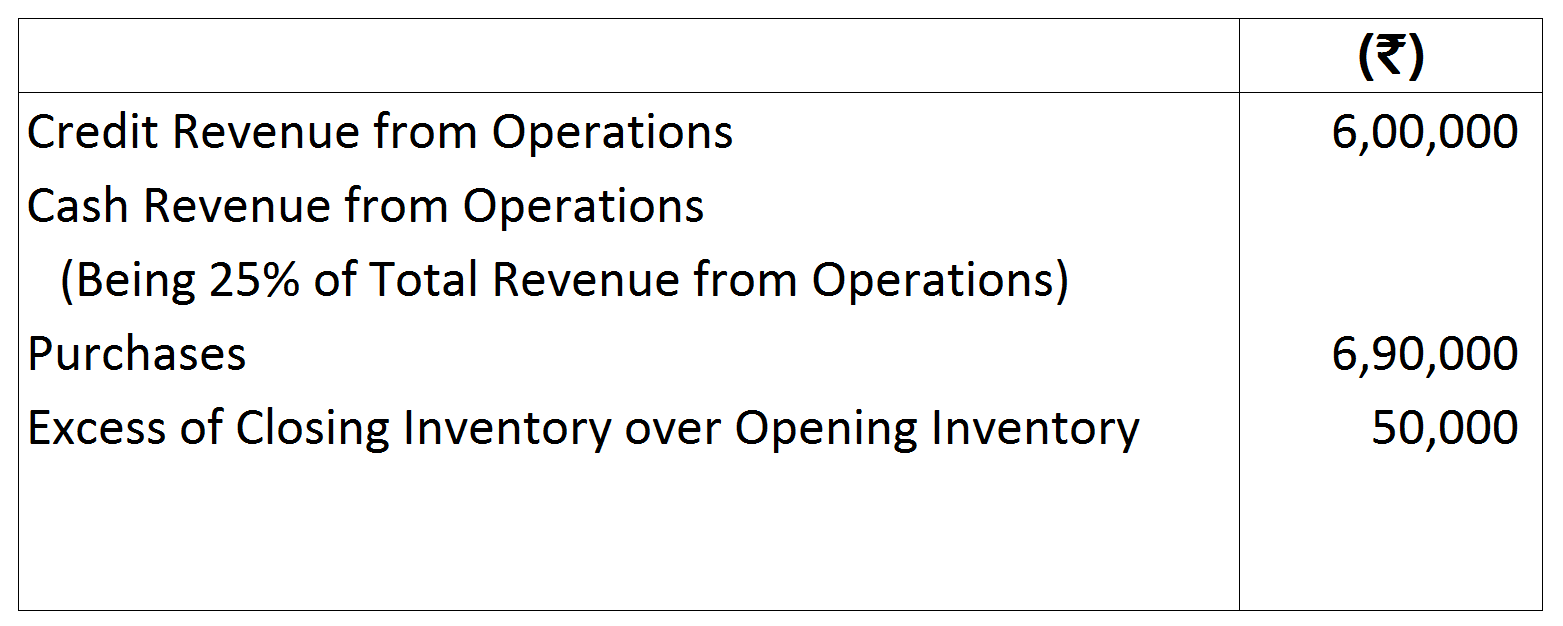
Calculate G.P. Ratio from the following:
Answer

If Total Revenue from Operations is ₹ 100, Cash Revenue from Operations will be ₹ 25 and Credit Revenue from Operations ₹ 75
Hence,
If Credit Revenue from Operations is ₹ 75
Total Revenue from Operations will be = ₹ 100
If Credit Revenue from Operations is ₹ 6,00,000
Total Revenue from Operations will be $=\frac{100}{75}\times ₹\ 6,00,000$
Cost of Revenue from Operations = Purchases - Excess of Closing Inventory over Opening Inventory
= ₹ 6,90,000 - ₹ 50,000 = ₹ 6,40,000
Gross Profit = Total Revenue from Operations - Cost of Revenue from Operations
= ₹ 8,00,000- ₹ 6,40,000 = ₹ 1,60,000
Gross Profit Ratio $=\frac{\text{Gross Profit}}{\text{Net Revenue from Operations}}\times100$
$=\frac{₹\ 1,60,000}{₹\ 8,00,000}\times100= 20\%$

Need a full question paper?

Generate a complete, print-ready paper with questions like this in minutes — across 16+ boards, with answer keys.

Start Generating Free

Similar questions

'Blue Star Ltd.' was registered with an authorised capital of ₹ 2,00,000 divided into 20,000 shares of ₹ 10 each. 6,000 of these shares were issued to the vendor for building purchased. 8,000 shares were issued to the public and ₹ 5 per share were called up as follows:
On application - ₹ 2 per share
On allotment - ₹ 1 per share
On first call - Balance of the called up amount
The amounts received on these shares were as follows:
On 6,000 shares - Full amount called
On 1,250 shares - ₹ 3 per share
On 750 shares - ₹ 2 per share
The directors forfeited 750 shares on which ₹ 2 per share were received.
Pass necessary journal entries for the above transactions in the books of Blue Star Ltd.
A company issued 10% Debentures of the face value of ₹ 1,20,000 at a discount of 6% on January 01, 2001. The debentures are payable by annual drawings of 40,000 commencing from the end of third year.
How will you deal with discount on debentures?
Show the discount on debentures account in the company ledger for the period of duration of debentures. Assume accounts are closed on December 31.
Alfa Ltd. invited applications for issuing 75,000 equity shares of ₹ 10 each. The amount was payable as follows:
On application and allotment - ₹ 4 per share,
On first Call - ₹ 3 per share,
On second and final Call - balance.
Applications for 1,00,000 shares were received. Shares were allotted to all the applicants on pro rata basis and excess money received with applications was transferred towards sums due on first call. Vibha who was allotted 750 shares failed to pay the first call. Her shares were immediately forfeited. Afterwards the second call was made. The amount due on second call was also received except on 1,000 shares applied by Monika. Her shares were also forfeited. All the forefited shares were reissued to Mohit for ₹ 9,000 as fully paid-up.
Pass necessary journal entries in the Books of Alfa Ltd. for the above transactions.
Exe Ltd. purchased the assets of the book value ₹ 4,00,000 and took over the liabilities of ₹ 50,000 from Mohan Bros. It was agreed that the purchase consideration, settled at ₹ 3,80,000 be paid by issuing debentures of ₹ 100 each.
Pass journal entries if debenture are issued:
  1. at par
  2. at a discount of 10% and
  3. at a premium of 10%.
It was agreed that any fraction of debentures be paid in cash.
Krishna & Co. Ltd. with an authorised capital of ₹ 2,00,000 divided into 20,000 Equity Shares of ₹ 10 each, issued the entire amount of the shares payable as:
₹ 5 on application (including premium ₹ 2 per share),
₹ 4 on allotment, and
₹ 3 on call.
All share money is received in full with the exception of the allotment money on 200 shares and the call money on 500 shares (including the 200 shares on which the allotment money has not been paid).
The above 500 shares are duly forfeited and 400 of these (including the 200 shares on which allotment money has not been paid) are reissued at ₹ 7 per share payable by the purchaser as fully paid-up. Pass journal entries (including cash transactions) and show the balances in the Balance Sheet giving effect to the above transactions.
Super Star Ltd. makes an issue of 10,000 Equity Shares of ₹ 100 each, payable as:
On application and allotment ₹ 50 per share,
On first call ₹ 25 per share,
On second and final call ₹ 25 per share.
Members holding 400 shares did not pay the second and final call and the shares are duly forfeited, 200 of which are reissued as fully paid-up @ ₹ 50 per share. Pass journal entries in the books of the company.
Opening Trade Receivables ₹ 10,000; Total Revenue from Operations (Total Sales) ₹ 4,00,000; Cash Revenue from Operations being $\frac{1}{2}\text{th}$ of Total Revenue from
Operations; Revenue from Operations Return (Sales Return) ₹ 60,000 $\big(\frac{1}{3}\text{rd}$ out of Cash Revenue from Operations$\big)$; Closing Trade Receivables were four times than that in the beginning. Calculate Trade Receivables Turnover Ratio and Average Collection Period.
X Ltd., had issued ₹ 8,00,000 9% debentures which are due to be redeemed out of profits on 1st Oct. 2015 at a premium of 5%. The company had a Debenture Redemption Reserve of ₹ 4,14,000. The Company invested the required amount in fixed deposit in a Bank on 30th April, 2015 earning interest at 10% p.a. Pass necessary journal entries for the redemption of debentures.
Explain briefly the meaning and significance of any two of the following ratios:
  1. Debt-Equity Ratio.
  2. Operating Ratio.
  3. Trade Receivables Turnover Ratio.
Kaveri Ltd. issued 50,000, 8% Debentures of ₹ 100 each at par on Oct. 1, 2012 redeemable on March, 31, 2016. It was decided to invest 15% of the face value of debentures to be redeemed towards Debenture Redemption Investment on 30th April, 2015. Debentures were redeemed on due date. Record necessary entries for issue and redemption of debentures.