Questions · Page 1 of 3

6 Marks Question

🎯

Test yourself on this topic

50 questions · timed · auto-graded

Question 16 Marks
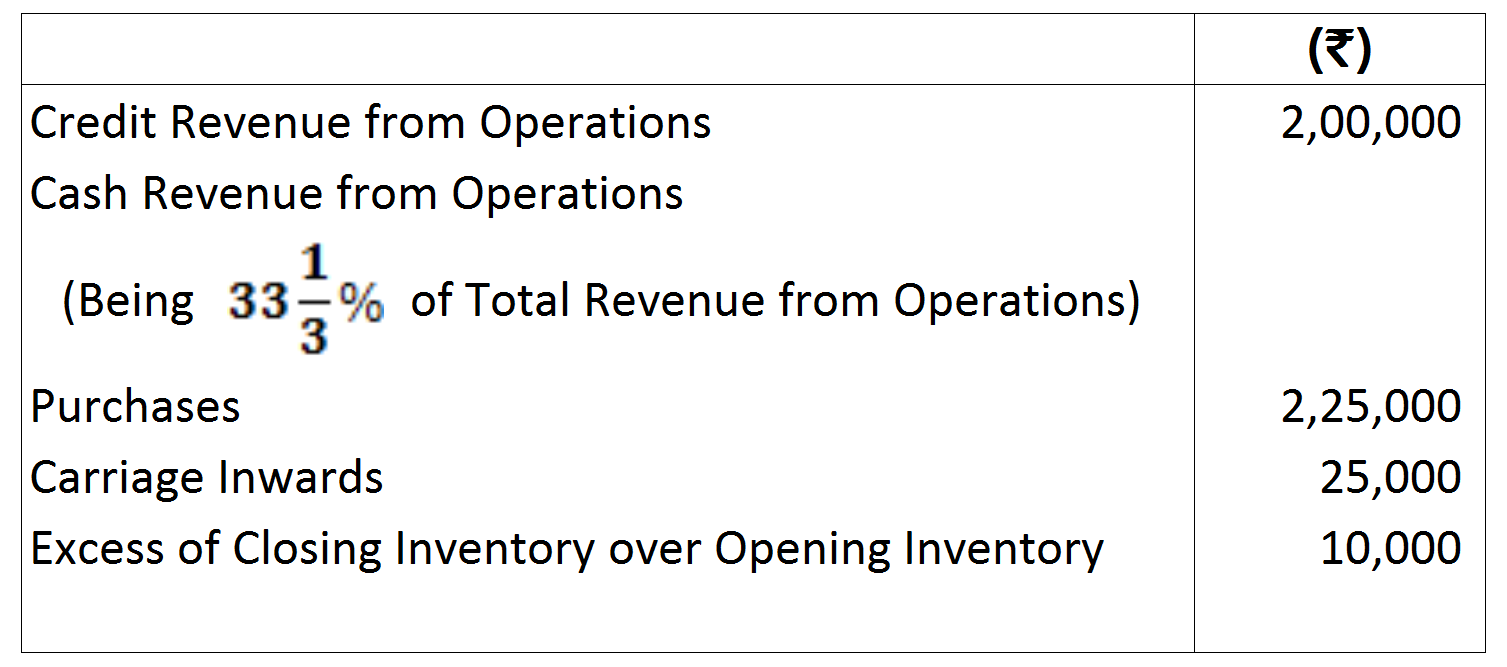
Calculate Gross Profit Ratio from the following data:
Answer
If Total Revenue from Operations is ₹ 100, Cash Revenue from Operations will be $₹\ 33 \frac{1}{3}$ and Credit Revenue from Operations $₹\ 66 \frac{2}{3}$
Hence,
If Credit Revenue from Operations is $₹\ 66 \frac{2}{3}$ Total Revenue from Operations will be= ₹ 100
If Credit Revenue from Operations is ₹ 2,00,000
Total Revenue from Operations will be $=\frac{100}{66\frac{2}{3}}\times ₹\ 2,00,000$
$=100\times\frac{2}{200}\times ₹\ 2,00,000$
$=₹\ 3,00,000$
Cost of Revenue from Operations = Purchases + Carriage Inwards - Excess of Closing Inventory over Opening Inventory
= ₹ 2,25,000 + ₹ 25,000 - ₹ 10,000
= ₹ 2,40,000
Gross Profit = Total Revenue from Operations - Cost of Revenue from Operations
= ₹ 3,00,000 - ₹ 2,40,000 = ₹ 60,000
Gross Profit Ratio $=\frac{\text{Gross Profit}}{\text{Net Revenue from Operations x}}\times100$
$=\frac{₹\ 60,000}{₹\ 3,00,000}\times100= 20 \%$
View full question & answer
Question 26 Marks
Calculate G.P. Ratio from the following:
Credit Revenue from Operations were $ \frac{1}{4}\text{th}$ of Total Revenue from Operations. Credit Revenue from Operations were ₹ 1,20,000. Credit Purchases were $ \frac{1}{5}\text{th}$ of Cash Purchases. Credit Purchases were ₹ 40,000. Opening Inventory ₹ 70,000. It was ₹ 20,000 more than Closing Inventory; Carriage ₹ 15,000, Wages ₹ 45,000.
Answer
Step I:
If Credit Revenue from Operations is ₹ 1,
Total Revenue from Operations will ₹ 4
If Credit Revenue from Operations is ₹ 1,20,000,
Total Revenue from Operations will be ₹ 1,20,000 × 4 = ₹ 4,80,000
Step II:
If Credit Purchase is ₹ 1, Cash Purchase will be ₹ 5 and hence total Purchase will be ₹ 6
$\therefore$ If Credit Purchase is ₹ 1, Total Purchase = ₹ 6
If Credit Purchase is ₹ 40,000, Total Purchase $=\frac{₹\ 6}{₹\ 1}\times₹\ 40,000=₹\ 2,40,000$
Step III:
Cost of Revenue from Operations = Opening Inventory + Purchase + Carriage + Wages - Closing Inventory
= ₹ 70,000 + ₹ 2,40,000 + ₹ 15,000 + ₹ 45,000 - ₹ 50,000
= ₹ 3,20,000
Gross Profit = Total Revenue from Operations - Cost of Revenue from Operations
= ₹ 4,80,000 - ₹3,20,000
= ₹ 1,60,000
Gross Profit Ratio $=\frac{\text{Gross Profit}}{\text{Net Revenue from Operations}}\times100$
$=\frac{₹\ 1,60,000}{₹\ 4,80,000}\times100=33.33\%$
View full question & answer
Question 36 Marks
Distinguish between Current Ratio and Quiek Ratio.
Answer
Distinction between Current Ratio and Quick Ratio
Basis of Distinction
Current Ratio
Quick Ratio(or Liquid Ratio)
1.
Relationship
It establishes a relationship between current Assest and Current Liabilities.
It establishes a relationship between Liquid Assets and Current Liabilities.
2.
Formula for computation
Current Ratio $=\frac{\text{Current Assets}}{\text{Current Liabilities}}$ Quick Ratio $=\frac{\text{Liquid Assets}}{\text{Current Liabilities}}$
3.
Obejctive
It measures the ability of the firm to meet its current liabilities within 12 months from the date of balance Sheet or within the period of operting cycle.
It measures the ability of the firm to meet its current liabilities immediately or within a month.
4.
Ideal Ratio
Current Ratio of 2 : 1 is Considered as an ideal ratio.
Quick Ratio of 1 : 1 is Considered as an ideal ratio.
5.
True Measurement
It is not a true measurement of short-term financial position of the firm as it may include a large amount of inventoires which may not be quickly convertible in to cash.
It removes this shortcoming of current ratio by excluding the amount of inventories.
 
View full question & answer
Question 46 Marks
Comment upon the short-term financial position of the Company on the basis of the following:
Goodwill ₹ 1,00,000; Sundry Debtors ₹ 2,50,000; Machinery ₹ 4,00,000; Inventory ₹ 5,00,000; Bills Payable ₹ 30,000; Sundry Creditors ₹ 4,20,000; Prepaid Expenses ₹ 25,000; Cash ₹ 40,000; Marketable Securities ₹ 80,000; Bills Receivable ₹ 30,000; Debentures ₹ 1,00,000; Expenses Payable ₹ 10,000; Live Stock ₹ 50,000; Patents ₹ 20,000 Provision for Taxation ₹ 40,000.
Answer
Short-term financial position can be ascertained by analysing its Liquidity Ratios. Liquidity Ratios include the following two ratios:
  1. Current Ratio.
  2. Quick Ratio.
  1. Current Ratio $=\frac{\text{Current Assets}}{\text{Current Liabilities}}$
Current Assets =Sundry Debtors + Inventory + Prepaid Expenses + Cash + Marketable Securities + Bills Receivable

= ₹ 2,50,000 + ₹ 5,00,000 + ₹ 2,10,000 + ₹ 25,000 + ₹ 40,000 + ₹ 80,000 + ₹ 30,000

= ₹ 9,25,000

Current Liabilities = Bills Payable + Sundry Creditors + Expenses Payable + Provision for Taxation

= ₹ 30,000 + ₹ 4,20,000 + ₹ 10,000 + ₹ 40,000

= ₹ 5,00,000

Current Ratio$=\frac{₹\ 9,25,000}{₹\ 5,00,000}= 1.85:1$
  1. Quick Ratio $=\frac{\text{Liquid Assets}}{\text{Current Liabilities}}$
Liquid Assets = Sundry Debtors + Cash + Marketable Securities + Bills Receivable

= ₹ 2,50,000 + ₹ 40,000 + ₹ 80,000 + ₹ 30,000

= ₹ 5,00,000

Quick Ratio $=\frac{₹\ 4,00,000 }{₹\ 5,00,000} =8:1$
View full question & answer
Question 56 Marks
Calculate Trade Receivables Turnover Ratio in the following:
Case: Cost of Revenue from Operations or Cost of Goods Sold ₹ 4,50,000; Gross Profit on Sales 20%; Cash Sales 25% of Net Credit Sales, Opening Trade Receivables ₹ 90,000; Closing Trade Receivables ₹ 60,000.
Answer
Case:
Let Sales be = x.
$\text{Gross Profit}=\text{x}\times\frac{20}{100}$
$=\frac{20\text{x}}{100}$
Sales = Cost of Goods Sold + Gross Profit
or, $\text{x} = 4,50,000+\frac{20\text{x}}{100}$
or, $\text{x}-\frac{20}{100}=4,50,000$
or, $\text{x}=\frac{4,50,000\times100}{80}$
= 5,62,500
Sales = x ₹ 5,62,500
Let Credit Sales be = a
$\text{Case Sales}=\text{a}\times\frac{25}{100}$
$=\frac{25\text{a}}{100}$
Sales = Case Sales + Credit sales
or, $5,62,500=\frac{25\text{a}}{100}+\text{a}$
or, $\text{a}=\frac{5,62,500\times100}{125}$
= 4,50,000
Credit Sales = a = 4,50,000
Average Trade Receivables $=\frac{\text{Opning Trade Receivable + Closing Trade Receivables}}{2}$
Average Trade Receivables $=\frac{90,000+60,000}{2}$
= 75,000
Trade Receivable Turnover Ratio $=\frac{\text{Net Credit Sales}}{\text{Average Trade Receivables}}$
Trade Receivable Turnover Ratio $=\frac{4,50,000}{75,000}=6\text{ Times}$
View full question & answer
Question 66 Marks
Balance Sheet had the following amounts as at 31st March, 2018:
 
10% Preference Share Capital. 5,00,000
Equity Share Capital. 15,00,000
Securities Premium Reserve. 1,00,000
Reserves and Surplus. 4,00,000
Long-term Loan from IDBI @ 9%. 30,00,000
Current Asset. 12,00,000
Current Liabilities. 8,00,000
(Investments in other companies). 2,00,000
Fixed Assets-Cost. 60,00,000
Depreciation Written off. 14,00,000
Calculate ratios indicating the Long-term and the Short-term financial position of the company.
Answer
  1. Debt-Equity Ratio is an indicator of Long-term financial health. It shows the proportion of Long-term loan in comparison of shareholders’ Funds.
Debt - Equity Ratio $=\frac{\text{Long Term Debts }}{\text{Equity}} $
Debt = Loan from IDBI @ 9% = 30,00,000
Equity = 10% Preference Share Capital + Equity Share Capital + Reserves & Surplus
= 5,00,000 + 15,00,000 + 4,00,000 = 24,00,000
Debt - Equity Ratio $=\frac{30,00,000}{24,00,000}=1.25:1$
  1. Current Ratio is an indicator of short-term financial portion. It shows the proportion of Current Assets in comparison of Current Liabilities.
Current Ratio $=\frac{\text{Current Assets}}{\text{Current Liabilities}}$
Current Assets = 12,00,000
Current Liabilities = 8,00,000
Current Ratio $=\frac{12,00,000}{8,00,000}=1.5:1$
Note: In the above question, Securities Premium Reserve is not considered while computing Equity because it is already included in the amount of Reserves and Surplus.
View full question & answer
Question 76 Marks
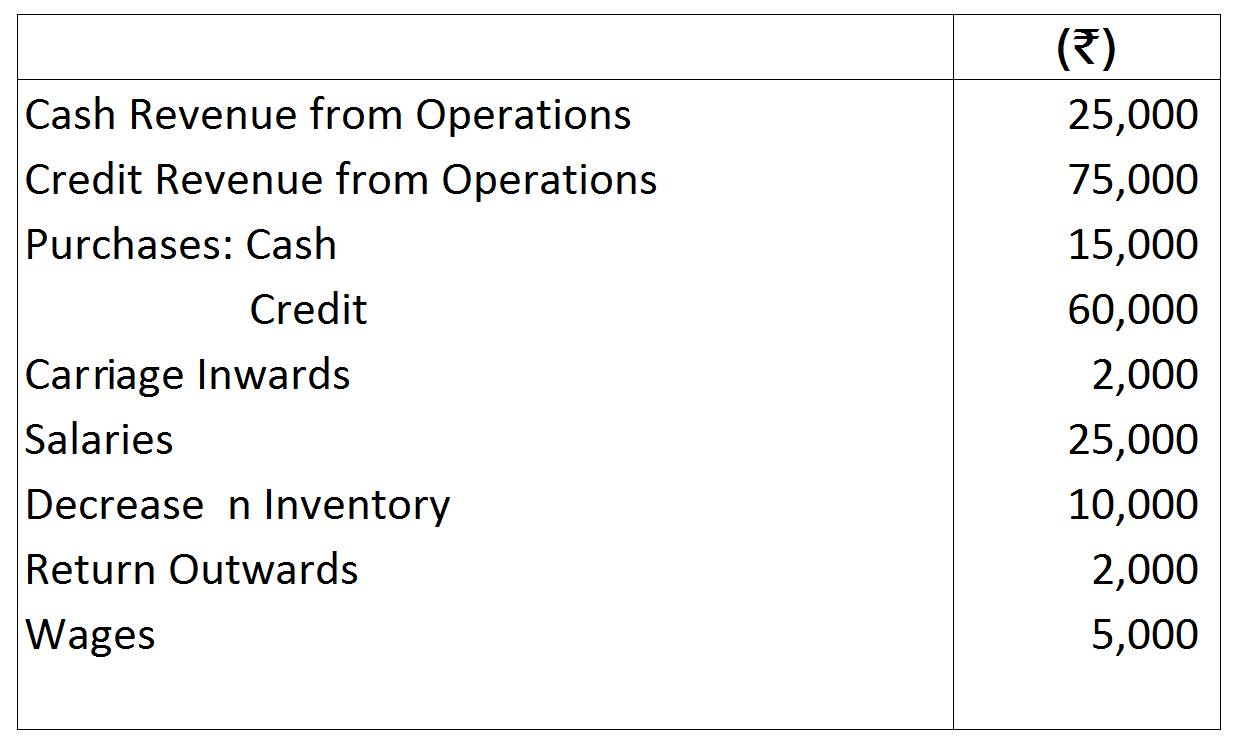
Following information is available for the year ending 31st March, 2018. Calculate gross profit ratio:
Answer
Net Revenue from Operations = Cash Revenue from Operations + Credit Revenue from Operations= ₹ 25,000 + ₹ 75,000 = ₹ 1,00,000
Net Purchases = Cash Purchases + Credit Purchases - Return Outwards
= ₹ 15,000 + ₹ 60,000 - ₹ 2,000 = ₹ 73,000
Cost of Revenue from Operations = Purchases + (Opening Inventory - Closing Inventory) + Direct Expenses
= Purchases + Decrease in inventory + Carriage Inwards + Wages
= ₹ 73,000 + ₹ 10,000 + ₹ 2,000 + ₹ 5,000
= ₹ 90,000
Gross Profit = Revenue from Operations - Cost of Revenue from Operations
= ₹ 1,00,000 - ₹ 90,000
= ₹ 10,000
Gross Profit Ratio = Gross Profit/ Net Revenue from Operations × 100
= ₹ 10,000/ ₹ 1,00,000 × 100 = 10%
View full question & answer
Question 86 Marks
A company's inventory turnover is 5 times. Inventory at the end of the year ₹ 4,000 more than inventory at the beginning of the year. Revenue from Operations during the year (all credit) were ₹ 3,00,000. Rate of Gross Profit is 25% on cost of Revenue from Operations. Current Liabilities at the end of the year were ₹ 50,000. Quick Ratio is 1 : 1. Calculate:
  1. Cost of revenue from operations (Cost of Goods Sold).
  2. Opening inventory.
  3. Closing inventory.
  4. Quick Assets.
  5. Current Assets at the end.
Answer
Gross Profit is 25% of cost. Therefore, goods costing ₹ 100 is sold for ₹ 125.
If Revenue from Operations are 125, Cost is 100
  1. If Revenue from Operations are ₹ 3,00,000, Cost is $\frac{100}{125}\times3,00,000$
= ₹ 2,40,000

Average Inventory $=\frac{₹\ 2,40,000}{5}=₹\ 48,000$
  1. Opening Inventory $=₹\ 48,000 - \frac{1}{2}\text{ of }4,000 = ₹\ 46,000$
  2. Closing Inventory $=₹\ 48,000 + \frac{1}{2}\text{ of }4,000 = ₹\ 50,000$
Current Liabilities are ₹ 50,000 and Quick Ratio is 1, therefore,
  1. Quick Assets = ₹ 50,000 × 1 = ₹ 50,000
  2. Current Assets = Quick Assets + Closing Inventory
= ₹ 50,000 + ₹ 50,000 = ₹ 1,00,000
View full question & answer
Question 96 Marks
Calculate Trade Payables Turnover Ratio and Average Debt Payment Period from the following information:
 
1st April, 2017
31st March, 2018
Sundry Creditors
1,50,000
4,50,000
Bills Payable
50,000
1,50,000
Total Purchases ₹ 21,00,000 Purchases Return ₹ 1,00,000; Cash Purchases ₹ 4,00,000.
Answer
Average Trade Payables $=\frac{\text{Opening Creditors & B/P + Closing Creditors & B/P}}{2}$
$=\frac{1,50,000+50,000 +4,50,000+1,50,000}{2}=₹\ 4,00,000$
Net Credit Purchases = Total Purchases - Purchases Return - Cash Purchases
= 21,00,000 - 1,00,000 - 4,00,000 = ₹ 16,00,000
Trade Payables Turnover Ratio $=\frac{\text{Net Credit Purchases}}{\text{Average Trade Payables}}$
$=\frac{16,00,000}{4,00,000}=4\text{ Times}$
Average Debt Payment Period $=\frac{12}{\text{Trade Payable Turnover Ratio}}$
$=\frac{12}{4}=3\text{ Months}$
View full question & answer
Question 106 Marks
Calculate Operating Profit Ratio and Operating Ratio from the following:
Cash Revenue from Operations ₹ 2,00,000; Credit Revenue from Operations ₹ 1,30,000; Revenue from Operations Return (Sales Return) ₹ 10,000; Cost of Revenue from Operations ₹ 1,80,000; Office and Administration Expenses ₹ 40,000; Selling Expenses ₹ 36,000; Interest on Debentures ₹ 23,000.
Answer
Operating Profit Ratio $=\frac{\text{Operating Profit}}{\text{Net Revenue from Operations }}\times100$
Operating Profit = Gross Profit - Operating Expenses
Gross Profit = Net Revenue from Operations - Cost of Revenue from Operations
= (Cash Revenue from Operations + Credit Revenue from Operations - Revenue from Operations Return) - Cost of Revenue from Operations
= (₹ 2,00,000 + ₹ 1,30,000 - ₹ 10,000) - ₹ 1,80,000
= ₹ 3,20,000 - ₹ 1,80,000 = ₹ 1,40,000
Operating Expenses = Ofice and Administration Expenses + Selling Expenses
= ₹ 40,000 + ₹ 36,000 = ₹ 76,000
Operating Profit Ratio $=\frac{64,000}{3,20,000}\times100=20\%$
Operating Ratio $=\frac{\text{Cost of Revenue from Operations + Operating Expenses}}{\text{Net Revenue from Operations}}\times100$
Operating Ratio $=\frac{₹\ 1,80,000+₹\ 76,000}{₹\ 3,20,000 }\times100$
$=\frac{₹\ 2,56,000}{₹\ 3,20,000}\times100=80\%$
Note: Interest on Debentures is not considered for calculating the above mentioned ratios.
View full question & answer
Question 116 Marks
Opening Inventory ₹ 28, 000; Closing Inventory ₹ 52,000 ; Revenue from Operations ₹ 6,00, 000; Gross Profit $33\frac{1}{3}\%$ on Calculate Inventory Turnover Ratio.
Answer
Inventory Turnover Ratio $=\frac{\text{Cost of Revenue from Operations}}{\text{Average Inventory}}$ Gross Profit Ratio is $33\frac{1}{3}\%$ on Cost. Therefore, Goods costing ₹ 100 is sold for $₹\ 133\frac{1}{3}.$ If Revenue from Operations are $₹\ 133\frac{1}{3}.$ Cost of Revenue from Operations is ₹ 100 If Revenue from Operations are ₹ 6,00,000 Cost of Revenue from Operations is $\frac{100}{133^\frac{1}{3}}\times\ ₹\ 6,00,000$ $= 100\times\ \frac{3}{400}\times\ ₹\ 6,00,000$$= ₹\ 4,50,000$
Average Inventory $=\frac{\text{Opening Inventory + Closing Inventory}}{2}$ Average Inventory $=\frac{₹ \ 28,000 +₹\ 52,000}{2}$ $=\frac{₹\ 80,000}{2}=₹\ 40,000$ Inventory Turnover Ratio $=\frac{₹ \ 4,50,000}{₹ \ 40,000}=11.25\text{ times}$
View full question & answer
Question 126 Marks
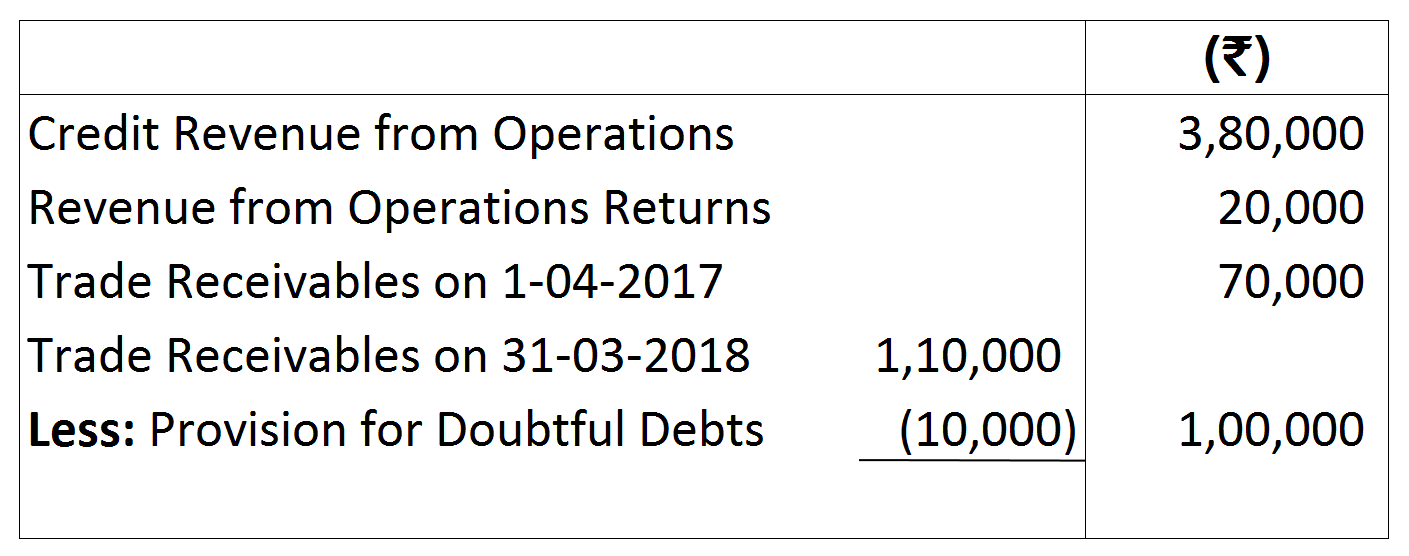
Calculate trade receivables turnover ratio from the following:

State, giving reason, what will be the effect of the following on trade receivables turnover ratio:
  1. Received ₹ 20,000 from a customer.
  2. Sale of goods on credit ₹ 30,000
  3. Cash Revenue from Operations ₹ 40,000
Answer
Trade Receivables Turnover Ratio $=\frac{\text{Credit Revenue from Operations}}{\text{Average Trade Receivables}}$
$=\frac{3,80,000 - 20,000}{\frac{1}{2}(70,000 + 1, 10,000)}=\frac{3,60,000}{90,000}=4\text{ Times}$
Provisions for Doubtful Debts are ignored while calculating trade receivables turnover ratio.
Effects on Trade Receivables Turnover Ratio:
Tr.
No.
Trade Receivables Turnover
Ratio will
Reason
i.
Increase
Receipt from trade receivables will decrease the closing trade receivables which will result in increase in trade receivables turnover ratio:
$\frac{3,60,000}{\frac{1}{2}(70,000+90,000)}=\frac{3,60,000}{80,000}=4.5\text{ times}$
ii.
Decrease
Credit revenue from operations will result in equal increase in Credit revenue from operations and Closing trade receivables which will result in decrease in trade receivables turnover ratio:
$\frac{3,90,000}{\frac{1}{2}(70,000+1,40,000)}=\frac{3,90,000}{1,05,000}=3.71\text{ Times}$
iii.
Not Alter
Neither the Credit revenue from operations nor the Trade Receivables are affected.
View full question & answer
Question 136 Marks
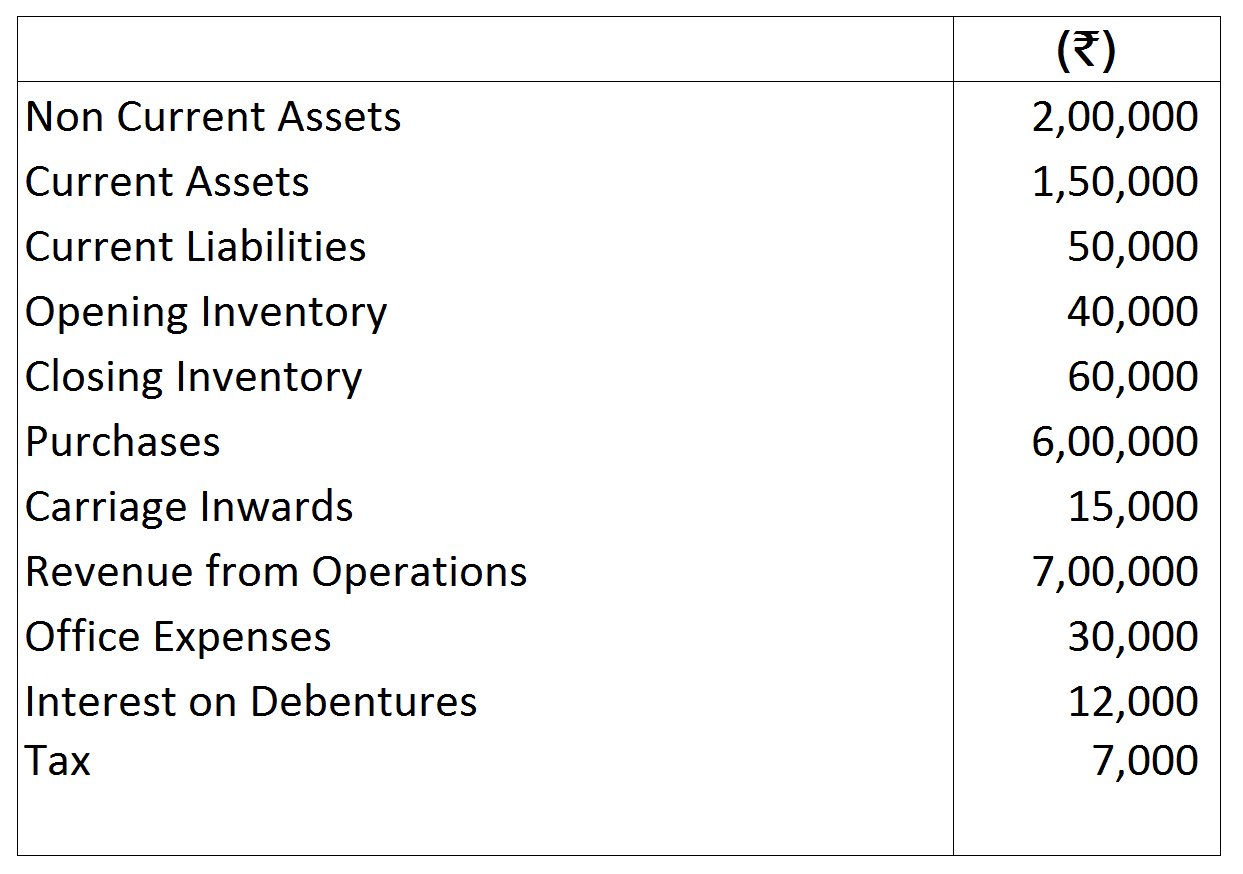
Calculate Return on Investment from the following:
Answer
Return on Investment or Capital Employed $=\frac{\text{Net profit before Interst & Tax}}{\text{Capital Employed }}\times100$
Net Profit before Interest = Gross Profit - Indirect Expenses (i.e., Office Expenses)
Gross Profit = Revenue from Operations -Cost of Revenue from Operations
Cost of Revenue from Operations = Opening Inventory + Purchases + Carriage Inwards - Closing Inventory
= ₹ 40,000 + ₹ 6,00,000 +₹ 15,000 - ₹ 60,000
= ₹ 5,95,000
Gross Profit = ₹ 7,00,000 - ₹ 5,95,000 = ₹ 1,05,000
Net Profit before Interest = Gross Profit - Office Expenses
= ₹ 1,05,000 - ₹ 30,000 = ₹ 75,000
Capital Employed = Non Current Assets + Current Assets - Current Liabilities
= ₹ 2,00,000 + ₹ 1,50,000 - ₹ 50,000
= ₹ 3,00,000
Return on Investment $=\frac{75,000}{3,00,000}\times100=25\%$
View full question & answer
Question 146 Marks
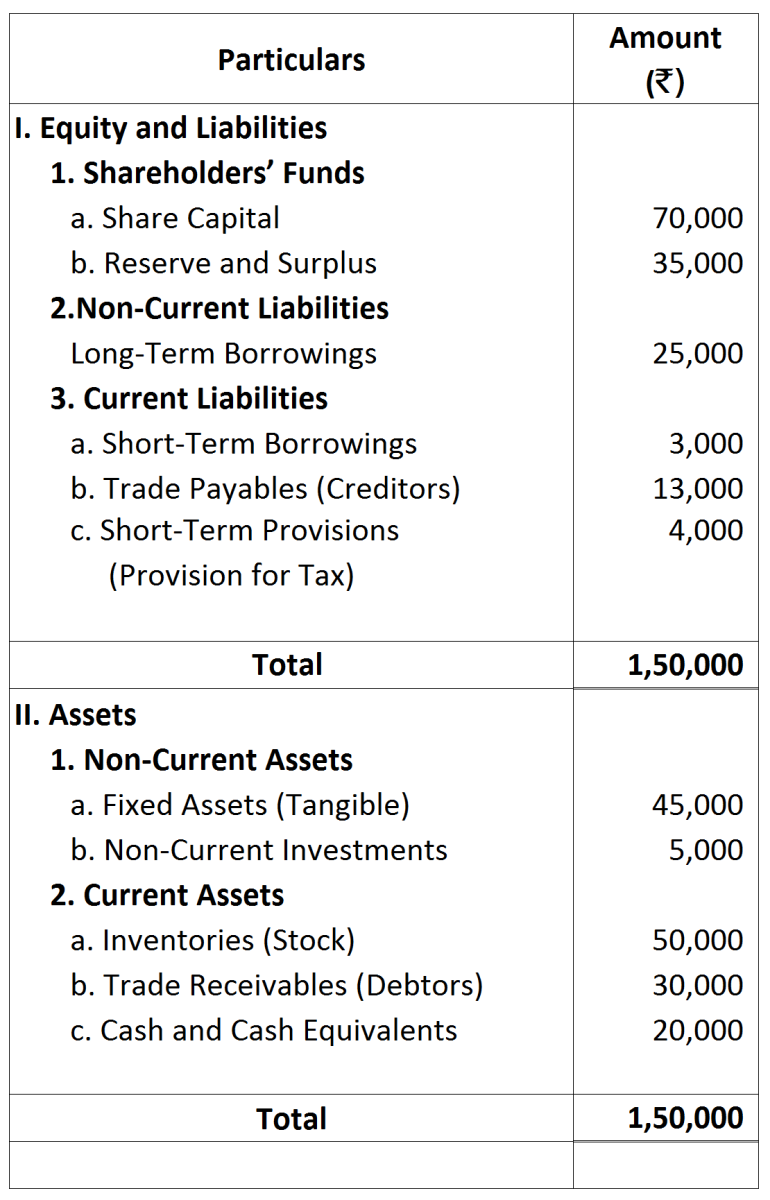
Following is the Balance Sheet of Crescent Chemical Works Limited as at 31st March, 2018:

Compute Current Ratio And Liquid Ratio.
Answer
Current Assets = Inventory + Trade Receivables + Cash and Cash Equivalents = 50,000 + 30,000 + 20,000 = 1,00,000 Current Liabilities = Short-term Borrowings + Trade Payables + Provision for Tax = 3,000 + 13,000 + 4,000 = 20,000 Quick Assets = Trade Receivables + Cash and Cash Equivalents = 30,000 + 20,000 = 50,000 $\text{Current Ratio}=\frac{\text{Current Assets}}{\text{Current Liabilities}}$ $=\frac{1,00,000}{20,000}=5:1$ $\text{Quick Ratio}=\frac{\text{Liquid Assets}}{\text{Current Liabilities}}$ $=\frac{50,000}{20,000}=2.5:1$Comments:
  1. Ideal Current Ratio for a business is considered to be 2 : 1. But in this case the ratio is quite high i.e. 5 : 1. This may be due to the following reasons:
  • Blockage of Funds in Stock.
  • High Amount outstanding from Debtors.
  • Huge Cash and Bank Balances.
  1. Ideal Quick Ratio of a business is supposed to be 1 : 1. This implies that Liquid Assets should be equal to the Current Liabilities. But in the given case Quick Ratio is 2.5 : 1 which indicates that the Liquid Assets are quite high in comparison to the Current Liabilities.
View full question & answer
Question 156 Marks
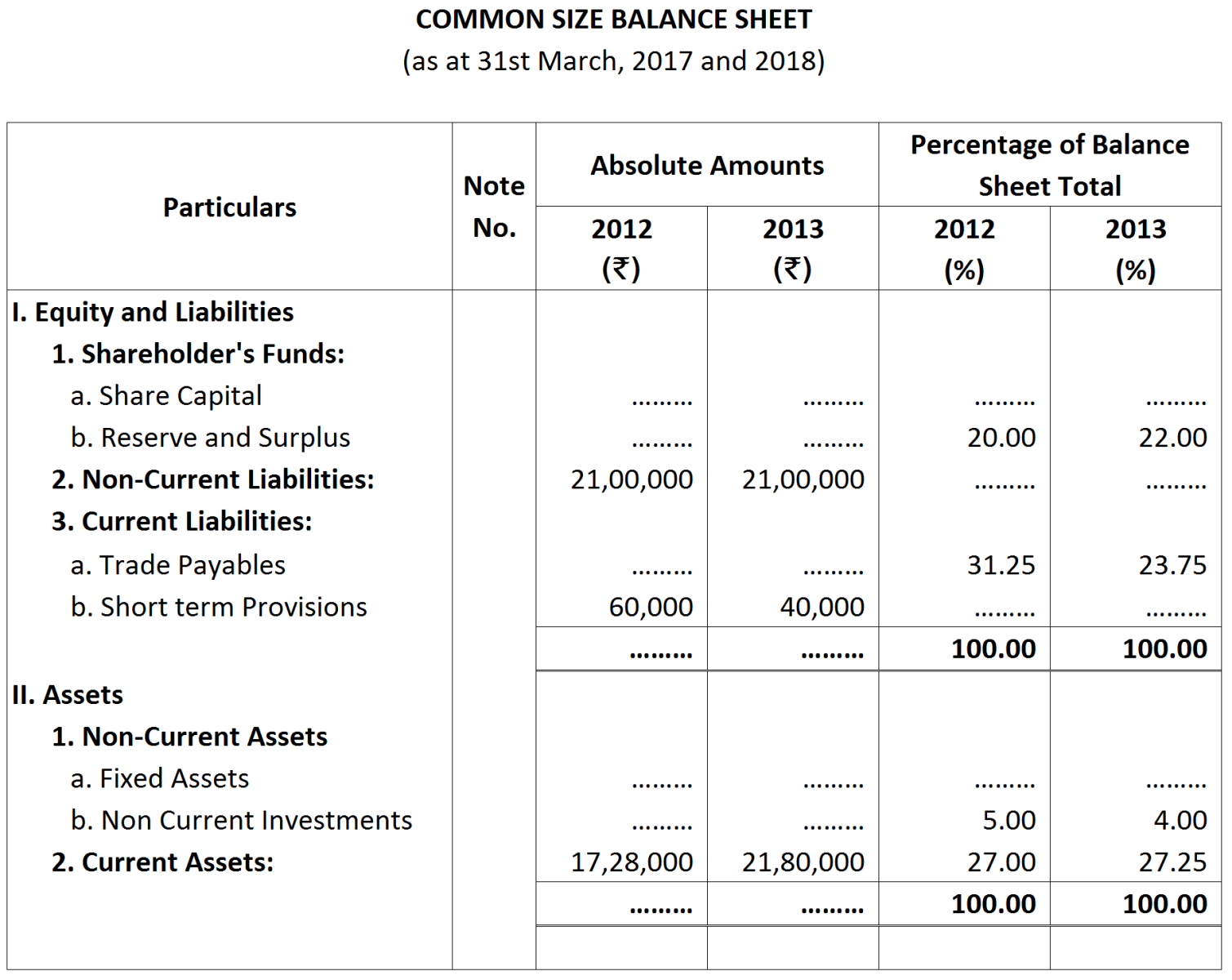
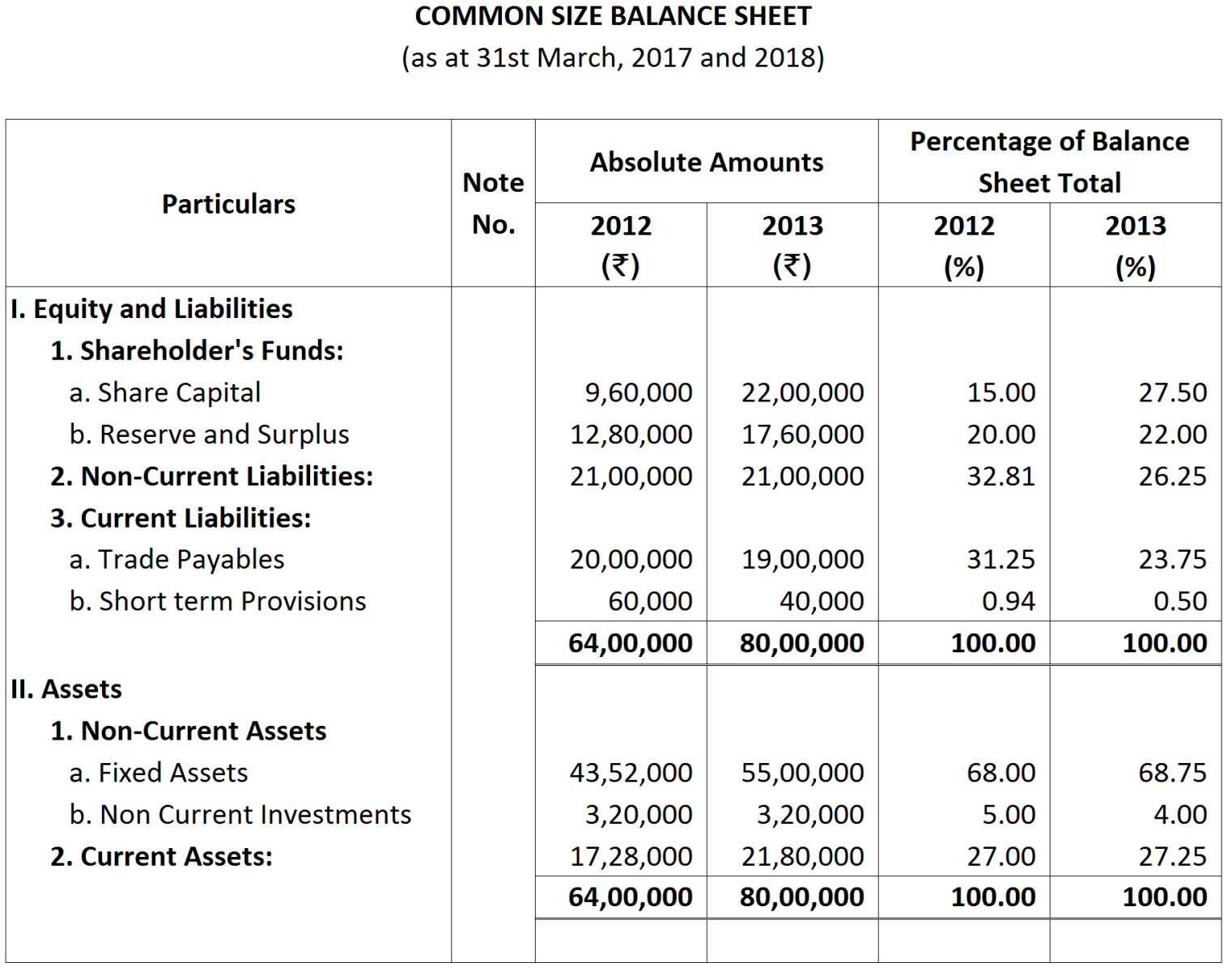
  1. you are required to fill in the missing figure in the following Commomn Size Balance Sheet:
  1. Also calculate the Debt Equity Ratio.
Answer
  1.  


Hint: First of all, missing figure of 'Total of Equity and Liabilities' (or Total of Assets) will be found out on the basis of Current Assets.
  1. Debt Equity Ratio : 2012 : 0.94 : 1
2013 : 0.53 : 1
View full question & answer
Question 166 Marks
Compute 'Trade Receivables Turnover Ratio' from the following information: Total Revenue from Operations ₹ 5,20,000, Cash Revenue from Operations 60% of the Credit Revenue from Operations, Closing Trade Receivables ₹ 80,000, Opening Trade Receivables are $\frac{3}{4}\text{th}$ of Closing Trade Receivables.
Answer
Trade Receivables Turnover Ratio $=\frac{\text{ Credit Revenue from Operations }}{\text{Average Trade Receivables}}$
  1. In order to ascertain the Trade Receivables Turnover Ratio, the figure of Credit Revenue from Operations will have to be ascertained. It is as follows:
If Credit Revenue from Operations are 100,

Cash Revenue from Operations will be 60

Therefore, Total Revenue from Operations will be 100 + 60 = 160

Again, if total Revenue from Operations are 160,

Credit Revenue from Operations = 100

If total Revenue from Operations are 5,20,000,

Credit Revenue from Operation $=\frac{100}{160}\times5,20,000= ₹\ 3,25,000$
  1. Opening Trade Receivable $=₹\ 80,000\times\frac{3}{4}=₹\ 60,000$
Average Trade Receivable $=\frac{₹\ 60,000+₹\ 80,000}{2}=₹\ 70,000$
  1. Trade Receivables Turnover Ratio $=\frac{3,25,000}{70,000}=4.64\text{ times}$
View full question & answer
Question 176 Marks
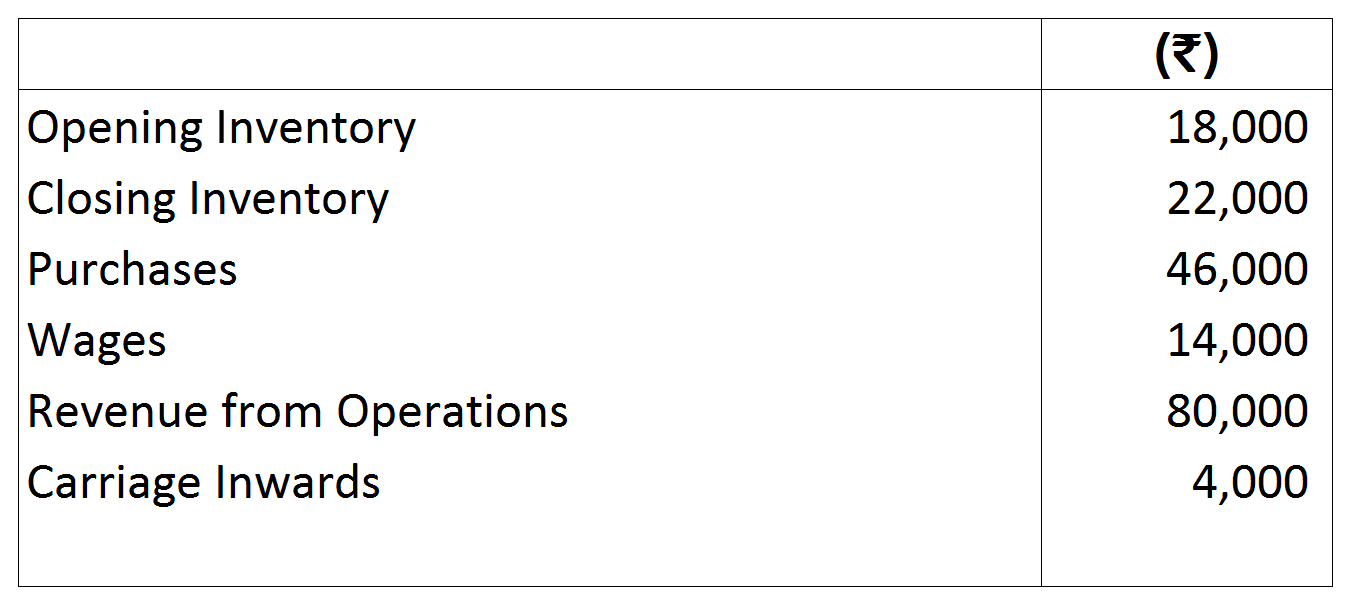
From the following informations, calculate the Inventory Turnover Ratio and the Gross Profit Ratio:
Answer
Inventory Turnover Ratio $= \frac{\text{Cost of Revenue from Operations}}{\text{Average Inventory}}$
Cost of Revenue from Operations Opening Inventory + Purchases +Wages+ Carriage Inwards - Closing Inventory
= ₹ 18,000 + ₹ 46,000 + ₹ 14,000 + ₹ 4,000 - ₹ 22,000
= ₹ 60,000
Average Inventory $=\frac{\text{Opening Inventory + Closing Inventory}}{2}$
$=\frac{ ₹\ 18,000+₹\ 22,000}{2}$
$=\frac{ ₹\ 40,000}{2}= ₹\ 20,000$
Inventory Turnover Ratio $=\frac{₹\ 60,000}{₹\ 20,000}=3\text{ times}$
Gross Profit Ratio $=\frac{\text{Gross Profit}}{\text{Net Revenue from Operations}}\times100$
Gross Profit = Revenue from Operations - Cost of Revenue from Operations
= ₹ 80,000 - ₹ 60,000
= ₹ 20,000
Gross Profit Ratio $=\frac{₹\ 20,000}{₹\ 80,000}\times100=25\%$
View full question & answer
Question 186 Marks
Quick Ratio of a company is 2 : 1. State giving reasons, which of the following transactions would (i) Improve, (ii) Reduce, (iii) Not change the Quick Ratio:
  1. Purchase of goods for cash
  2. Purchase of goods on credit
  3. Sale of goods (costing ₹ 10,000) for ₹ 10,000
  4. Sale of goods (costing ₹ 10,000) for ₹ 11,000
  5. Cash received from Trade Receivables.
Answer
Quick Ratio = 2 : 1
Let Quick Assets be = ₹ 20,000
Current Liabilities = ₹ 10,000
  1. Purchase of goods for Cash-Reduce
Reason: This transaction will result decrease in cash and increases in stock. Liquid Asset will decrease due payment for goods purchased.

Example: Purchase of goods ₹ 5,000 for cash

Quick Assets = 20,000 - 5,000 (Cash) = ₹ 15,000

Quick Ratio after Purchase of will be $=\frac{(20,000-5,000)}{10,000}=1.5:1$
  1. Purchase of goods on Credit-Reduce
Reason: Purchase of goods on credit will result increase in Current Liabilities and no change in Quick Assets.

Example: Purchase of goods on Credit ₹ 5,000

Current Liabilities = 10,000 + 5,000 (Creditors) = ₹ 15,000

Quick Ratio after Purchase of good on Credit $=\frac{(20,000)}{(10,000+5,000)}=1.33:1$
  1. Sale of goods for ₹ 10,000- Improve
Reason: Sale of goods will result in increase in Quick Assets by the amount of ₹ 10,000 in the form of either in cash or debtor. This transaction will result no change in current liabilities.

Quick Ratio after Sale of goods $=\frac{(20,000+10,000)}{(10,000)}=3:1$
  1. Sale of goods costing ₹ 10,000 of or ₹ 11,000-Improve
Reason: This transaction will increase the Quick Assets by ₹ 11,000 in the form of either in cash or debtors but no effect on the Current Liabilities.

Quick Assets after sale of goods = 20,000 + 11,000 = ₹ 31,000

Quick Ratio after Sale of goods $=\frac{(20,000+11,000)}{(10,000)}=3.1:1$
  1. Cash received from debtors-No change
Reason: This transaction results increase in one quick asset in the form of cash and decrease in other quick asset in the form of debtor with equal amount. Therefore it result in no change in the total of Quick Assets.

Example: Cash received from debtors ₹ 5,000

Quick Assets = 20,000 + 5,000 (Cash) - 5,000 (Debtors) = ₹ 20,000

Quick Ratio after case received from debtors $=\frac{(20,000-5,000+5,000)}{(10,000)}=2:1$
View full question & answer
Question 196 Marks
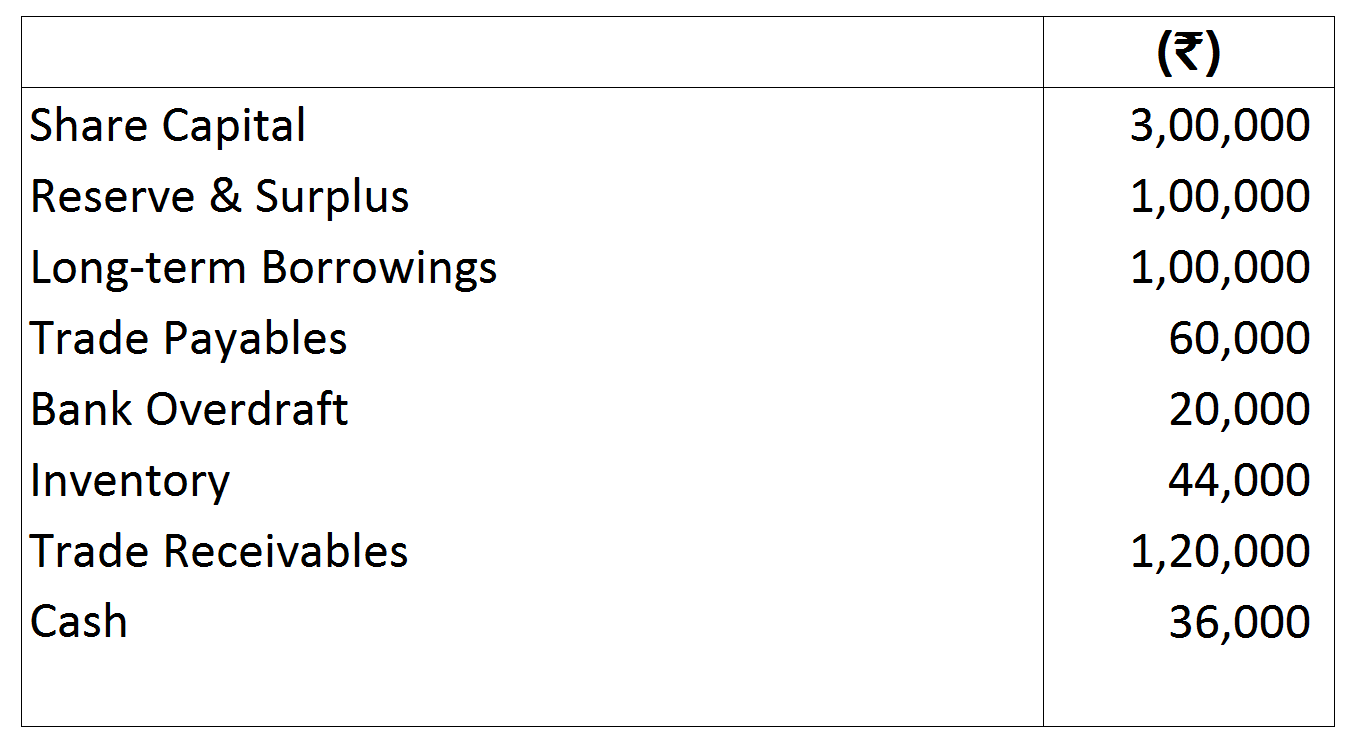
Following particulars are obtained from the books of A Ltd. as on 31.3.2018

You are required to calculate:
  1. Working Capital Ratio.
  2. Debt Equity Ratio.
  3. Trade Receivables Turnover Ratio if credit revenue from operations are ₹ 7,20,000.
Answer
  1. Working Capital Ratio (Current Ratio ) $=\frac{\text{Current Assets}}{\text{Current Liabilities}} $
Current Assets = Inventory + Trade Receivables + Cash

= ₹ 44,000 + ₹ 1,20,000 + ₹ 36,000

= ₹ 2,00,000

Current Liabilities = Trade Payables + Bank Overdraft

= ₹ 60,000 + ₹ 20,000

= ₹ 80,000

Working Capital Ratio $=\frac{₹\ 2,00,000}{₹\ 80,000}= 2.5:1$
  1. Debt Equity Ratio $=\frac{\text{Debts}}{\text{Equity}}$
$=\frac{\text{Long Term Borrowings}}{\text{Share Capital+ Reserves & Surplus}}$

$=\frac{₹\ 1,00,000}{₹\ 3,00,000 + ₹\ 1,00,000 }= \frac{₹\ 1,00,000}{₹\ 4,00,000}= 0.25:1$
  1. Trade Receivables Turnover Ratio $=\frac{\text{Credit Revenue from Operations}}{\text{Trade Receivables}}$
$=\frac{₹\ 7,20,000}{₹\ 1,20,000}= 6\text{ times}$
View full question & answer
Question 206 Marks
Opening Trade Receivables ₹ 3,60,000; Cash Revenue from Operations being 20% of Credit Revenue from Operations. Excess of Closing Trade Receivables over Opening Trade Receivables ₹ 60,000. Cost of Revenue from Operations ₹ 18,00,000; Gross a Profit ₹ 5,40,000. Calculate Trade Receivables Turnover Ratio.
Answer
Trade Receivables Turnover Ratio $=\frac{\text{Credit Revenue from Operations}}{\text{Trade Receivables}}$
Revenue from Operations = Cost of Revenue from Operations + Gross Profit
= ₹ 18,00,000 + ₹ 5,40,000 = ₹ 23,40,000
Ratio of Cash Revenue from Operations to Credit Revenue from Operations = 1 : 5
$\therefore$ Credit Revenue from Operations $=₹\ 23,40,000 \times \frac{5}{6} = ₹\ 19,50,000$
Closing Trade Receivables = Opening Trade Receivables + ₹ 60,000
= ₹ 3,60,000 + ₹ 60,000
= ₹ 4,20,000
Average Trade Receivables $=\frac{\text{Opening Trade Receivables + Closing Trade Receivables}}{2}$
$=\frac{₹\ 3,60,000 + ₹\ 4,20,000}{2}$
$=\frac{₹\ 7,80,000}{2} = ₹\ 3,90,000$
Trade Receivables Turnover Ratio $=\frac{₹\ 19,50,000}{₹\ 3,90,000}= 5 \text{ times}$
View full question & answer
Question 216 Marks
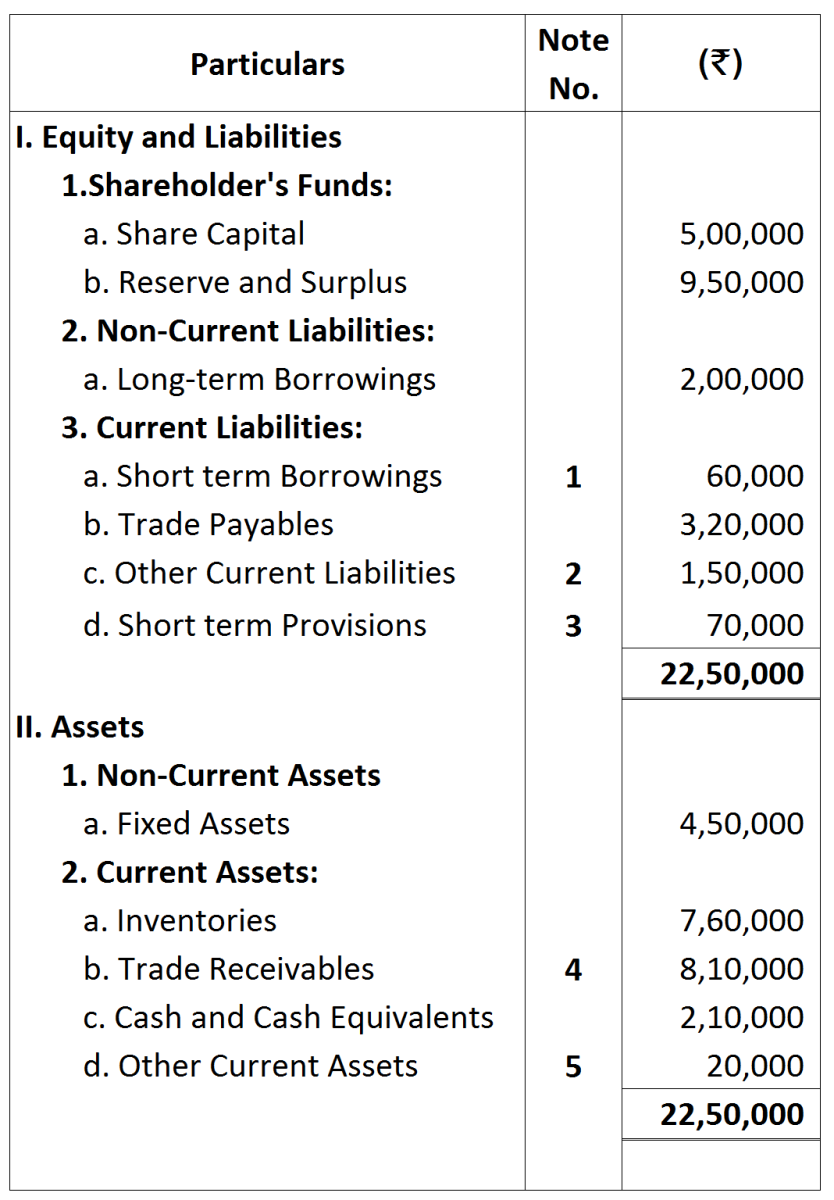
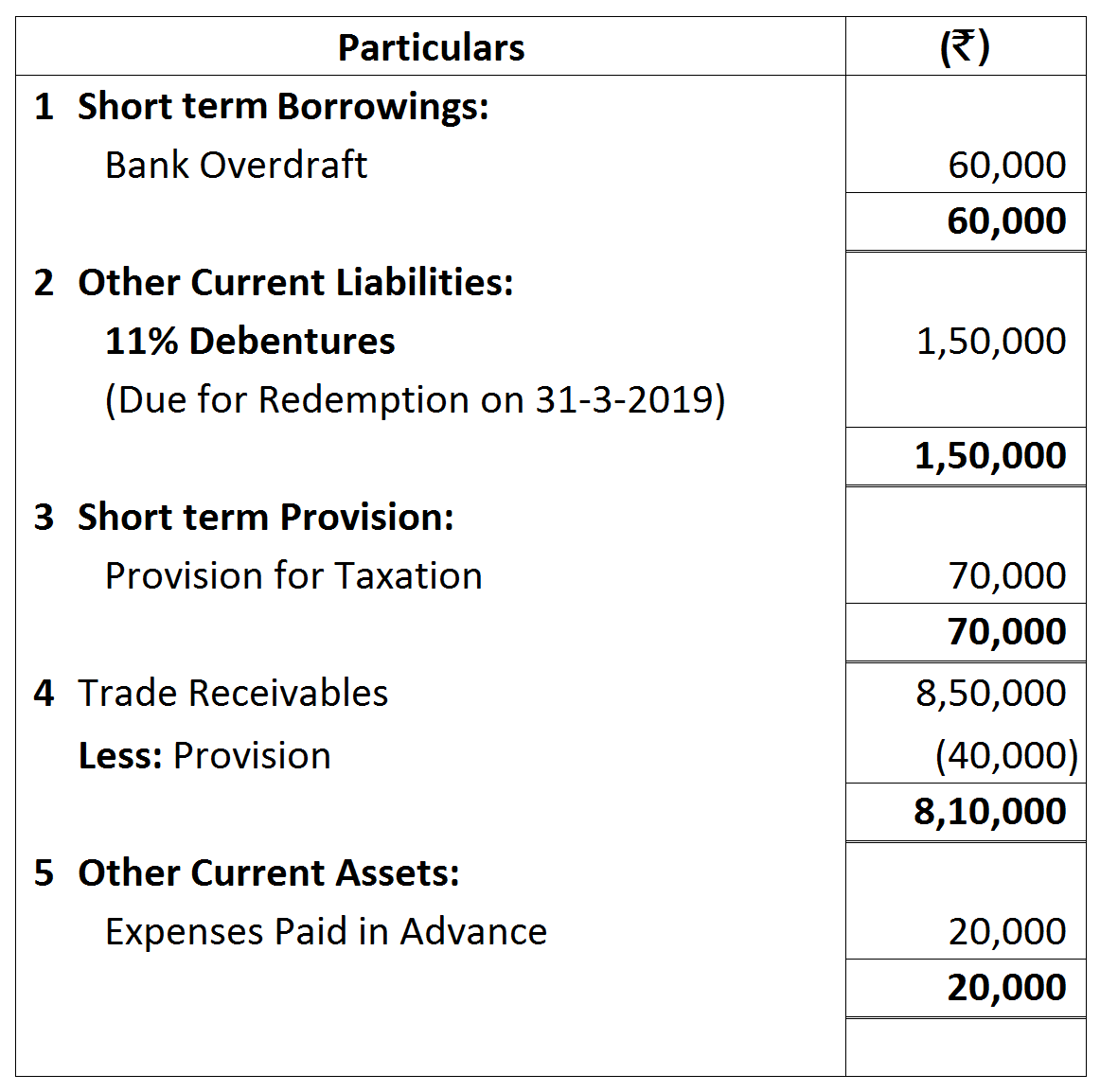
Following is the Balance Sheet of Vikas Ltd. as at 31st March, 2018 Note:
Throw light on the short-term financial position of the Company with the help of suitable ratios.
Answer
Short-term financial position can be ascertained by analysing its Liquidity Ratios. Liquidity Ratios include the following two ratios:
  1. Current Ratio.
  2. Quick Ratio.
  1. Current Ratio $=\frac{\text{Current Assets}}{\text{Current Liabilities}}$
Current Assets = Inventory + Trade Receivables + Cash & Cash Equivalents + Expenses paid in Advance.

= ₹ 7,60,000 + ₹ 8,10,000 + ₹ 2,10,000 + ₹ 20,000

= ₹ 18,00,000

Current Liabilities = 11% Debentures (Due for Redemption on 31.3.2019 + Bank Overdraft + Trade Payables + Provision for Taxation.

= ₹ 1,50,000 + ₹ 60,000 + ₹ 3,20,000 + ₹ 70,000

= ₹ 6,00,000

Current Ratio$=\frac{₹\ 18,00,000}{₹\ 6,00,000}= 3:1$
  1. Quick Ratio $=\frac{\text{Liquid Assets}}{\text{Current Liabilities}}$
Liquid Assets = Trade Receivables + Cash & Cash Equivalents

= ₹ 8,10,000 + ₹ 2,10,000 = ₹ 10,20,000

Quick Ratio $=\frac{₹\ 10,20,000 }{₹\ 6,00,000} =1.7:1$
View full question & answer
Question 226 Marks
Opening Inventory ₹ 29,000; Purchases ₹ 2,42,000; Revenue from Operations ₹ 3,20,000; Gross Profit Ratio is 25% on revenue from operations. Calculate Inventory Turnover ratio.
Answer
Inventory Turnover Ratio $=\frac{\text{Cost of Revenue from Operations }}{\text{Average Inventory}}$
Cost of Revenue from Operations = Revenue from Operations - Gross Profit
= ₹ 3,20,000 - 25% of 3,20,000
= ₹ 3,20,000 - ₹ 80,000
= ₹ 2,40,000
Calculation of Closing Inventory:
Cost of Revenue from Operations = Opening Inventory + Purchases - Closing Inventory
Hence, Closing Inventory = Opening Inventory + Purchases - Cost of Revenue from Operations
= 29,000 + 2,42,000 - 2,40,000
= 31,000
Average Inventory $=\frac{\text{Opening Inventory}+\text{Closing Inventory}}{2}$
Average Inventory $=\frac{₹\ 29,000\ +\ ₹\ 31,000}{2}$
Average Inventory $=\frac{₹\ 60,000}{2}=₹\ 30,000$
Inventory Turnover Ratio $=\frac{₹\ 2,40,000}{₹\ 30,000}=8\text{ times}$
View full question & answer
Question 236 Marks
Assuming that the Debt to Equity Ratio is 2 : 1, state giving reasons, which of the following transactions would (i) Increase; (ii) Decrease; (iii) Not alter Debt to Equity Ratio:
  1. Issue of new shares for cash.
  2. Conversion of debentures into equity shares.
  3. Sale of a fixed asset at profit.
  4. Purchase of a fixed asset on long-term deferred payment basis.
  5. Payment to creditors.
Answer
Let’s take Debt and Equity as ₹ 2,00,000 and ₹ 1,00,000
$\text{Debt to Equity Ratio}=\frac{\text{Debt}}{\text{Equity}}$
$=\frac{2,00,000}{1,00,000}=2:1$
  1. Issue of new shares for cash (say ₹ 50,000)
Debt to Equity Ratio $=\frac{2,00,000}{1,00,000+50,000}=1.33:1\text{ (Decrease)}$
  1. Conversion of debentures into equity shares (say ₹ 50,000)
Debt to Equity Ratio $=\frac{2,00,000}{1,00,000+50,000}=1.33:1\text{ (Decrease)}$
  1. Sale of a fixed asset at profit (say ₹ 50,000 profit)
Debt to Equity Ratio $=\frac{2,00,000}{1,00,000+50,000}=1.33:1\text{ (Decrease)}$
  1. Purchase of fixed asset on long term payment basis (say ₹ 50,000)
Debt to Equity Ratio $=\frac{2,00,000+50,000}{1,00,000}=2.5:1\text{ (Increase)}$
  1. Payment to creditors (say ₹ 50,000)
Debt to Equity Ratio $=\frac{2,00,000}{1,00,000}=2:1\text{ (No Change)}$
View full question & answer
Question 246 Marks
Calculate G.P. Ratio from the following:
Cash Revenue from Operations are $\frac{1}{3}\text{rd}$ of total Revenue from Operations. Cash Revenue from Operations were ₹ 6,00,000; Credit Purchases are 25% of total purchases. Credit Purchases were ₹ 3,00,000. Opening Inventoryt ₹ 1,00,000; Closing Inventory was ₹ 50,000 more than Opening Inventory. Carriage ₹ 15,000. Wages ₹ 35,000.
Answer
If Cash Revenue from Operations is ₹ 1
Total Revenue from Operations will be = ₹ 3
If Cash Revenue from Operations is ₹ 6,00,000
Total Revenue from Operations will be $=\frac{3}{1}\times₹ \ 6,00,000$
$= ₹ \ 18,00,000$
If Credit Purchase is ₹ 25
Total Purchase will be = ₹ 100
If Credit Purchase is ₹ 3,00,000Total Purchase will be $=\frac{100}{25}\times₹ \ 3,00,000$
$= ₹ \ 12,00,000$
Cost of Revenue from Operations = Purchases+ Carriage+ Wages - Excess of Closing Inventory over Opening Inventory
= ₹ 12,00,000 + ₹ 15,000 + ₹ 35,000 - ₹ 50,000
= ₹ 12,00,000
Gross Profit = Revenue from Operations - Cost of Revenue from Operations
= ₹ 18,00,000 - ₹ 12,00,000
= ₹ 6,00,000
Gross Profit Ratio $=\frac{\text{Gross Profit}}{\text{Net Revenue from Operations}}\times100$
$=\frac{₹ \ 6,00,000}{₹ \ 18,00,000}\times100=33.33\%$
View full question & answer
Question 256 Marks
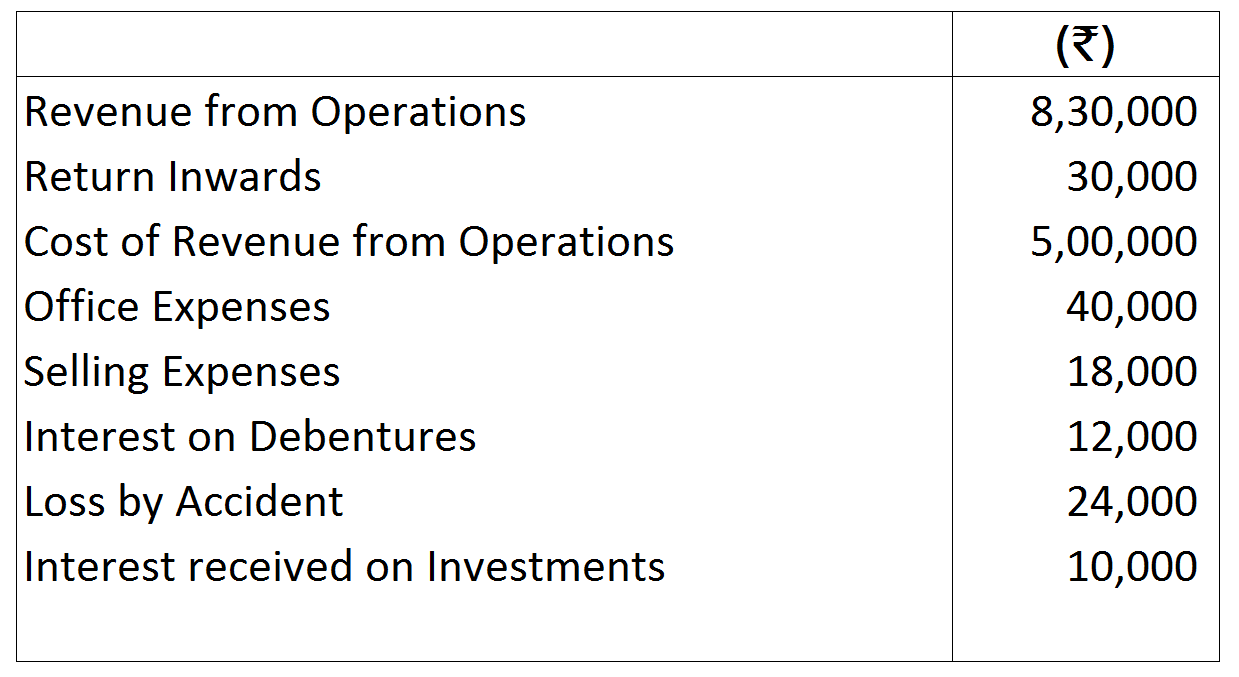
Calculate:
  1. Operating Profit Ratio.
  2. Net Profit Ratio from the following.
​​​​​​​
Answer
  1. Operating Profit Ratio $=\frac{\text{Operating Profit}}{\text{Net Revence from Operations}}\times100$
Operating Profit = G.p - Other Operating Exp. (i.e. Office Exp. and Selling Exp.)

G.p. = Revenue from Operations - Returns Inwards - Cost OF Revenue from Operations

= ₹ 8,30,000 - ₹ 30,000 - ₹ 5,00,000 = ₹ 3,00,000

Other Operating Exp. = Office Exp. + Selling Exp.

= ₹ 40,000 + ₹ 18,000 = ₹ 58,000

Operating Profit Ratio $=\frac{ ₹\ 3,00,000- ₹\ 58,000}{ ₹\ 8,00,000}\times100 =30.25\%$
  1. Net Profit Ratio $​​​​​=\frac{​​\text{Net Prof}}{\text{Revenue from Operations}}\times100$
Net Profit = G.P. - Indirect Exp. & Losses + Other Incomes

= ₹ 3,00,000 - ₹ 40,000 - ₹ 18,000 - ₹ 12,000 + ₹ 24,000 - ₹ 10,000 =₹ 2,16,000

Net Profit Ratio $=\frac{₹\ 2,16,000}{₹\ 8,00,000}\times=27\%$
View full question & answer
Question 266 Marks
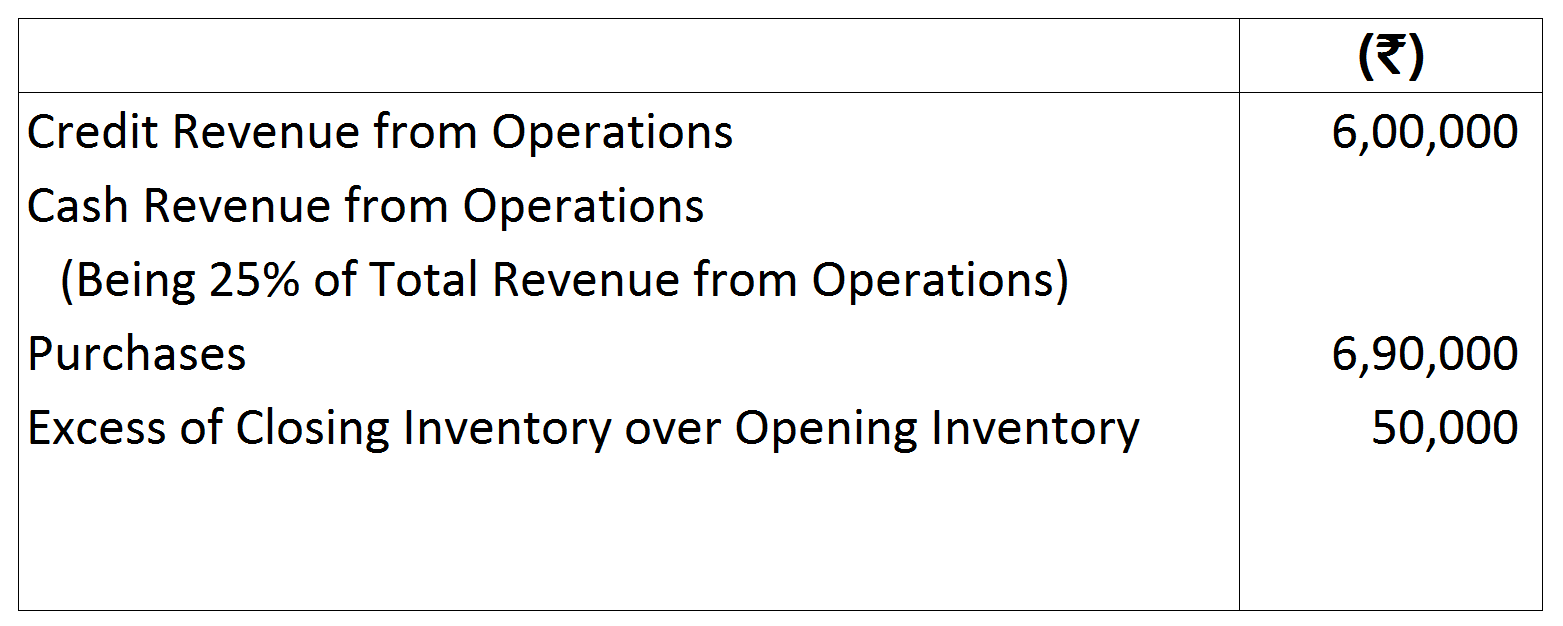
Calculate G.P. Ratio from the following:
Answer
If Total Revenue from Operations is ₹ 100, Cash Revenue from Operations will be ₹ 25 and Credit Revenue from Operations ₹ 75
Hence,
If Credit Revenue from Operations is ₹ 75
Total Revenue from Operations will be = ₹ 100
If Credit Revenue from Operations is ₹ 6,00,000
Total Revenue from Operations will be $=\frac{100}{75}\times ₹\ 6,00,000$
Cost of Revenue from Operations = Purchases - Excess of Closing Inventory over Opening Inventory
= ₹ 6,90,000 - ₹ 50,000 = ₹ 6,40,000
Gross Profit = Total Revenue from Operations - Cost of Revenue from Operations
= ₹ 8,00,000- ₹ 6,40,000 = ₹ 1,60,000
Gross Profit Ratio $=\frac{\text{Gross Profit}}{\text{Net Revenue from Operations}}\times100$
$=\frac{₹\ 1,60,000}{₹\ 8,00,000}\times100= 20\%$
View full question & answer
Question 276 Marks
Calculate Operating Profit Ratio and Operating Ratio from the following:
Net Revenue from Operations ₹ 3,00,000; Gross Profit ₹ 1,20,000; Operating Expenses ₹ 45,000.
Answer
Operating Profit Ratio $=\frac{\text{Operating Profit}}{\text{Net Revenue from Operations }}\times100$ Operating Profit = Gross Profit - Operating Expenses = ₹ 1,20,000 + ₹ 45,000 = ₹ 75,000 $=\frac{₹\ 75,000}{₹\ 3,00,000}\times100=25\%$ Operating Ratio $=\frac{\text{Cost of Revenue from Operations + Operating Expenses}}{\text{Net Revenue from Operations}}\times100$Cost of Revenue from Operations = Net Revenue from Operations - Gross Profit
= ₹ 3,00,000 - ₹ 1,20,000
= ₹ 1,20,000
Operating Ratio $=\frac{₹\ 1,80,000+₹\ 45,000}{₹\ 3,00,000 }\times100$
$=\frac{₹\ 2,25,000}{₹\ 3,00,000}\times100=75\%$
View full question & answer
Question 286 Marks
State with reason, whether the Proprietary Ratio will improve, decline or will not change because of the following transactions if Proprietary Ratio is 0.8 : 1:
  1. Obtained a loan of ₹ 5,00,000 from State Bank of India payable after five years.
  2. Purchased machinery of ₹ 2,00,000 by cheque.
  3. Redeemed 7% Redeemable Preference Shares ₹ 3,00,000.
  4. Issued equity shares to the vendor of building purchased for ₹ 7,00,000.
  5. Redeemed 10% redeemable debentures of ₹ 6,00,000.
Answer
 
Transaction
Impact
(i)
Obtained a loan of ₹ 5,00,000 from State Bank of India payable after five years.
Total assets increase by 5,00,000 (as cash is coming in). However, since shareholders' funds remain unchanged, therefore proprietary ratio will decrease.
(ii)
Purchased machinery of ₹ 2,00,000 by cheque.
Total assets are increasing and decreasing by 2,00,000 simultaneously (as cash is going out and machinery is coming in). Thus, both numerator and denominator remain unchanged and so proprietary ratio will not change.
(iii)
Redeemed 7% Redeemable Preference Shares ₹ 3,00,000.
Both shareholders' funds and total assets decrease by 3,00,000 simultaneously and so proprietary ratio will decrease.
(iv)
Issued equity shares to the vendor of building purchased for ₹ 7,00,000.
Both shareholders' funds and total assets increase by 7,00,000 simultaneously and so proprietary ratio will improve.
(v)
Redeemed 10% redeemable debentures of ₹ 6,00,000
Total assets decrease by 6,00,000 (as cash is going out). However, since shareholders' funds remain unchanged, therefore proprietary ratio will improve.
View full question & answer
Question 296 Marks
The ratio of Current Assets (₹ 9,00,000) to Current Liabilities is 1.5 : 1. The accountant of this firm is interested in maintaining a Current Ratio of 2 : 1 by paying some part of Current Liabilities. You are required to suggest him the amount of Current Liabilities which must be paid for this purpose.
Answer
Current Ratio $=\frac{\text{Current Assets}}{\text{Current Liabilities}}$ 1.5 (Given) $=\frac{₹\ 9,00,000\text{(Given)}}{\text{Current Liabilities}}$ $\therefore$ Current Liabilities $=\frac{₹\ 9,00,000}{1.5}= ₹\ 6,00,000$In order to increase Current Ratio, Current Liabilities must be paid. But payment of Current Liabilities will result in equivalent reduction in the amount of Current Assets as well as Current Liabilities. Let's assume the amount to be paid as x. After the payment of Current Liabilities of ₹ x.
Current Liabilities = ₹ 6,00,000 - x
Current Assets = ₹ 9,00,000 - x
Current Ratio $=\frac{\text{Current Assets}}{\text{Current Liabilities}}$ 2 (Ratio to be maintained) $=\frac{₹\ 9,00,000-\text{x}}{₹\ 6,00,000-\text{x}}$ ₹ 12,00,000 - 2x = ₹ 9,00,000 - x x = ₹ 3,00,000 Therefore, Current Liabilities off ₹ 3,00,000 must be paid to maintain the Current Ratio of 2 : 1.
View full question & answer
Question 306 Marks
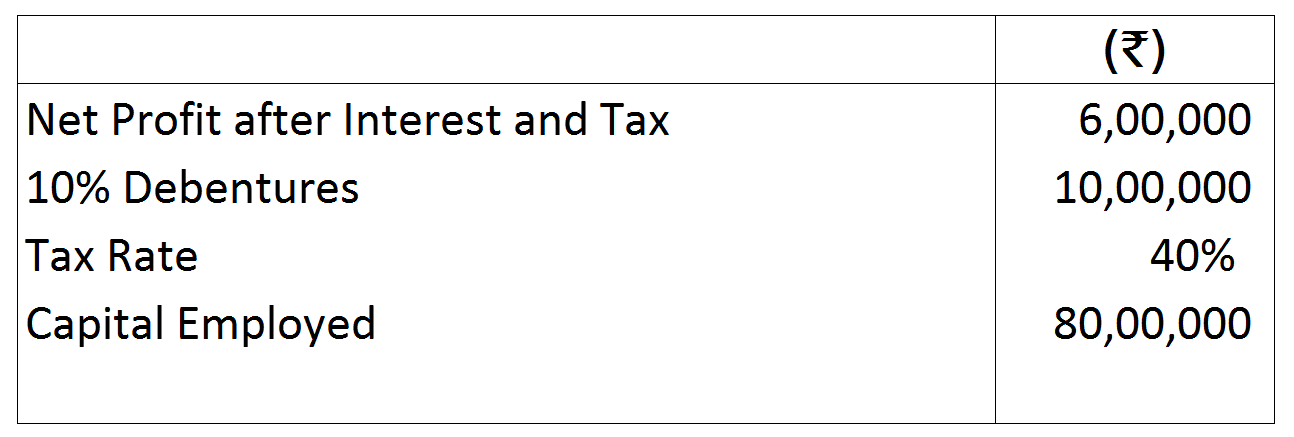
Calculate 'Return on Investment' and 'Debt to Equity Ratio' from the following information:
Answer
  1. Return on Investment $=\frac{\text{Net Profit before Interest and Tax}}{\text{Capital Employed}}\times100$
Calculation of Net Profit before Interest and Tax:

Net Profit after Tax = ₹ 6,00,000

Net Profit before Tax $=6,00,000\times\frac{100}{60}=₹\ 10,00,000$

Net Profit before Interest and Tax = ₹ 10,00,000 + Interest ₹ 1,00,000

= ₹ 11,00,000

Return on Investment $=\frac{11,00,000}{80,00,000}\times100=13.75\%$
  1. Debt Equity Ratio $=\frac{\text{Debt}}{\text{Equity}}$
Debt = 10% Debentures = ₹ 10,00,000

Equity = Capital Employed - Debt

= ₹ 80,00,000 - ₹ 10,00,000 = ₹ 70,00,000

Debt Equity Ratio $=\frac{10,00,000}{70,00,000}=0.14:1$
View full question & answer
Question 316 Marks
Calculate current assets of a company from the following information:
  1. Inventory turnover 4 times.
  2. Inventory in the end is ₹ 20,000 more than inventory in the beginning.
  3. Revenue from Operations ₹ 3,00,000.
  4. Gross profit ratio 20%.
  5. Current liabilities ₹ 40,000.
  6. Quick ratio 0.75.
Answer
Current Assets = Liquid Assets+ Closing Inventory With the help of Quick Ratio, we can find out Liquid Assets: Quick Ratio $=\frac{\text{Liquid Assets}}{\text{Current Liabilities}}$ $0. 75 \text{(Given)}=\frac{\text{Liquid Assets}}{₹\ 40,000}$ or Liquid Assets = ₹ 40,000 × 0.75 = ₹ 30,000 With the help of Inventory Turnover Ratio, we can find out Closing Inventory: Inventory Turnover Ratio $=\frac{\text{Cost of Revenue from Operations}}{\text{Average Inventory}}$ $4 \text{(Given)}=\frac{\text{(Revenue from Operations - Gross Profit)}}{\text{Average Inventory}}$ Average Inventory $= \frac{(₹\ 3,00,000- 20\% \text{of}\ ₹\ 3,00,000)}{4}$ Average Inventory $= \frac{₹\ 2,40,000}{4} = ₹\ 60,000$ Closing Inventory $= ₹\ 60,000 +\frac{1}{2}\text{of}\ ₹\ 20,000$ = ₹ 60,000 + ₹ 10,000= ₹ 70,000
Current Assets = Liquid Assets + Inventory = ₹ 30,000 + ₹ 70,000 = ₹ 1,00,000
View full question & answer
Question 326 Marks
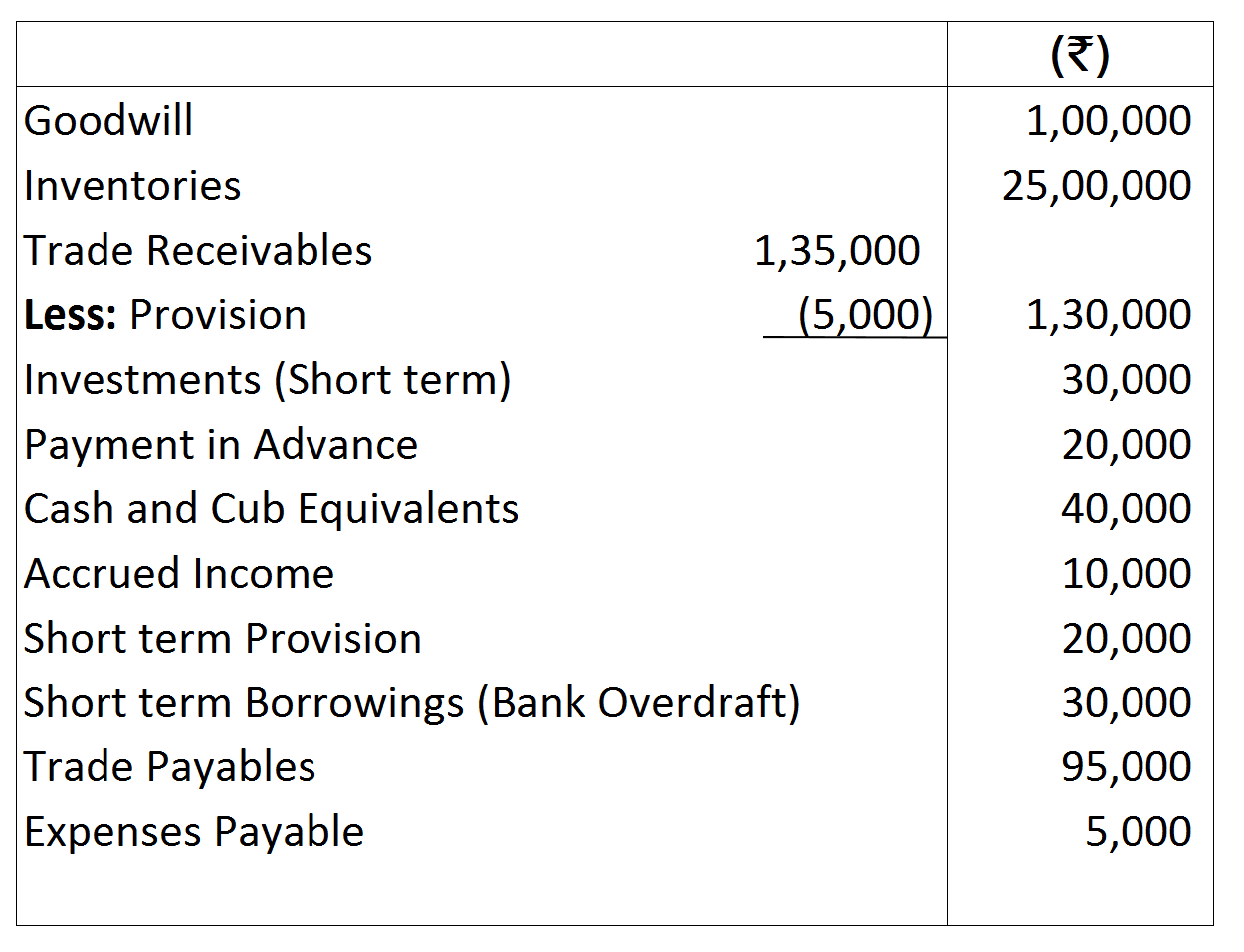
Following particulars are given to you:

Calculate the Current Ratio and Quick Ratio. What Conclusions do you draw from these ratios?
Answer
  1. Current Ratio $=\frac{\text{Current Assets}}{\text{Current Liabilities}}$
Current Assets = Inventories + Trade Receivables + Short Term Investments + Payment in Advance + Cash & Cash Equivalents + Accrued Income.

= ₹ 2,50,000 + ₹ 1,30,000 + ₹ 30,000 + ₹ 20,000 + ₹ 40,000 = ₹ 10,000

= ₹ 4,80,000

Current Liabilities = Short term Provision + Short term Borrowings + Trade Payables + Expenses Payable.

= ₹ 20,000 + ₹ 30,000 + ₹ 95,000 + ₹ 5,000

= ₹ 1,50,000

Current Ratio $=\frac{₹\ 4,80,000}{₹\ 1,50,000}=3.2:1$
  1. Quick Ratio $=\frac{\text{Liquid Assets}}{\text{Current Liabilities}}$
Liquid Assets = Current Assets - Inventories - Payment in advance.

= ₹ 4,80,000 - ₹ 2,50,000 - ₹ 20,000

= ₹ 2,10,000

Quick Ratio $=\frac{₹\ 2,10,000}{₹\ 1,50,000}=1.4:1$
View full question & answer
Question 336 Marks
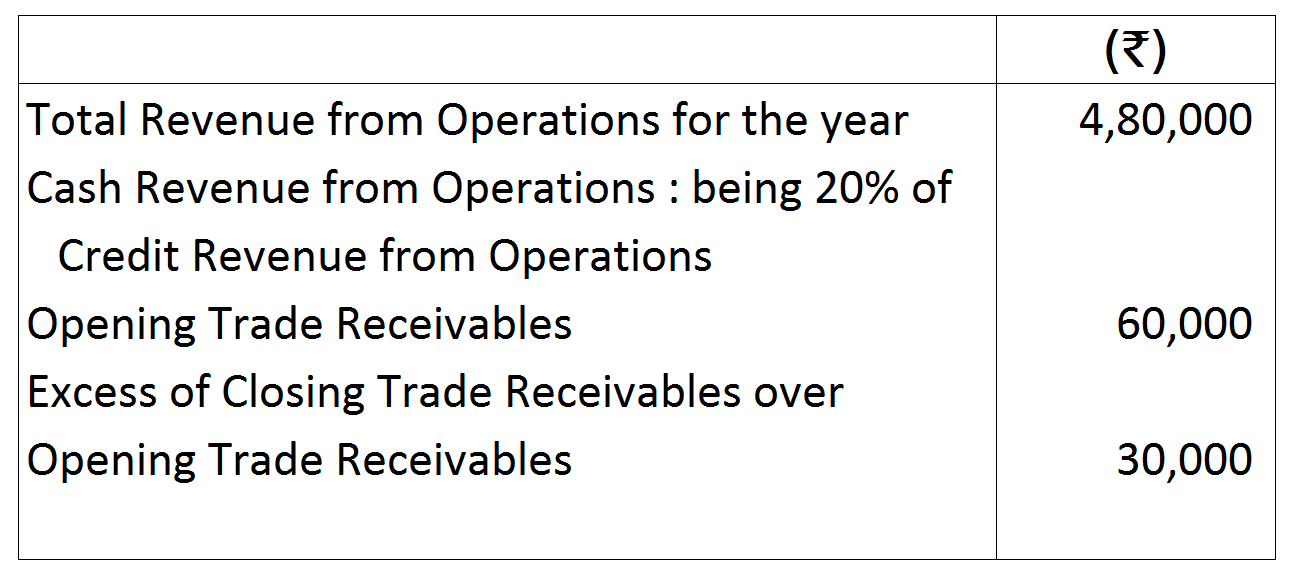
Calculate Trade Receivables Turnover Ratio and Average Collection Period from the following:
Answer
In order to ascertain the Trade Receivables Turnover Ratio, the figure of Credit Revenue from Operations will have to be ascertained. It is as follows:
If Credit revenue from operations are 100, Cash revenue from operations will be 20
Therefore, Total revenue from operations will be 100 + 20 = 120
Again, If total revenue from operations are 120
Credit revenue from operations = 100
If total revenue from operations are 4,80,000
Credit revenue from operations $=\frac{100}{120}\times4,80,000=₹\ 4,00,000$
Closing Trade Receivables = Opening Trade Receivables + Excess of Closing Trade Receivables over Opening Trade Receivables
= 60,000 + 30,000 = ₹ 90,000
Average Trade Receivables $=\frac{\text{Opening Trade Receivables + Closing Trade Receivables}}{2}$
$=\frac{₹\ 60,000+₹\ 90,000}{2}=₹\ 75,000$
Trade Receivables Turnover Ratio $=\frac{\text{Credit Revenue from Operations}}{\text{Average Trade Receivables}}$
$=\frac{₹\ 4,00,000}{₹\ 75,000}=5.33\text{ Times}$
Average Collection Period $=\frac{\text{Days in a year}}{\text{Trade Receivables Turnover Ratio}}$
$=\frac{365}{5.33}=68.48 \text{ days or 69 days}$
It is to be noted that any fraction of a day such as .48 would, in practice, mean that the payment will be received next day.
Hence, in the above case, 68.48 days would imply 69 days.
View full question & answer
Question 346 Marks
The Current Ratio of a Company is 0.8 : 1. State giving reasons which of the following transactions would.
  1. Improve.
  2. Reduce.
  3. Not change; The Current Ratio.
  1. Payment of Outstanding Liabilities.
  2. Purchase of goods on Credit.
  3. Sale of furniture costing ₹ 10,000 at a loss of ₹ 2,000.
  4. Sale of goods costing ₹ 10,000 at a profit of ₹ 1,000.
  5. Payment of dividend payable.
Answer
Statement showing the effect of various transactions on Current Ratio:
Tr.No.
Current Ratio will
Reasons
(a)
Reduce.
Since current ratio is 0.8 : 1 which is less than one and both the current assets and current liabilities are decreased by the same amount.
(b)
Improve.
Since current ratio is less than one and both the current assets and current liabilities are increased by the same amount.
(c)
Improve.
Current liabilities remain unchanged but current assets are increased.
(d)
Improve.
Current liabilities remain unchanged but current assets are increased by the amount of profit.
(e)
Reduce.
Since current ratio is less than one and both the current assets and current liabilities are decreased by the same amount.
View full question & answer
Question 356 Marks
The debt-equity ratio of a company is 1 : 2. Which of the following suggestions would increase, decrease or not change it?
  1. Issue of Equity Shares.
  2. Cash Received from Trade Receivables.
  3. Sale of Goods on Cash Basis.
  4. Repayment of long term borrowings.
  5. Purchased Goods on Credit.
Answer
Debt-Equity Ratio $=\frac{\text{Debt}}{\text{Equity}}\text{ or }\frac{\text{Long term Debts}}{\text{Shareholder's Funds}}$
In the above question, Debt-Equity Ratio is given as 1 : 2, therefore, it may be assumed that Long-term Debts are ₹ 1,00,000 and Shareholder's Funds are ₹ 2,00,000.
  1. Issue of Equity Shares: Suppose Equity Shares worth ₹ 1,00,000 are issued then by the issue of equity shares, shareholder's funds will be increased and will stand at ₹ 2,00,000 + ₹ 1,00,000 = ₹ 3,00,000. Therefore, the revised ratio will be:
$\frac{₹\ 1,00,000}{₹\ 3,00,000}=0.33:1$

Before the issue of equity shares the ratio was 1 : 2 (or 0.5 : 1) which is now reduced to 0.33 : 1. It means that the ratio has decreased.

Therefore, it can be concluded that increase in shareholder's funds decreases the ratio.
  1. Cash Received from Trade Receivables: By receiving cash from Trade Receivables there will be affect on the cash and trade receivables only.
Hence, there will be no change in debt-equity ratio because neither the long-term debts nor the Shareholder's Funds are affected.
  1. Sale of Goods on Cash Basis: Goods sold on Cash will affect only the Inventories and Cash.
Hence, there will be no change in debt-equity ratio because neither the long-term debts nor the Shareholder's Funds are affected.
  1. Repayment of Long term Borrowings: Suppose there is repayment of long term borrowings for ₹ 50,000 then by the repayment of long term. borrowings of ₹ 50,000, Long-term Debts will be reduced by ₹ 50,000 and these will stand at ₹ 1,00,000 - ₹ 50,000 = ₹ 50,000. Therefore, the revised ratio will be:
$\frac{₹\ 50,000}{₹\ 2,00,000}=0.25:1$

Before the repayment of long term borrowings, the ratio was 1 : 2 (or 0.5 : 1) which is now reduced to 0.25 : 1. It means that the ratio has decreased.

Therefore, it can be concluded that decrease in long-term debts decreases this ratio.
  1. Purchase of Goods on Credit: Goods Purchased on credit will affect only the inventories and trade payables.
Hence, there will be no change in debt-equity ratio because neither the long-term debts nor the Shareholder's Funds are affected.
View full question & answer
Question 366 Marks
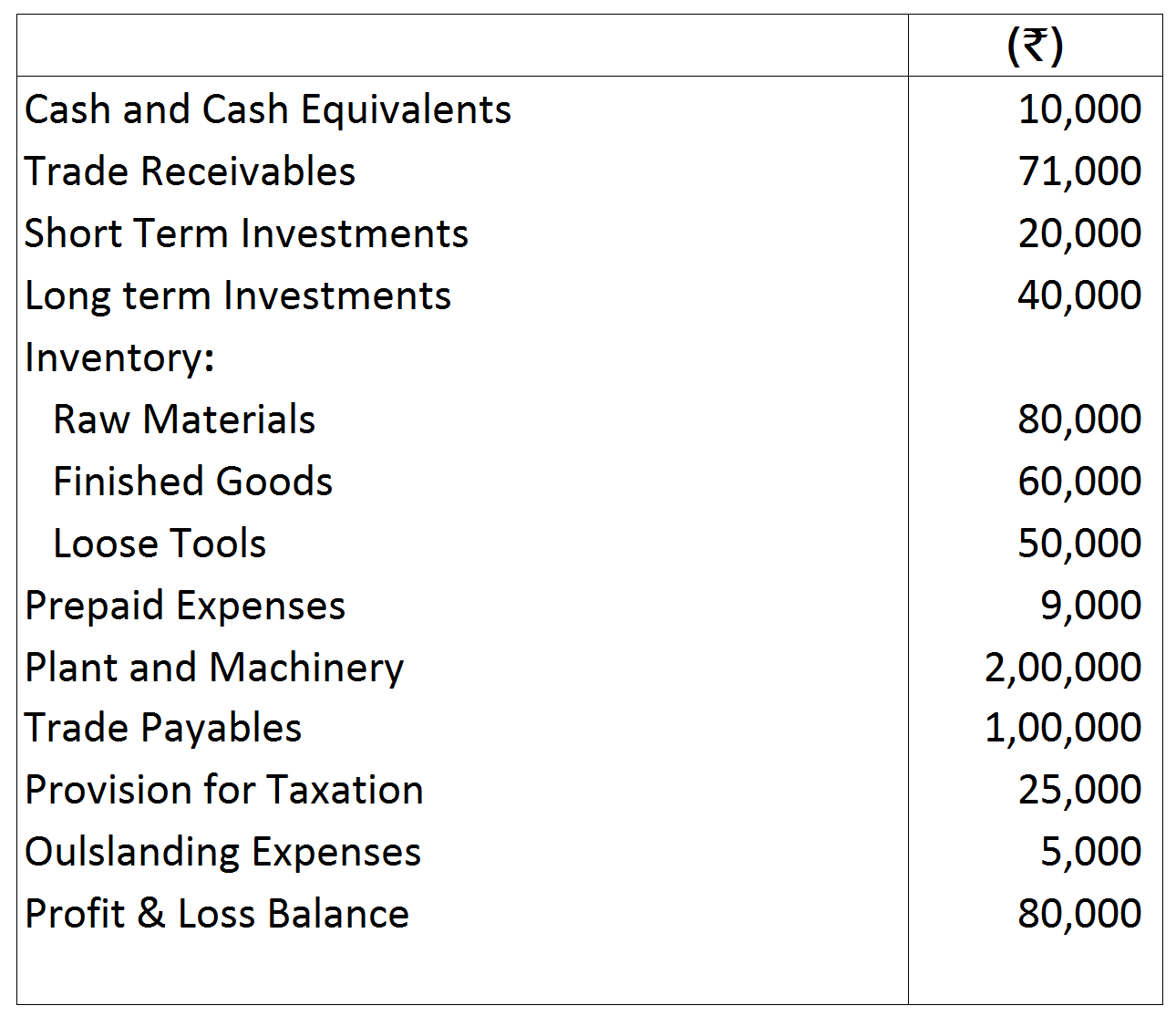
Calculate Current Ratio and Quick Ratio from the following. Also give your opinion about the short term financial position of the company:-
Answer
Current Ratio $=\frac{\text{Current Assets}}{\text{Current Liabilities}}$
Current Assets = Cash & Cash Equivalents + Trade Receivables + Short Term Investments + Inventory of Raw Materials + Inventory of Finished Goods + Prepaid Expenses.
= ₹ 10,000 + ₹ 71,000 + ₹ 20,000 + ₹ 80,000 + ₹ 60,000 = ₹ 9,000
= ₹ 2,50,000
Current Liabilities = Trade Payables + Provision for Taxation + Outstanding Expenses.
= ₹ 1,00,000 + ₹ 25,000 + ₹ 5,000
= ₹ 1,30,000
Current Ratio $=\frac{₹\ 2,50,000}{₹\ 1,30,000}=1.92:1$
Quick Ratio $=\frac{\text{Liquid Assets}}{\text{Current Liabilities}}$
Liquid Assets = Cash & Cash Equivalents + Trade Receivables + Short Term Investments.
= ₹ 10,000 - ₹ 71,000 + ₹ 20,000
= ₹ 1,01,000
Quick Ratio $=\frac{₹\ 1,01,000}{₹\ 1,30,000}=0.78:1$
View full question & answer
Question 376 Marks
Closing Inventory ₹ 22,000; Purchases ₹ 1,48,000; Purchase Return ₹ 8,000; Carriage ₹ 4,000; Revenue from Operations (Sales) ₹ 1,90,000; Revenue from Operations Return (Sales Return) ₹ 10,000; Gross Profit 20% on Cost. Calculate Inventory Turnover Ratio.
Answer
Inventory Turnover Ratio $=\frac{\text{Cost of Revenue from Operations }}{\text{Average Inventory}}$
Cost of Revenue from Operations = Net Revenue from Operations - Gross Profit
Net Revenue from Operations = Revenue from Operations - Revenue from Operations Return
= ₹ 1,90,000 - 10,000
= ₹ 1,80,000
Gross Profit = 20% on cost
Therefore, goods costing ₹ 100 is sold for ₹ 120
If Revenue from Operations is ₹ 120, Gross Profit is ₹ 20
If Revenue from Operations is ₹ 1,80,000
Gross Profit is $ \frac{20}{120}\times₹\ 1,80,000=₹\ 30,000$
Cost of Revenue from Operations = ₹ 1,80,000 - ₹ 30,000
= ₹ 1,50,000
Average Inventory $=\frac{\text{Opening Inventory}+\text{Closing Inventory}}{2}$
Since figure of opening inventory is not given, it may be calculated as follows:
Cost of Revenue from Operations = Opening Inventory + Purchases + Carriage - Closing Inventory
Hence, Opening Inventory = Cost of Revenue from Operations - Purchases - Carriage + Closing Inventory
= ₹ 1,50,000 - 1,40,000 - 4,000 + 22,000
= ₹ 28,000
Average Inventory $=\frac{₹\ 28,000\ +\ ₹\ 22,000}{2}$
$=\frac{₹\ 50,000}{2}=₹\ 25,000$
Inventory Turnover Ratio $=\frac{₹\ 1,50,000}{₹\ 25,000}=6\text{ times}$
View full question & answer
Question 386 Marks
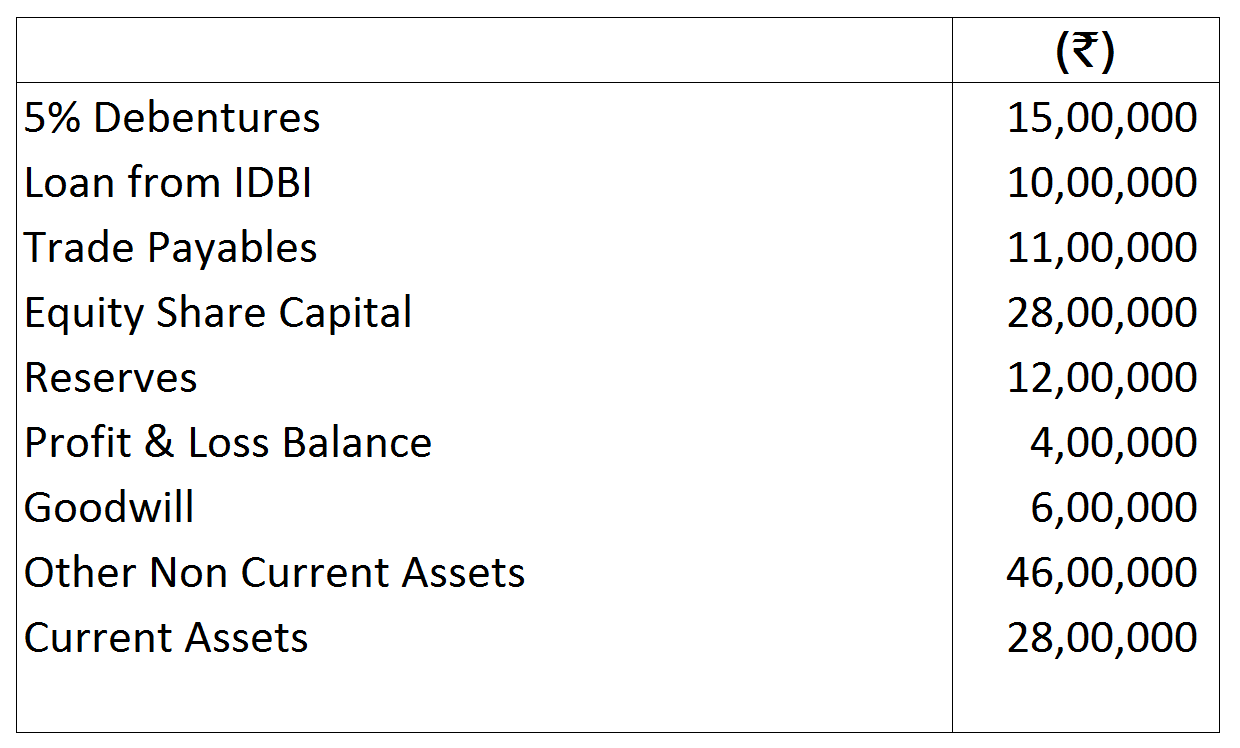
Calculate (i) Debt Equity Ratio, (ii) Proprietary Ratio and (iii) Total Assets to Debt Ratio from the following information:
Answer
  1. Debt-Equity Ratio $=\frac{\text{Long term Debts}}{\text{Shareholder's Funds}}$
Long-term Debts = 5% Debentures + Loan from IDBI

= ₹ 15,00,000 + ₹ 10,00,000 = ₹ 25,00,000

Shareholder's Funds = Equity Share Capital + Reserves + P & L Balance.

= ₹ 28,00,000 + ₹ 12,00,000 + ₹ 4,00,000

= ₹ 44,00,000

$=\frac{₹\ 25,00,000}{₹\ 44,00,000}=.57:1$
  1. Proprietary Ratio $=\frac{\text{Shareholder's Funds}}{\text{Total Assets}}$
Total Assets = Goodwill + Other Non Current Assets + Current Assets.

= ₹ 6,00,000 + ₹ 46,00,000 + ₹ 28,00,000

= ₹ 80,00,000

Proprietary Ratio $=\frac{₹\ 44,00,000}{₹\ 80,00,000}=.55\text{ or }55\%$
  1. Total Assets to Debt Ratio $=\frac{\text{Total Assets}}{\text{Long Term Debts}}$
$=\frac{₹\ 80,00,000}{₹\ 25,00,000}=3.2:1$
View full question & answer
Question 396 Marks

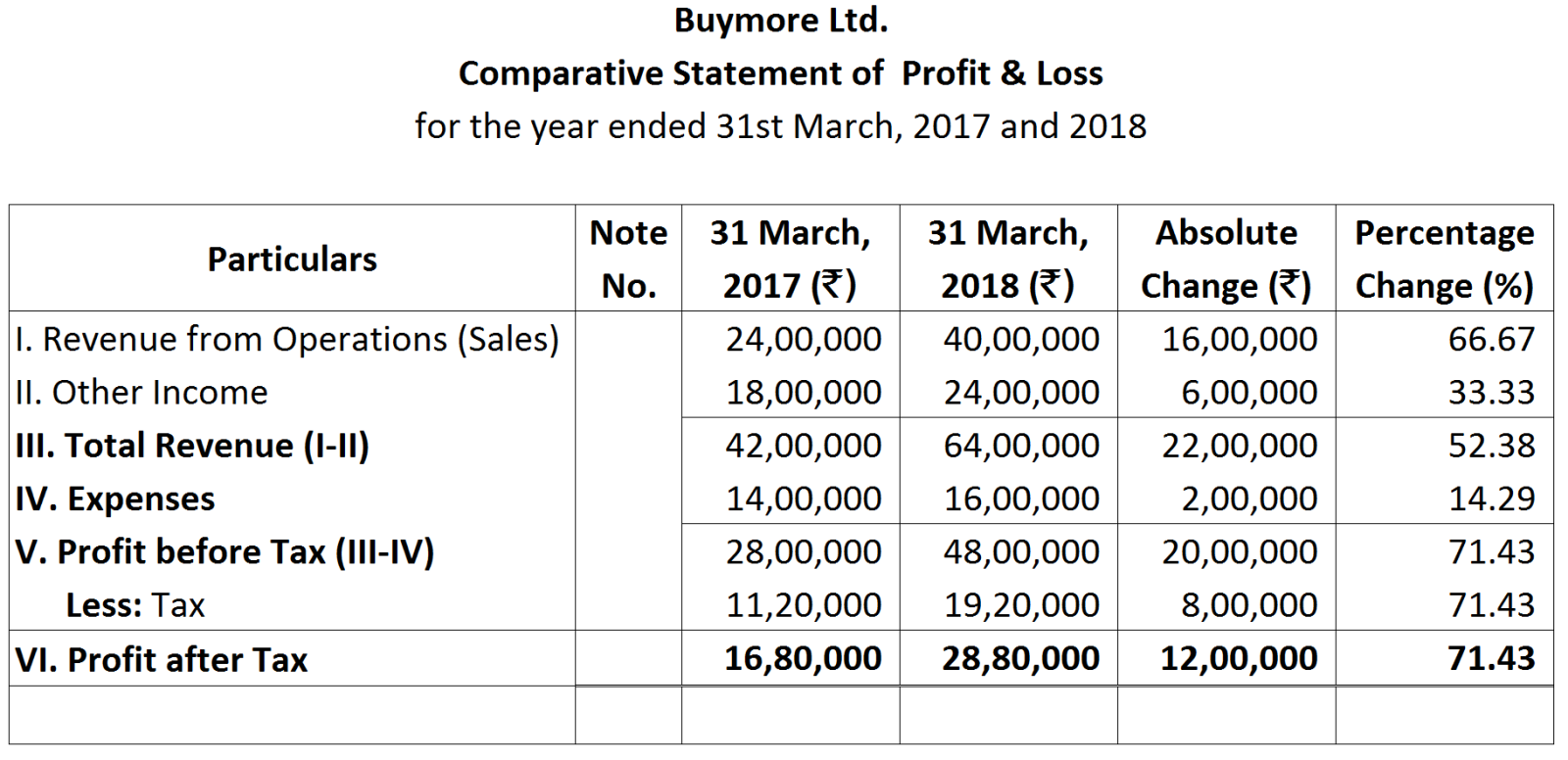
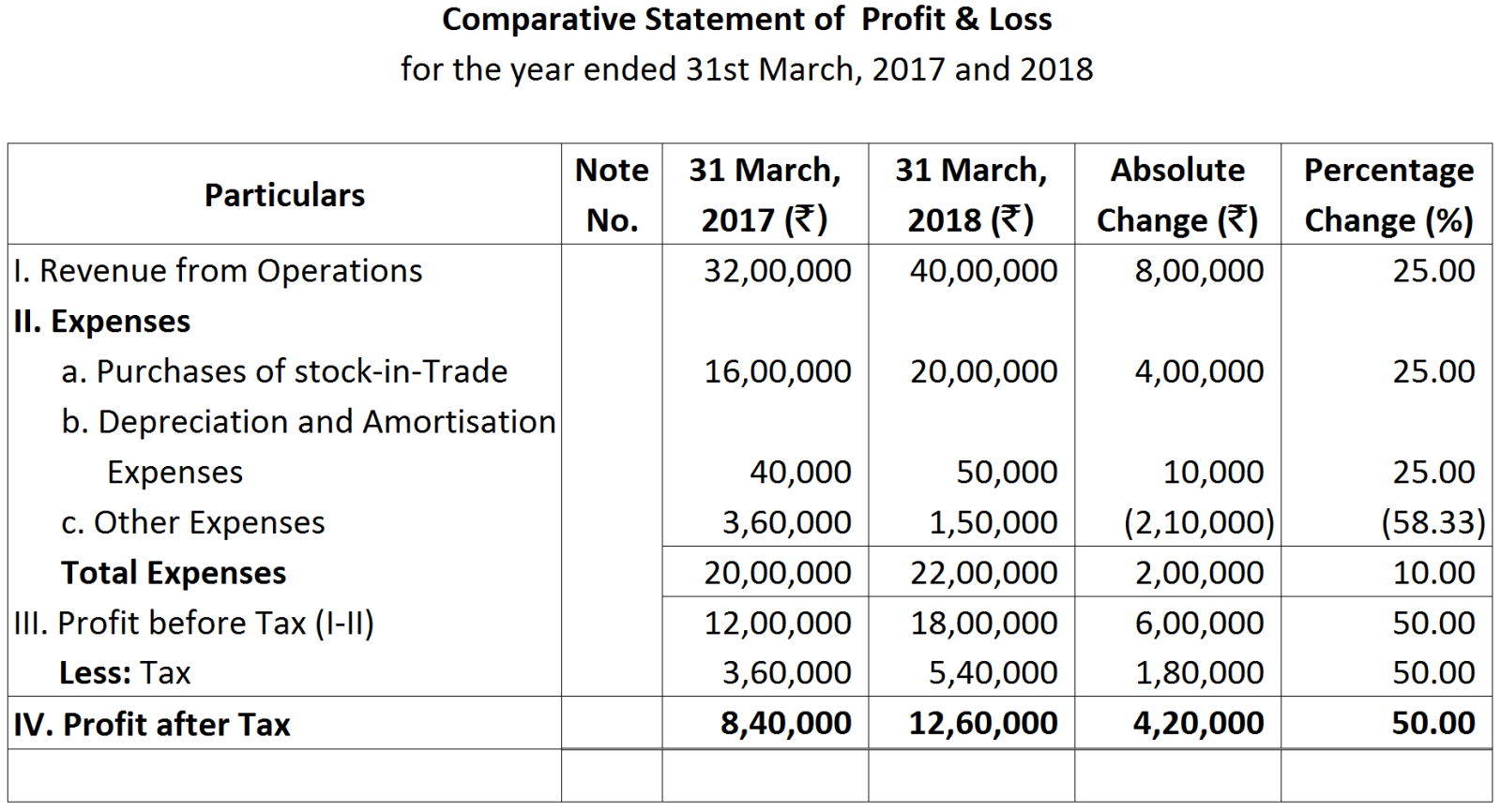
From the above Comparative Statement of Profit and loss for the year ended 31st March, 2017 and 31st March, 2018, compute Net Profit ratio.
Answer
Net Profit Ratio 31st March, 2017 31st March, 2018
$\frac{\text{Net Profit after Tax}}{\text{Revenue from Operation}}\times100$ $=\frac{₹\ 16,80,000}{₹\ 24,00,000}\times100=70\%$ $=\frac{₹\ 28,80,000}{₹\ 40,00,000}\times100=72\%$
Note: It is assumed that no expenses is incurred to earn Non-Operating Income (Other Income).
View full question & answer
Question 406 Marks
A limited company made Credit Sales of ₹ 4,00,000 during the financial period. If the collection period is 36 days and year is assumed to be 360 days, calculate:
  1. Trade Receivables Turnover Ratio.
  2. Average Trade Receivables.
  3. Trade Receivables at the end when Trade Receivables at the end are more than that in the beginning by ₹ 6,000.
Answer
  1. Debt Collection Period $=\frac{360}{\text{Trade Receivable Turnover Ratio}}$
$36=\frac{360}{\text{Trade Receivable Turnover Ratio}}$

Trade Receivables Turnover Ratio = 10 Times
  1. Trade Receivable Turnover Ratio $=\frac{\text{Net Credit Sale}}{\text{Average Trade Receivables}}$
$10=\frac{4,00,000}{\text{Average Trade Receivables}}$

Average Trade Receivable = ₹ 40,000
  1. Let the Opening Trade Receivables be x
$\therefore$ Closing Trade Receivables = x + 6,000

Average Trade Receivables $=\frac{\text{Opning Trade Receivables+Closing Trade Receivables}}{2}$

$40,000=\frac{\text{x+x}+6,000}{2}$

or, 80,000 = 2x + 6,000

or, 2x = 74,000

or, x = 37,000

$\therefore$ Opening Trade Receivables = x = ₹ 37,000

Closing Trade Receivables = x + 6,000 = 43,000.
View full question & answer
Question 416 Marks

From the above Comparative Statment of Profit and loss for the year ended 31st March, 2017 and 31st March, 2018, compute Operating ratio.
Answer
Operating Ratio 31st March, 2017 31st March, 2018
$\frac{\text{Operating Cost}}{\text{Revenue from Operation}}\times100$ $=\frac{₹\ 20,00,000}{₹\ 32,00,000}\times100=62.50\%$ $=\frac{₹\ 22,00,000}{₹\ 40,00,000}\times100=55.00\%$
View full question & answer
Question 426 Marks
Calculate the amount of Opening Trade Receivables and Closing Trade Receivables from the following particulars:
Cost of Revenue from Operations : ₹ 9,00,000
Gross Profit on Revenue from Operations : 25%
Cash Revenue from Operations : 20% of Credit Revenue from Operations
Trade Receivables Turnover Ratio : 5 Times
Closing Trade Receivables were 3 times than that in the beginning.
Answer
Gross Profit is 25% on Revenue from Operations.
It means if Revenue from Operations
Gross Profit
& Cost of Revenue from Operations
=
=
=
₹ 100
₹ 25
₹ 75
If Cost of Revenue from Operations is ₹ 75, Revenue from Operations is ₹ 100
If Cost of Revenue from Operations is ₹ 9,00,000, Revenue from Operations is $\frac{100}{75}\times9,00,000=₹\ 12,00,000$
As Cash Revenue from Operations being 20% of Credit Revenue from Operations
The ratio between Cash Revenue from Operations and Credit Revenue from Operations = 20 : 100 or 1 : 5
Therefore Credit Revenue from Operations $=12,00,000\times\frac{5}{6}=₹\ 10,00,000 $
Trade Receivables Turnover Ratio $=\frac{\text{Credit Revenue from Operations}}{\text{Average Trade Receivables}}$
Average Trade Receivables $=\frac{10,00,000}{5}=₹\ 2,00,000$
Total of Opening Trade Receivables and Closing Trade Receivables
₹ 2,00,000 × 2 = ₹ 4,00,000
Since Closing Trade Receivables are 3 times than that in the beginning, ratio between Opening Trade Receivables and Closing Trade Receivables will be 1 : 3
$\therefore$ Opening Trade Receivables $₹\ 4,00,000\times\frac{1}{4}₹\ 1,00,000$
Closing Trade Receivables $=₹\ 4,00,000\times\frac{3}{4}=₹\ 3,00,000$
View full question & answer
Question 436 Marks

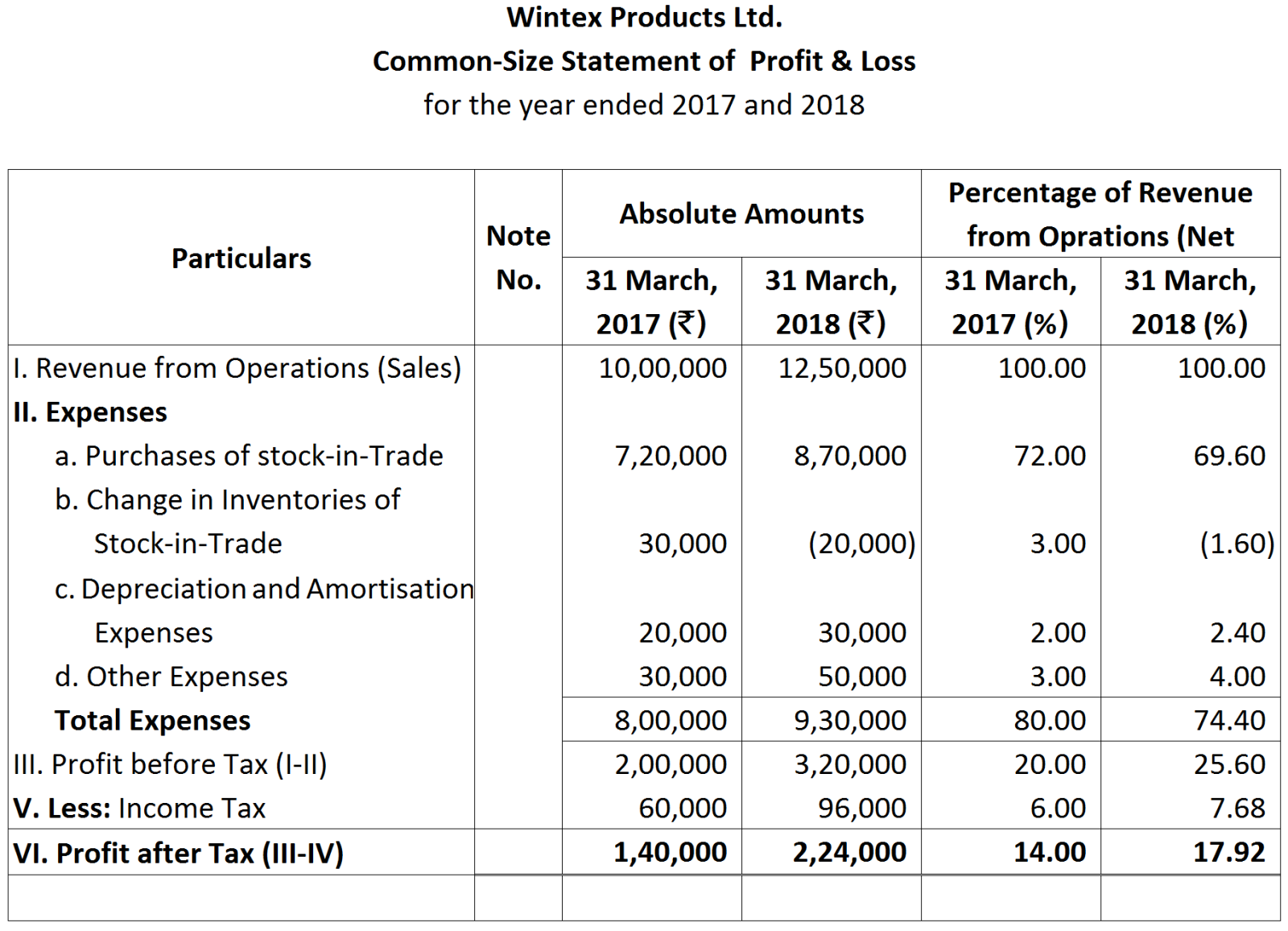
From the above Common-size Statment of Profit and loss for the year ended 31st March, 2017 and 31st March, 2018, compute Gross Profit ratio.
Answer
Gross Profit Ratio 31st March, 2017 31st March, 2018
$\frac{\text{Gross Profit}}{\text{Revenue from Operation}}\times100$ $=\frac{₹\ 2,50,000}{₹\ 10,00,000}\times100=25\%$ $=\frac{₹\ 4,00,000}{₹\ 12,50,000}\times100=32\%$
Gross Profit:
Revenue From Operations. $1,00,000$ $12,50,000$
Less: Cost of Revenue from Operations. $\underline{7,50,000}$ $\underline{8,50,000}$
  $\underline{2,50,000}$ $\underline{4,00,000}$
View full question & answer
Question 446 Marks
From the following information calculate any two of the following ratios:
  1. Current Ratio.
  2. Debt Equity Ratio.
  3. Operating Ratio.
Revenue from Operations ₹ 1,00,000; Cost of Revenue from Operations was 80% of Revenue from Operations; Equity Share Capital ₹ 7,00,000; General Reserve ₹ 3,00,000; Operating Expenses ₹ 10,000; Quick Assets ₹ 6,00,000; 9% Debentures ₹ 5,00,000; Closing Inventory ₹ 50,000; Prepaid Expenses ₹ 10,000 and Current Liabilities ₹ 4,00,000.
Answer
  1. Current Ratio $=\frac{\text{Current Assets}}{\text{Current Liabilities}}$
Current Assets = Quick Assets + Closing Inventory + Prepaid Exp.

= ₹ 6,00,000 + ₹ 50,000 + ₹ 10,000 = ₹ 6,60,000

Current Ratio $=\frac{6,60,000}{4,00,000}=1.65:1$
  1. Debt-Equity Ratio $=\frac{\text{Long term Debts}}{\text{Shareholder's Funds}}$
Shareholder's Funds = Equity Share Capital + General Reserve

= ₹ 7,00,000 + ₹ 3,00,000 = ₹ 10,00,000

Debt-Equity Ratio $=\frac{5,00,000\text{ (Debentures)}}{10,00,000}=0.5:1$
  1. Operating Ratio $=\frac{\text{Cost of Revenue from Operations + Operating Expenses }}{\text{Net Revenue from Operations}}\times100$
$=\frac{80,000+10,000 }{1,00,000}\times100=90\%$
View full question & answer
Question 456 Marks
Closing Trade Receivables ₹ 1,00,000; Cash Sales being 25% of Credit Sales; Excess of Closing Trade Receivables over Opening Trade Receivables ₹ 40,000; Revenue from Operations, i.e., Net Sales ₹ 6,00,000. Calculate Trade Receivables Turnover Ratio.
Answer
Let Credit Sales be = x
$\text{Case Sale}=\text{Total Sales}\times\frac{25}{100}$
$\text{Case Sales}=\text{x}\times\frac{25}{100}=\frac{25\text{x}}{100}$
Total Sales = Cash Sales + Credit Sales
$6,00,000=\frac{25\text{x}}{100}+\text{x}$
or, $\frac{125\text{x}}{100}=6,00,000$
or, $\frac{6,00,000\times100}{125}=4,80,000$
Credit Sales = 4,80,000
Closing Trade Receivables = Opening Trade Receivables + 40,000
1,00,000 = Opening Trade Receivables + 40,000
Opening Trade Receivables = ₹ 60,000
Average Trade Receivable $=\frac{\text{Opening Trade Receivable+Closing Trade Receivables}}{2}$
$=\frac{1,00,000+60,000}{2}=₹\ 80,000$
Trade Receivable Turnover Ratio $=\frac{\text{Credit Sales}}{\text{Average Trade Receivable}}$
$=\frac{4,80,000}{80,000}=6\text{ Times}$
View full question & answer
Question 466 Marks
From the following, calculate:
  1. Debt to Equity Ratio.
  2. Total Assets to Debt Ratio.
  3. Proprietary Ratio.
 
Equity Share Capital.
75,000
Preference Share Capital.
25,000
General Reserve.
45,000
Balance in Statement of Profit and Loss.
30,000
Debentures. 75,000
Trade Payables. 40,000
Outstanding Expenses. 10,000
Answer
Debt to Equity Ratio $=\frac{\text{Long-term Debts}}{\text{Shareholders' Funds}}$ Debt to Equity Ratio $=\frac{\text{Debentures}}{\text{Equity Share Cpital + Perferance Share Capital + General Reserve + Balance in stament}}$ Debt to Equity Ratio $=\frac{75,000}{75,000+25,000+45,000+30,000}=0.43:1$ Total Assets to Debt Ratio $=\frac{\text{Total Assets}}{\text{Long-term Debts}}$ Total Assets to Debt Ratio $=\frac{\text{Equity Share Cpital + Perferance Share Capital + General Reserve + Balance in staments}}{\text{Debenteres}}$ Total Assets to Debt Ratio $=\frac{75,000+25,000+45,000+30,000+75,000+40,000+10,000}{75,000}=4:1$ Proprietary Ratio $=\frac{\text{Shareholders' Fund}}{\text{Total Assets}}$ $\text{Proprietary Ratio}=\frac{\ \ \ \ \text{Equity Share Capital}\\ +\text{ Preference Share Capital}\\ +\text{ General Reserve}\\+ \text{ Balance in Statement of Profit & Loss}}{\ \ \ \ \text{Equity Share Capital}\\+\text{ Preference Share Capital}\\+\text{ General Reserve }\\+ \text{ Balance in Statement of Profit & Loss}\\+\text{ Trade Payables}\\+\text{ Outstanding Expenses}}$$$Proprietary Ratio $=\frac{75,000+25,000+45,000+30,000}{75,000+25,000+45,000+30,000+75,000+40,000+10,000}=0.58:1\text{ or }58.33\%$
View full question & answer
Question 476 Marks
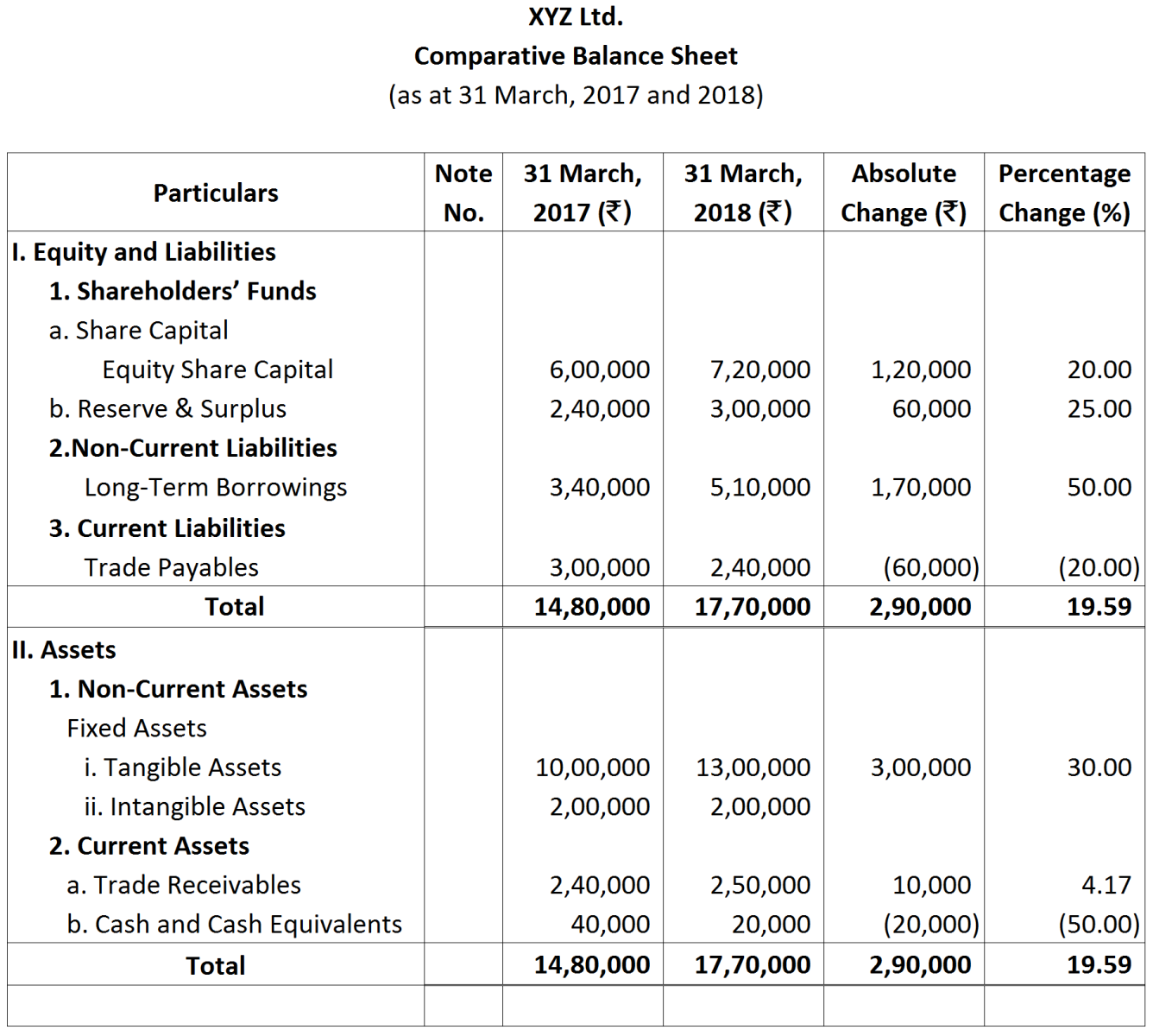
XYZ Ltd., in the bussiness of readymade garments, decided to take part in Sawachh Bharat Abhiyan by educating the people about the disadvantages of pollation and its effect on health. Its Comparative Balance Sheet is given Below:

Compute Proprietary Ratio from the Comparative Balance Sheet as at 31st March, 2017 and 31st March, 2018. Also identify the value practiced by the company.
Answer
Proprietary Ratio 31st March, 2017 31st March, 2018
$\frac{\text{Shareholders' Funds}}{\text{Total Assets}}$ $=\frac{₹\ 6,00,000+₹\ 2,40,000}{₹\ 14,80,000}=0.57:1$ $=\frac{₹\ 7,20,000+₹\ 3,00,000}{₹\ 17,70,000}=0.58:1$
Value: Practiced is educating people about the harmful effects of pollution on health.
View full question & answer
Question 486 Marks
From the following calculate:
  1. Current Ratio.
  2. Working Capital Turnover Ratio.
 
Revenue from Operations.
1,50,000
Total Assets.
1,00,000
Shareholders' Funds.
60,000
Non-current Liabilities.
20,000
Non-current Assets.
50,000
Answer
  1. Current Ratio = $\frac{\text{Current Assets}}{\text{Current Liabilities}}$
Current Assets = Total Assets - Non Current Assets

= 1,00,000 - 50,000

= ₹ 50,000

Total Assets = Total Liabilities = Shareholders’ Funds + Non Current Liabilities + Current Liabilities

1,00,000 = 60,000 + 20,000 + Current Liabilities

Current Liabilities = ₹ 20,000

Current Ratio = $\frac{50,000}{20,000}=2.5:1$
  1. Working Capital Turnover Ratio = $\frac{\text{Revenue From Operation}}{\text{Working Capital}}$
Working Capital = Current Assets - Current Liabilities

= 50,000 - 20,000

= ₹ 30,000

Working Capital Turnover Ratio = $\frac{1,50,000}{30,000}=5\text{ Times}$
View full question & answer
Question 496 Marks

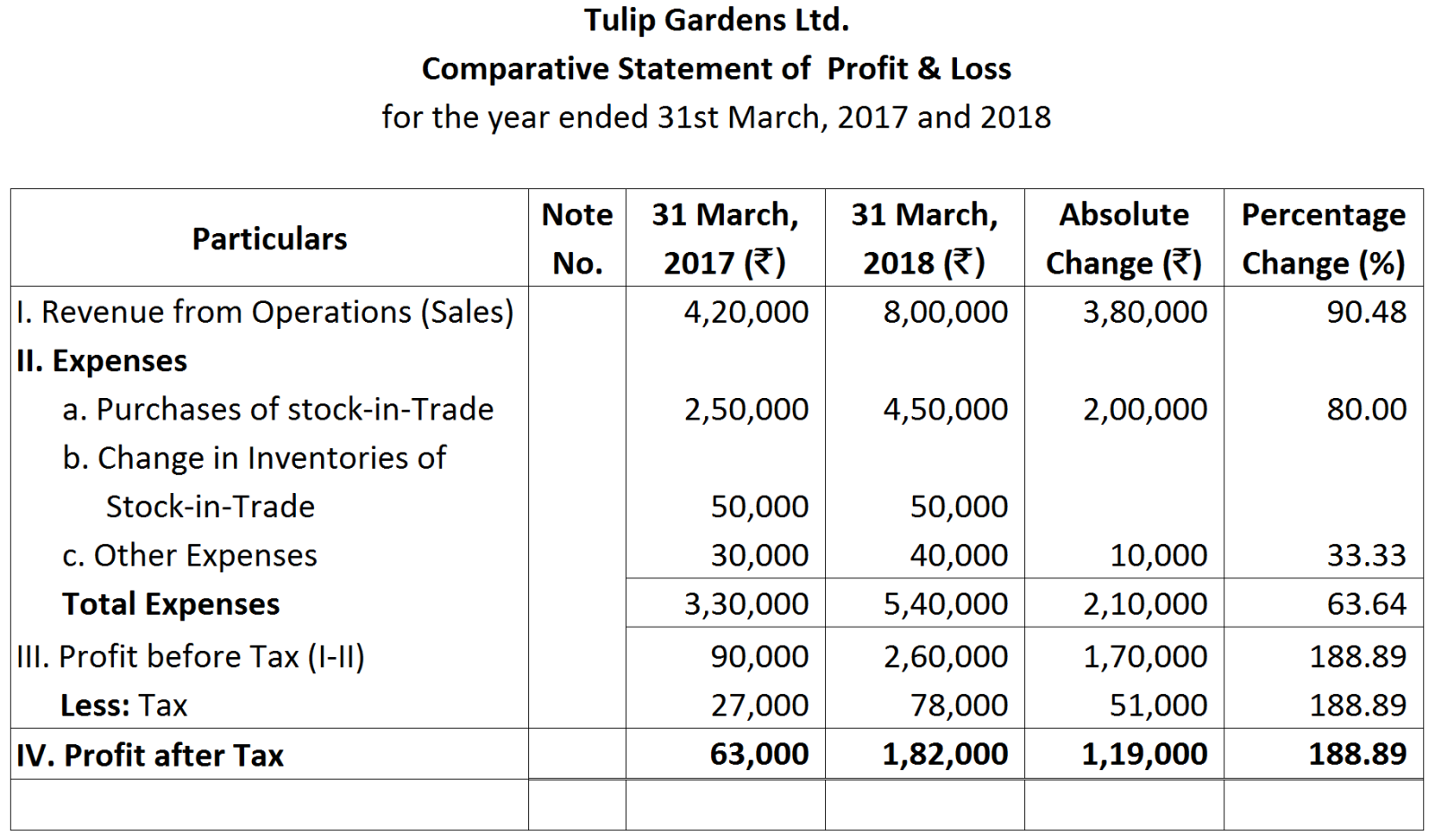
From the above Comparative Statment of Profit and loss for the year ended 31st March, 2017 and 31st March, 2018, compute Gross Profit ratio.
[Hint: Cost of Revenue from Operations (Cost of Goods Sold) = Purchases of Stock-in- Trade + Change in Inventories of Stock-in-Trade.]
Answer
Gross Profit Ratio 31st March, 2017 31st March, 2018
$\frac{\text{Gross Profit}}{\text{Revenue from Operation}}\times100$ $=\frac{₹\ 1,20,000}{₹\ 4,20,000}\times100=28.57\%$ $=\frac{₹\ 3,00,000}{₹\ 8,00,000}\times100=37.50\%$
View full question & answer
Question 506 Marks
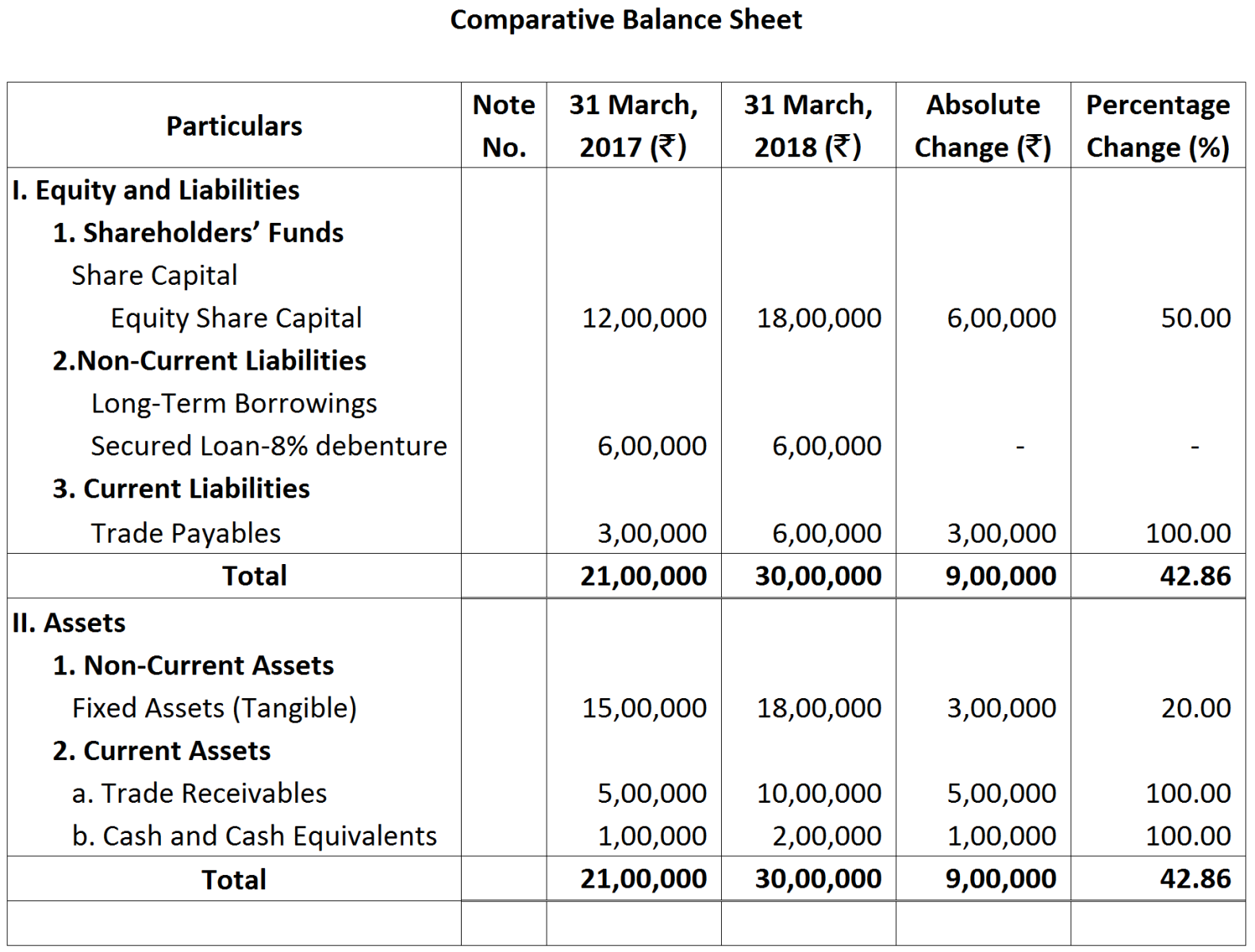
Hopeful Ltd. in the business of manufacturing and selling FMCG decided to set up a new Manufacturing unit in economically backward area of Chattisgarh. It decided to employ Factory staff the local population. But before that it imparted training to them for six months and gave each trainee a stiped of ₹ 5,000 per month, Given below is its Comparative Balance Sheet:

Calculate Debt to Equity Ratio From the above. Also identify the value adopted by the Company.
Answer
Debt to Equity Ratio 31st March, 2017 31st March, 2018
$\frac{\text{Debt}}{\text{Equity(Shareholders' Funds)}}$ $=\frac{₹\ 6,00,000}{₹\ 12,00,000}=0.5:1$ $=\frac{₹\ 6,00,000}{₹\ 18,00,000}=0.33:1$
Value practiced are: Economic uplifting the backward region and developing employable skills in the local population.
View full question & answer
6 Marks Question - Accountancy STD 12 Commerce Questions - Vidyadip