Question
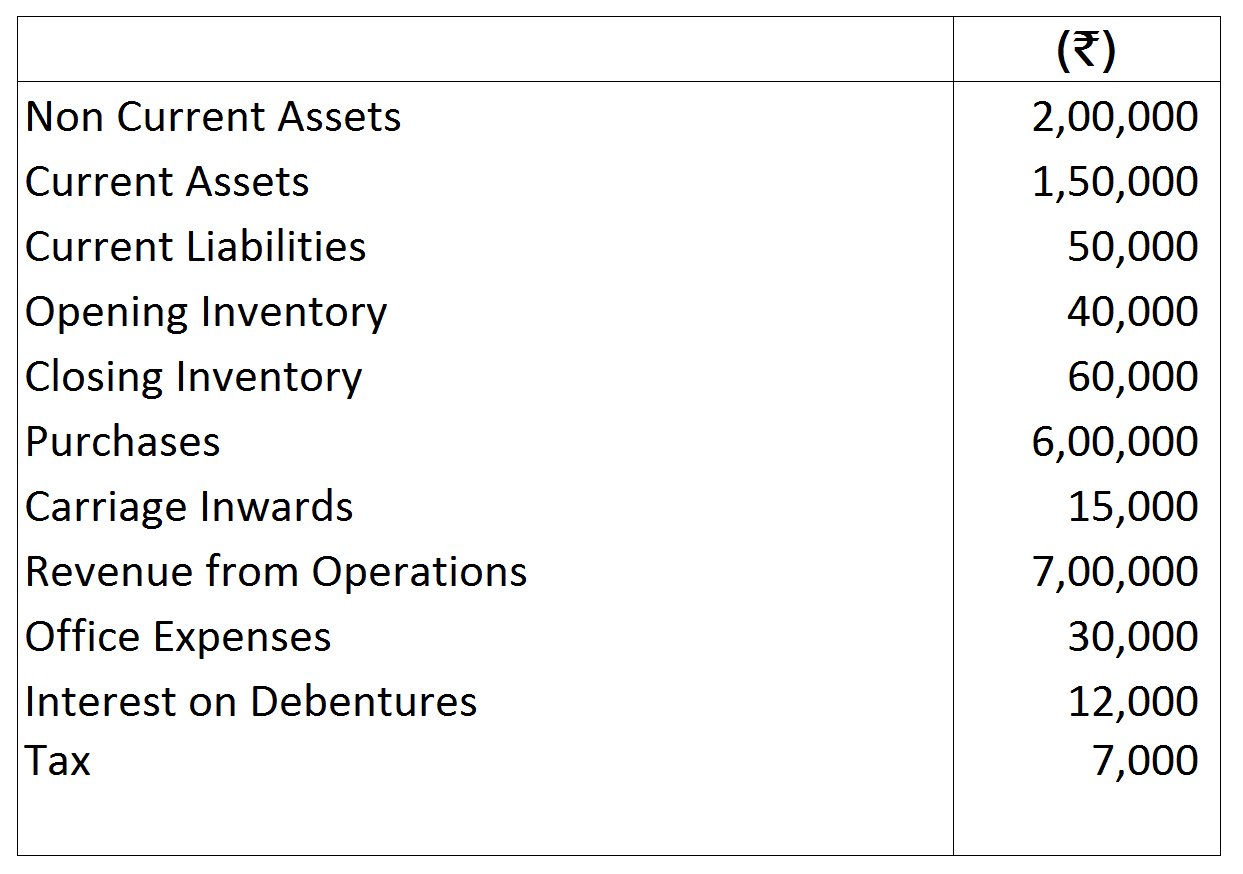
Calculate Return on Investment from the following:
Answer

Return on Investment or Capital Employed $=\frac{\text{Net profit before Interst & Tax}}{\text{Capital Employed }}\times100$
Net Profit before Interest = Gross Profit - Indirect Expenses (i.e., Office Expenses)
Gross Profit = Revenue from Operations -Cost of Revenue from Operations
Cost of Revenue from Operations = Opening Inventory + Purchases + Carriage Inwards - Closing Inventory
= ₹ 40,000 + ₹ 6,00,000 +₹ 15,000 - ₹ 60,000
= ₹ 5,95,000
Gross Profit = ₹ 7,00,000 - ₹ 5,95,000 = ₹ 1,05,000
Net Profit before Interest = Gross Profit - Office Expenses
= ₹ 1,05,000 - ₹ 30,000 = ₹ 75,000
Capital Employed = Non Current Assets + Current Assets - Current Liabilities
= ₹ 2,00,000 + ₹ 1,50,000 - ₹ 50,000
= ₹ 3,00,000
Return on Investment $=\frac{75,000}{3,00,000}\times100=25\%$

Need a full question paper?

Generate a complete, print-ready paper with questions like this in minutes — across 16+ boards, with answer keys.
Start Generating Free

Similar questions

On 1-4-2013 Kaka Ltd. had ₹ 50,00,000, 9% debentures of ₹ 100 each outstanding.
  1. On 1-4-2014 the company purchased in the open market 25,000 of its own debentures for ₹ 99 each and cancelled the same immediately.
  2. On 1-4-2015 the company redeemed at par debentures of ₹ 10,00,000 by draw of lot.
  3. On 1-1-2016 the remaining debentures were purchased for ₹ 14,99,000 and were cancelled immediately.
Ignoring debenture redemption reserve and interest on debentures pass necessary journal entries for the above transactions in the books of the company.
Khushboo Ltd. issued for Public subscription 50,000 equity shares of ₹ 10 each at a premium of 30% payable as under:
₹ 4 on application
₹ 5 on allotment (including premium)
₹ 4 on first & final call
Applications were received for 1,00,000 shares. Allotment was made pro-rata to the applicants for 80,000 shares, the remaining applications being refused. Money overpaid on application was utilised towards sums due on allotment.
Chatterjee, to whom 1,000 shares were allotted, failed to pay the allotment and call money and the shares were subsequently forfeited. Half of the forfeited shares were reissued as fully paid at a discount of 10%. Show the journal entries to record the above transactions.
X Ltd. issued 50,000 shares of ₹ 10 each at a premium of ₹ 2 per share payable as follows:
₹. 3 on Application
₹ 6 on Allotment (including premium) and
₹ 3 on call.
Applications were received for 75,000 shares and pro-rata allotment was made as follows:
To the applicants of 40,000 shares, 30,000 shares were issued and for the rest 20,000 shares were issued. All moneys due were received except the ‘allotment and call money from Ram who had applied for 1,200 shares (out of the group of 40,000 shares). All his shares were forfeited. The forfeited shares were re-issued for ₹ 8 per share fully paid-up.
Pass necessary journal entries for the above transactions.
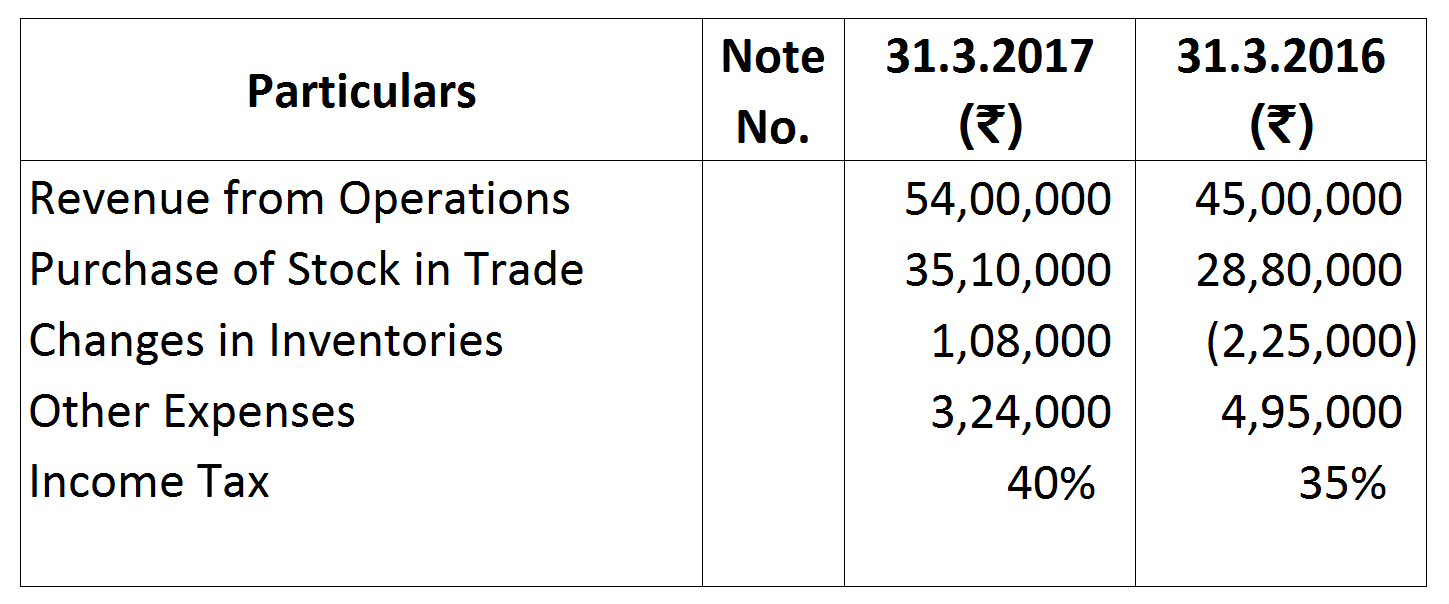
Prepare a Common Size Statement of Profit & Loss from the following:
Show the following items in the Balance Sheet of Panjim Fruits Ltd. as at 31st March 2017:
Particulars
50,000, 9% Debenture of ₹ 100 each
20,000, 8% Debenture of ₹ 100 each
50,00,000
(Redeemable on 31st October, 2017)
10% Public Deposits
20,00,000
(One-third repayable during 2017-18)
15,00,000
Half Year's interest on Public Deposits has not yet been paid.
Mahima Ltd. issued ₹ 38,00,000, 9% Debentures of ₹ 100 each on 1st April, 2013. The debentures were redeemable at a premium of 5% on 30th June, 2015. The company transferred an amount of ₹ 9,50,000 to Debentures Redemption Reserve on 31st March, 2015. Investments as required by law were made in fixed deposit of a bank on 1st April, 2015.
Ignoring interest on fixed deposit, pass necessary journal entries starting from 31st March, 2015 regarding redemption of debentures.
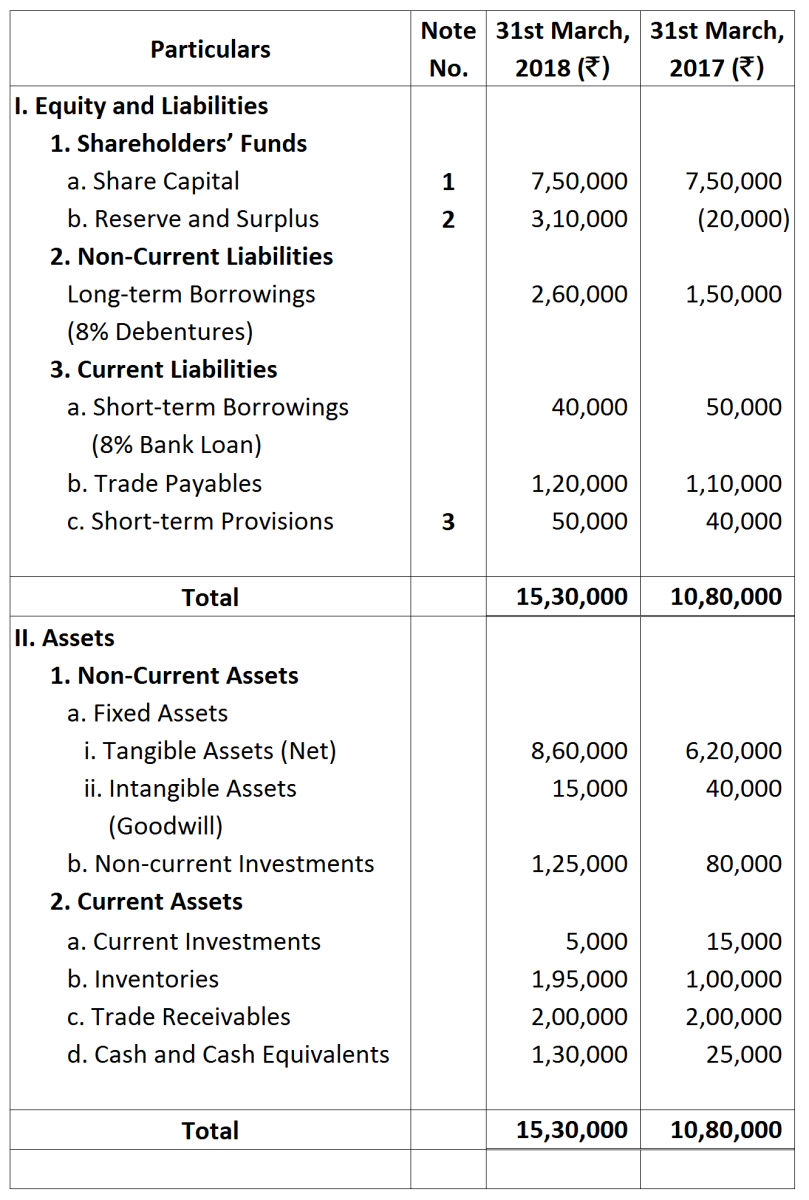
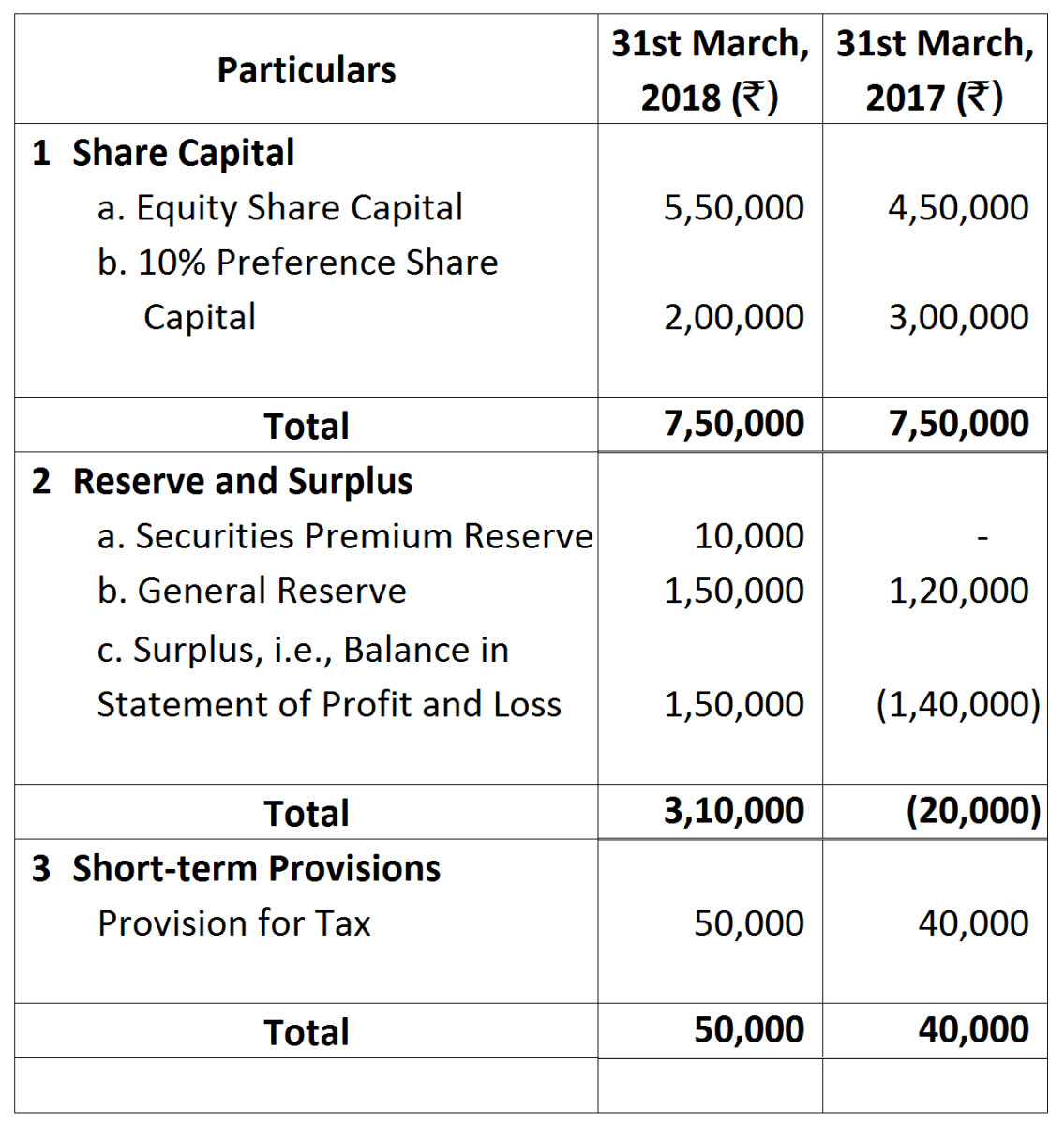
From the following Balance Sheet of Samta Ltd., as at 31st March, 2018, prepare Cash Flow Statement.
Note to Accounts:
Additional Information:
  1. During the year a piece of machinery costing ₹ 60,000 on which depreciation charged was ₹ 20,000 was sold at 50% of its book value. Depreciation provided on tangible Assets ₹ 60,000.
  2. Income tax ₹ 45,000 was provided.
  3. Additional Debentures were issued at par on 1st October, 2017 and Bank Loan was repaid on the same date.
  4. At the end of the year Preference Shares were redeemed at a premium of 5%.
XYZ Ltd. invited applications for 10,000 shares of ₹ 100 each payable as follows: ₹ 20 on application, ₹ 30 on allotment, ₹ 20 on first call and the balance on final call.
All the shares were applied and allotted. All the money was duly received. You are required to journalise these transactions.
A Ltd. issued 20,000 Equity Shares of ₹ 10 each at a premium of ₹ 5 per share, payable as ₹ 7 (including premium) on application , ₹ 5 on allotment and the balance after three months of allotment.
A shareholder to whom 200 shares were allotted failed to pay the allotment and call money and his shares were forfeited. 160 of the forfeited shares were reissued for ₹ 1,600.
Give necessary entries in company's journal and the Balance Sheet.
XYZ Ltd. is registered with an authorised capital of ₹ 2,00,000 divided into 2,000 shares of ₹ 100 each of which, 1,000 shares were offered for public subscription at a premium of ₹ 5 per share, payable as:
On Application - ₹ 10 per share,
On Allotment - ₹ 25 per share (including premium)
On First Call - ₹ 40 per share,
On Final call - ₹ 30 per share
Applications were received for 1,800 shares, of which applications for 300 shares were rejected outright; the rest of the application were allotted 1,000 shares on pro rata basis. Excess application money was transferred to allotment.
All the money was duly received except from Sundar, holder of 100 shares, who failed to pay allotment and first call money. His shares were later forfeited and reissued to Shyam at ₹ 60 per share ₹ 70 paid-up. Final call has not been made.
Pass necessary Journal entries and prepare Cash Book in the books of XYZ Limited.