MCQ
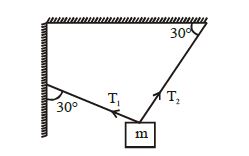
Calculate $T_1$ and $T_2$
  • $\frac{{\sqrt 3 }}{2}mg,\frac{{mg}}{2}$
  • B
    $mg,\frac{{\sqrt 3 }}{2}mg$
  • C
    $\frac{{\sqrt 3 }}{2}mg,\frac{{\sqrt 3 }}{2}mg$
  • D
    $\frac{{mg}}{2},\frac{{mg}}{2}$

Answer

Correct option: A.
$\frac{{\sqrt 3 }}{2}mg,\frac{{mg}}{2}$
a
$\frac{\mathrm{T}_{1}}{\sin 120^{\circ}}=\frac{\mathrm{Mg}}{\sin 90^{\circ}}$

$\mathrm{T}_{1}=\frac{\sqrt{3}}{2} \mathrm{Mg}$

$\frac{\mathrm{T}_{2}}{\sin 150^{\circ}}=\frac{\mathrm{Mg}}{\sin 90^{\circ}}$

$\mathrm{T}_{2}=\frac{\mathrm{Mg}}{2}$

Need a full question paper?

Generate a complete, print-ready paper with questions like this in minutes — across 16+ boards, with answer keys.
Start Generating Free

Similar questions

Two samples $A$ and $B$ of a gas initially at the same pressure and temperature are compressed from volume $ V$ to $ V/2$ ($A$ isothermally and adiabatically). The final pressure of $ A$ is
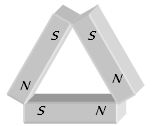
Three identical bar magnets each of magnetic moment $M$ are placed in the form of an equilateral triangle as shown. The net magnetic moment of the system is
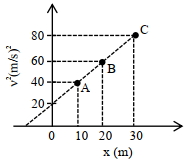
A particle is moving with constant acceleration $'a'.$ Following graph shows $v^{2}$ versus $x$ (displacement) plot. The acceleration of the particle is $......{m} / {s}^{2}$
The position$(x)$ of a particle at any time$(t)$ is given by $x(t) = 4t^3 -3t^2 + 2$ The acceleration and velocity of the particle at any time $t = 2\, sec$ are respectively
Which of the following is a one dimensional motion
The decrease in the potential energy of a ball of mass $20 \,kg$ which falls from a height of $50 \,cm$ is ............ $\mathrm{J}$
A straight wire of diameter $0.5\, mm$ carrying a current of $1\, A$ is replaced by another wire of $1\, mm$ diameter carrying the same current. The strength of magnetic field far away is
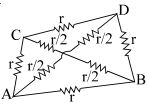
The figure shows a tetrahedron, each side of which has a resistance $r$ Choose the correct statement $(s)$ related to the resistance between any two points.
Starting from rest, a body slides down a $45^°$ inclined plane in twice the time it takes to slide down the same distance in the absence of friction. The coefficient of friction between the body and the inclined plane is
An accident in a nuclear laboratory resulted in deposition of a certain amount of radioactive material of half-life $18$ days inside the laboratory. Tests revealed that the radiation was $64$ times more than the permissible level required for safe operation of the laboratory. What is the minimum number of days after which the laboratory can be considered safe for use?