Question
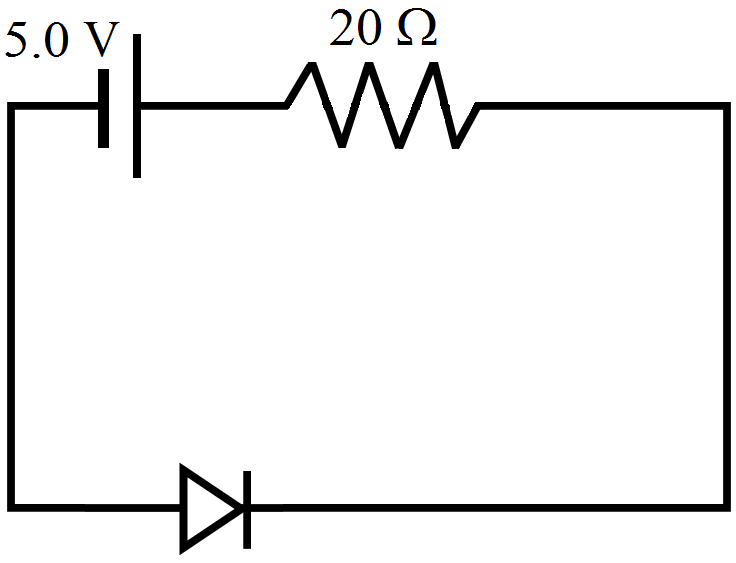
Calculate the current through the circuit and the potential difference across the diode shown in figure. The drift current for the diode is $20\mu\text{A}.$
Answer


Current in the circuit = Drift current

(Since, the diode is reverse biased $=20\mu\text{A})$

Voltage across the diode $=5-\big(20\times20\times10^{-6}\big)$

$=5-\big(4\times10^{-4}\big)=5\text{V}.$

Need a full question paper?

Generate a complete, print-ready paper with questions like this in minutes — across 16+ boards, with answer keys.

Start Generating Free

Similar questions

The photoelectric cut-off voltage in a certain experiment is 1.5 V. What is the maximum kinetic energy of photoelectrons emitted?
How does the maximum kinetic energy of electrons emitted vary with the work function of the metal?Maximum kinetic energy Ek = hν – W Clearly, smaller the work function W, greater is the Ek This means that when work function of a metal increases, maximum kinetic energy of photoelectrons decreases.
A capacitor of capacitance C is given a charge Q. At t = 0, it is connected to an ideal battery of emf $\in$ through a resistance R. Find the charge on the capacitor at time t.
A wire-loop confined in a plane is rotated in its own plane with some angular velocity. A uniform magnetic field exists in the region. Find the emf induced in the loop.
What are Eddy currents? Give its two uses.
A potential difference $V$ is applied across the ends of a conductor of length $L$ and diameter $D$. What will be the effect on drift velocity of charge carriers in the conductor when (i) V is made half (ii) L is doubled and (iii) D is made half?
State Bohr’s quantisation condition of angular momentum. Calculate the shortest wavelength of the Bracket series and state to which part of the electromagnetic spectrum does it belong.
Does the polarising angle for any transparent medium depend on the wavelength of light?
Explain series connection of cells. Derive the formula for equivalent emf and equivalent internal resistance for series connection of cell.
Find the dimensions of:
  1. Linear momentum.
  2. Frequency.
  3. Pressure.