Question
Calculate the force with which you attract the earth.

Answer

Consider that a man is standing on the surface of the Earth. Force acting on the man $= mg$
Here, $m =$ mass of the man and $g =$ acceleration due to gravity on the surface of earth $(= 10m/s^2)$ Assume that the mass of the man is equal to $65\ kg.$
Then $F = W = mg = 65 \times 10 = 650N =$ force acting on the man
$\therefore$ By Newton's third law $($action$-$reaction are always equal$),$ the man is also attracting the earth with a force of $650N$ in the opposite direction.

Need a full question paper?

Generate a complete, print-ready paper with questions like this in minutes — across 16+ boards, with answer keys.
Start Generating Free

Similar questions

The combination of two bar magnets makes 10 oscillations per second in an oscillation magnetometer when like poles are tied together and 2 oscillations per second when unlike poles are tied together. Find the ratio of the magnetic moments of the magnets. Neglect any induced magnetism.
If the radius of a circular current carrying coil is doubled and the current flowing through it is reduced to half, then what will be effect on magnetic moment?
A person goes to bed at sharp 10:00 pm every day. Is it an example of periodic motion? If yes, what is the time period? If no, why?
According to de $-$ Broglie, a moving material particle sometimes acts as a wave and sometimes as a particle or a wave associated with moving material particle which controls the particle in every respect. The wave associated with moving particle is called matter wave or de $-$ Broglie wave where wavelength called de $-$ Broglie wavelength $, rs$ given by $\lambda=\frac{\text{h}}{\text{mv}}$.
  1. If a proton and an electron have the same de Broglie wavelength, then:
  1. Kinetic energy of electron $ < $ kinetic energy of proton.
  2. Kinetic energy of electron $=$ kinetic energy of proton.
  3. Momentum of electron $=$ momentum of proton.
  4. momentum of electron $ < $ momentum of proton.
  1. Which of these particles having the same kinetic energy has the largest de Broglie wavelength?
  1. Electron
  2. Alpha particle
  3. Proton
  4. Neutron
  1. Two particles $A_1$ and $A_2 $ of masses $m_1, m_2 (m_1 > m_2)$ have the same de Broglie wavelength. Then:
  1. Their momenta are the same.
  2. Their energies are the same.
  3. Momentum of $A_1$ is less than the momentum of $A_1$.
  4. Energy of $A_1$ is more than the energy of $A_2.$
  1. When the velocity of an electron increases, its de Broglie wavelength:
  1. Increases.
  2. Decreases.
  3. Remains same.
  4. May increase or decrease.
  1. Proton and $\alpha-$ particle have the same de $-$ Broglie wavelength. What is same for both of them?
  1. Time period
  2. Energy
  3. Frequency
  4. Momentum
When a current/ flows through a coil, flux linked with it is $\phi=\text{LI},$ where $L$ is a constant known as self inductance of the coil. Any change in current sets up an induced $emf$ in the coil. Tims, self inductance of a coil is the induced emf set up in it when the current passing through it changes at the unit rate. It is a measure of the opposition to the growth or the decay of current flowing through the coil. Also, value of self inductance depends on the number of turns in the solenoid, its area of cross$-$section and the relative permeability of its core material.
  1. The inductance in a coil plays the same role as:
  1. Inertia in mechanics.
  2. Energy in mechanics.
  3. Momentum in mechanics.
  4. Force in mechanics.
  1. A current of $2.5A$ flows through a coil of inductance $5H.$ The magnetic flux linked with the coil is:
  1. $0.5\ Wb$
  2. $12.5\ Wb$
  3. Zero
  4. $2\ Wb$
  1. The inductance $L$ of a solenoid depends upon its radius $R$ as:
  1. $\text{L}\propto\text{R}$
  2. $\text{L}\propto\frac{1}{\text{R}}$
  3. $\text{L}\propto\text{R}^2$
  4. $\text{L}\propto\text{R}^3$
  1. The unit of self$-$inductance is:
  1. Weber ampere
  2. Weber$^{-1}$ ampere
  3. Ohm second
  4. Farad
  1. The induced $e.m.f.$ in a coil of $10$ henry inductance in which current varies from $9A$ to $4A$ in $0.2$ second is:
  1. $200V$
  2. $250V$
  3. $300V$
  4. $500V $
The magnetic field at a point, $10\ cm$ away from a magnetic dipole, is found to be $2.0 \times 10^{-4 }T.$ find the magnetic moment of the dipole if the point is.
  1. In end$-$on position of the dipole.
  2. In broadside$-$onposition of the dipole.
A small object is embedded in a glass sphere $(\mu=1.5)$ of radius 5.0cm at a distance 1.5cm left to the centre. Locate the image of the object as seen by an observer standing.
  1. To the left of the sphere.
  2. To the right of the sphere.
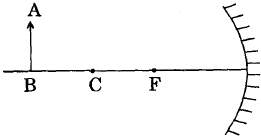
An object AB is kept in front of a concave mirror as shown in the figure.
  1. Complete the ray diagram showing the image formation of the object.
  2. How will the position and intensity of the image be affected if the lower half of the mirror's reflecting surface is painted black?
Define self-inductance and write its S.I. unit. Find the self inductance for a solenoid of N turns, length $l$ and radius $r$.
When a ferromagnetic material goes through a hysteresis loop, its thermal energy is increased. Where does this energy come from?