Question
When a ferromagnetic material goes through a hysteresis loop, its thermal energy is increased. Where does this energy come from?

Answer

When a ferromagnetic material is taken through the cycle of magnetisation, magnet dipoles of the material orient and reorient with time. This molecular motion within the material results in the production of heat, which increses thermal energy of material.

Need a full question paper?

Generate a complete, print-ready paper with questions like this in minutes — across 16+ boards, with answer keys.
Start Generating Free

Similar questions

Two fat astronauts each of mass 120kg are travelling in a closed spaceship moving at a speed of 15km/s in the outer space far removed from all other material objects. The total mass of the spaceship and its contents including the astronauts is 660kg. If the astronauts do slimming exercise and thereby reduce their masses to 90kg each, with what velocity will the spaceship move?
Derive the formula of electric potential at a point due to electric dipole.
The electric field intensity at a point at a distance of 20 cm from the centre of a sphere is 10 Volt/meter. Find the intensity of the electric field at a point located at a distance 8 cm from the centre of that circle. The radius of the sphere is 5 cm.
Consider a gravity$-$free hall in which an experimenter of mass $50\ kg$ is resting on a $5\ kg$ pillow, $8ft$ above the floor of the hall. He pushes the pillow down so that it starts falling at a speed of $8ft/s.$ The pillow makes a perfectly elastic collision with the floor, rebounds and reaches the experimenter's head. Find the time elapsed in the process.
Maxwell showed that the speed of an electromagnetic wave depends on the penneability and pennittivity of the medium through which it travels. The speed of an electromagnetic wave in free space is given by $\text{c}=\frac{1}{\sqrt{\mu_0\epsilon_0}}.$ The fact led Maxwell to predict that light is an electromagnetic wave. The emergence of the speed of light from purely electromagnetic considerations is the crowning achievement of Maxwell's electromagnetic theory. The speed of an electromagnetic wave in any medium of permeability $\mu$ and pennittivity $\epsilon$ will be $\frac{\text{c}}{\sqrt{\text{K}\mu_\text{r}}}$ where $K$ is the dielectric constant of the medium and $\mu,$ is the relative permeability.
  1. The dimensions of $\frac{1}{2}\epsilon_0\text{E}^2$ ($\epsilon:$ pennittivity of free space; $E =$ electric field$)$ is:
  1. $MLT^{-1}$
  2. $ML^2T^{-2}$
  3. $ML^{-1}T^{-2}$
  4. $ML^2T^{-1}$
  1. Let $[\epsilon_0]$ denote the dimensional formula of the permittivity of the vacuum. $UM =$ mass, $L =$ length, $T = $ time and $A =$ electric current, then
  1. $[\epsilon_0]=\text{M}^{-1}\text{L}^{-3}\text{T}^2\text{A}$
  2. $[\epsilon_0]=\text{M}^{-1}\text{L}^{-3}\text{T}^4\text{A}^2$
  3. $[\epsilon_0]=\text{MLT}^{-2}\text{A}^{-2}$
  4. $[\epsilon_0]=\text{ML}^{2}\text{A}^{-1}$
  1. An electromagnetic wave offrequency $\text{3MHz}$ passes from vacuum into adielectricmedium with permittivity $\epsilon=4.$ Then
  1. Wavelength and frequency both remain unchanged.
  2. Wavelength is doubled and the frequency remains unchanged.
  3. Wavelength is doubled and the frequency becomes half.
  4. Wavelength is halved and the frequency remains unchanged.
  1. Which of the following are not electromagnetic waves?
  1. Cosmic rays
  2. $\gamma-\text{rays}$
  3. $\beta-\text{rays}$
  4. $X-$rays
  1. The electromagnetic waves travel with,
  1. The same speed in all media.
  2. The speed oflight $c = 3 \times 10^8ms^{-1}$ in free space.
  3. The speed oflight $c = 3 \times 10^8ms^{-1}$ in solid medium
  4. The speed of light $c = 3 \times 10^8ms^{-1}$ in fluid medium.
A small candle, 2.5 cm in size is placed at 27 cm in front of a concave mirror of radius of curvature 36 cm. At what difference from the mirror should a screen be placed in order to obtain a sharp image? Describe the nature and size of the image. If the candle is moved closer to the mirror, how would the screen have to be moved?
A lady cannot see objects closer than 40cm from the left eye and closer than 100cm from the right eye. While on a mountaineering trip, she is lost from her team. She tries to make an astronomical telscope from her reading glasses to look for her teammates.
  1. Which glass should she use as the eyepiece?
  2. What magnification can she get with relaxed eye?
Establish the formula : $\frac{n_{2}}{v}-\frac{n_{1}}{u}=\frac{n_{2}-n_{1}}{R}$ for refraction at single curved surface, where symbols have their usual meanings.
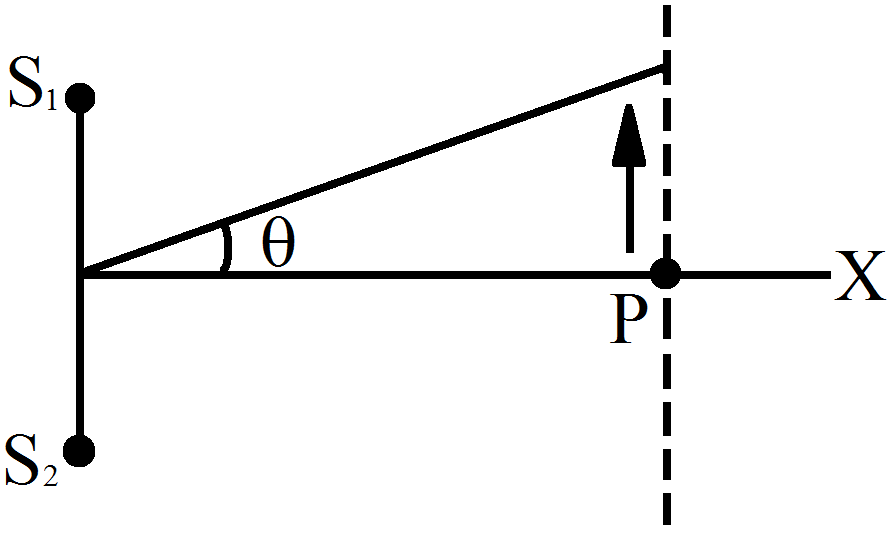
Two speakers $S_1$ and $S_2,$ driven by the same amplifier, are placed at $y = 1.0m$ and $y = -1.0m$ figure, The speakers vibrate in phase at $600\ Hz.$ A man stands at a point on the $X-$axis at a very large distance from the origin and starts moving parallel to the $Y-$axis. The speed of sound in air is 330m/s.
  1. At what angle $\theta$ will the intensity of sound drop to a minimum for the first time?
  2. At what angle will he hear a maximum of sound intensity for the first time?
  3. If he continues to walk along the line, how many more maxima can he hear?
Explain refraction at spherical surfaces and derive formula $-\frac{n_1}{n}+\frac{n_2}{v}=\frac{n_2-n_1}{ R }$.