Question
Calculate the force with which you attract the earth.

Answer

Consider that a man is standing on the surface of the Earth.
Force acting on the man = mg Here,
$m =$ mass of the man and
$g =$ acceleration due to gravity on the surface of earth $(= 10m/s^2)$ Assume that the mass of the man is equal to 65kg.
Then $F = W = mg = 65 × 10 = 650N =$ force acting on the man
$\therefore$ By Newton's third law (action-reaction are always equal),
the man is also attracting the earth with a force of 650N in the opposite direction.

Need a full question paper?

Generate a complete, print-ready paper with questions like this in minutes — across 16+ boards, with answer keys.
Start Generating Free

Similar questions

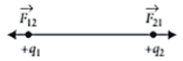
Coulomb's law states that the electrostatic force of attraction or repulsion acting between two stationary point charges is given by
Image

where $F$ denotes the force between two charges $q _1$ and $q _2$ separated by a distance $r$ in free space, $\varepsilon_0$ is a constant known as the permittivity of free space. Free space is a vacuum and may be taken to be air practically. If free space is replaced by a medium, then $\varepsilon_0$ is replaced by $\left(\varepsilon_0 k\right)$ or $\left(\varepsilon_0 \varepsilon_r\right)$ where $k$ is known as dielectric constant or relative permittivity.
$(i)$ In coulomb's law, $F =k \frac{q_1 q_2}{r^2}$, then on which of the following factors does the proportionality constant $k$ depends?
$(a)$ Nature of the medium between the two charges
$(b)$ Distance between the two charges
$(c)$ Electrostatic force acting between the two charges
$(d)$ Magnitude of the two charges
$(ii)$ Dimensional formula for the permittivity constant $\varepsilon_0$ of free space is
$(a) \left[ M ^{-1} L^3 T^2 A^2\right]$
$(b) \left[ ML ^{-3} T^4 A^2\right]$
$(c) \left[ M ^{-1} L^{-3} T^4 A^2\right]$
$(d) \left[ ML ^{-3} T^4 A^{-2}\right]$
$(iii)$ The force of repulsion between two charges of $1 C$ each, kept $1m$ apart in vaccum is
$(a) \frac{1}{9 \times 10^9} N$
$(b) \frac{1}{9 \times 10^{12}} N$
$(c) 9 \times 10^7 N$
$(d) 9 \times 10^9 N$
$(iv)$ Two identical charges repel each other with a force equal to $10$ mgwt when they are $0.6 m$ apart in air.
$(g =10 m s ^{-2} ).$ The value of each charge is
$(a) 2 mC$
$(b) 2 \times 10^{-7} mC$
$(c) 2 \mu C$
$(d) 2 nC$
OR
Coulomb's law for the force between electric charges most closely resembles with
$(a)$ law of conservation of energy
$(b)$ Newton's $2^{nd}$ law of motion
$(c)$ law of conservation of charge .
$(d)$ Newton's law of gravitation
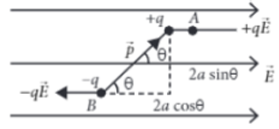
When electric dipole is placed in uniform electric field, its two charges experience equal and opposite forces, which cancel each other and hence net force on electric dipole in uniform electric field is zero. However these forces are not collinear, so they give rise to some torque on the dipole. Since net force on electric dipole in uniform electric field is zero. so no work is done in moving the electric dipole in uniform electric field. However some work is done in rotating the dipole against the torque acting on it.
Image
$(i)$ The dipole moment of a dipole in a uniform external field $\vec{E}$ is $\vec{P}$. Then the torque $\vec{\tau}$ acting on the dipole is
$(a) \ \vec{\tau}=2(\vec{P}+\vec{E})$
$(b) \ \vec{\tau}=\vec{P} \cdot \vec{E}$
$(c) \ \vec{\tau}=(\vec{P}+\vec{E})$
$(d) \ \vec{\tau}=\vec{P} \times \vec{E}$
$(ii)$ An electric dipole consists of two opposite charges, each of magnitude $1.0 \mu C$ separated by a distance of $2.0 \ cm$ . The dipole is placed in an external field of $10^5 NC ^{-1}$. The maximum torque on the dipole is
$(a) \ 4 \times 10^{-3} Nm$
$(b) \ 2 \times 10^{-3} Nm$
$(c) \ 1 \times 10^{-3} Nm$
$(d) \ 0.2 \times 10^{-3} Nm$
$(iii)$ Torque on a dipole in uniform electric field is minimum when $\theta$ is equal to
$(a) \ 0^{\circ} \ (b) \ 90^{\circ}\  (c) \ 180^{\circ} \ (d)$ Both $0^{\circ}$ and $180^{\circ}$
$(iv)$ When an electric dipole is held at an angle in a uniform electric field, the net force $F$ and torque on the dipole are
$(a) \ F =0, \tau=0$
$(b) \ F \neq 0, \tau \neq 0$
$(c) \ F \neq 0, \tau=0$
$(d) \ F =0, \tau \neq 0$
OR
An electric dipole of moment $p$ is placed in an electric field of intensity $E$. The dipole acquires a position such that the axis of the dipole makes an angle $\theta$ with the direction of the field. Assuming that the potential energy of the dipole to be zero when $\theta=90^{\circ}$, the torque and the potential energy of the dipole will respectively be
$(a) \ pE \sin \theta,- pE \cos \theta$
$(b) \ pE \cos \theta,- pE \sin \theta$
$(c) \ pE \sin \theta, 2 pE \cos \theta$
$(d) \ pE \sin \theta,-2 pE \cos \theta$
The charge density of two uniformly charged parallel infinite plane sheets ' 1 ' and ' 2 ' are $+\sigma$ and $-2 \sigma$ respectively. Find the magnitude and direction of the net electric field (i) at any point between these two sheets and (ii) at any point outisde these two sheets but near sheet ' 1 '.
In a microwave oven, the food is kept in a plastic container and the microwave is directed towards the food. The food is cooked without melting or igniting the plastic container. Explain.
A charge is a property associated with the matter due to which it experiences and produces an electric and magnetic field. Charges are scalar in nature and they add up like real numbers. Also, the total charge of an isolated system is always conserved. When the objects rub against each other charges acquired by them must be equal and opposite.
Image
(i) The cause of charging is:
(a) the actual transfer of atoms
(b) the actual transfer of protons
(c) the actual transfer of electrons
(d) the actual transfer of neutrons

(ii) Pick the correct statement.
i. The glass rod gives protons to silk when they are rubbed against each other.
ii. The glass rod gives electrons to silk when they are rubbed against each other.
iii. The glass rod gains protons from silk when they are rubbed against each other.
iv. The glass rod gains electrons when they are rubbed against each other.
(a) Option (i) (b) Option (iv) (c) Option (iii) (d) Option (ii)

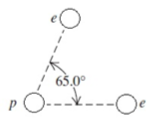
(iii) If two electrons are each $1.5 \times 10^{-10} m$ from a proton, as shown in Figure, magnitude of the net electric force they will exert on the proton is
Image

(a) $1.97 \times 10^{-8} N$
(b) $3.83 \times 10^{-8} N$
(c) $4.63 \times 10^{-8} N$
(d) $2.73 \times 10^{-8} N$

(iv) A charge is a property associated with the matter due to which it produces and experiences:
(a) electric effects only
(b) magnetic effects only
(c) both electric and magnetic effects
(d) non magnetic effects only

OR

The cause of quantization of electric charges is:
(a) transfer of an integral number of electrons
(b) transfer of an integral number of neutrons
(c) transfer of an integral number of protons
(d) transfer of an integral number of Atom
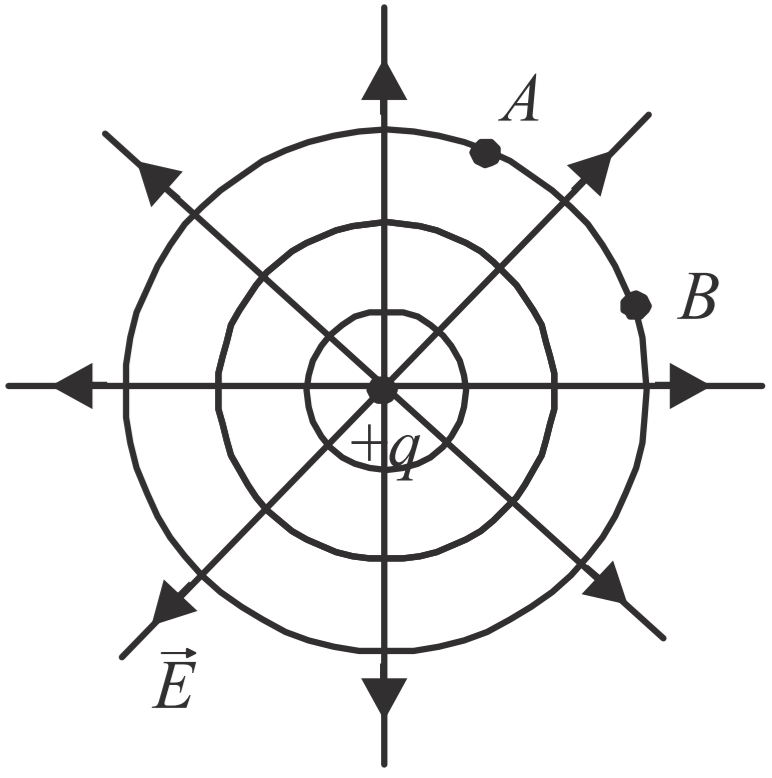
For the various charge systems, we represent equipotential surfaces by curves and line of force by full line curves. Between any two adjacent equipotential surfaces, we assume a constant potential difference the equipotential surfaces of a single point charge are concentric spherical shells with their centres at the point charge. As the tines of force point radially outwards, so they are perpendicular to the equipotential surfaces at all points.
  1. Identify the wrong statement.
  1. Equipotential surface due to a single point charge is spherical.
  2. Equipotential surface can be constructed for dipoles too.
  3. The electric field is normal to the equipotential surface through the point.
  4. The work done to move a test charge on the equipotential surface is positive.
  1. Nature of equipotential surface for a point charge is:
  1. Ellipsoid with charge at foci.
  2. Sphere with charge at the centre of the sphere.
  3. Sphere with charge on the surface of the sphere.
  4. Plane with charge on the surface.
  1. A spherical equipotential surface is not possible:
  1. Inside a uniformly charged sphere.
  2. For a dipole.
  3. Inside a spherical condenser.
  4. For a point charge.
  1. The work done in carrying a charge q once round a circle of radius a with a charge Q at its centre is:
  1. $\frac{\text{qQ}}{4\pi\in_0\text{a}}$
  2. $\frac{\text{qQ}}{4\pi\in_0\text{a}^2}$
  3. $\frac{\text{q}}{4\pi\in_0\text{a}}$
  4. $\text{Zero}$
  1. The work done to move a unit charge along an equipotential surface from P to Q:
  1. Must be defined as $-\int\limits_{\text{P}}^{\text{Q}}\vec{\text{E}}\cdot\text{d}\vec{\text{l}}.$
  2. Is zero.
  3. Can have a non-zero value.
  4. Both (a) and (b) are correct.
If the earth's magnetic field has a magnitude $3.4 \times 10^{-5} T$ at the magnetic equator of the earth what would be its value at the earth's geomagnetic poles?
A magnetic field can be produced by moving, charges or electric currents. The basic equation governing the magnetic field due to a current distribution is the Biot-Savart law. Finding the magnetic field resulting from a current distribution involves the vector product, and is inherently a calculas problem when the distance from the current to the field point is continuously changing. According to this law, the magnetic field at a point due to a current element of length $\text{d}\vec{\text{I}}$ carrying current I, at a distance r from the element is $\text{dB}=\frac{\mu_0}{4\pi}\frac{\text{I}(\text{d}{\vec{\text{I}}\times\vec{\text{r}}})}{\text{r}^3}$Biot-Savart law has certain similarities as well as difference with Coloumb's law for electrostatic field e.g., there is an angle dependence in Biot-Savart law which is not present in electrostatic case.
  1. The direction of magnetic field $\text{d}\vec{\text{B}}$ due to a current element $\text{Id}\vec{\text{l}}$ at a point of distance $\vec{\text{r}}$ from it, when a current I passes through a long conductor is in the direction
  1. Of position vector $\vec{\text{r}}$ of the point.
  2. Of current element $\text{Id}\vec{\text{l}}$
  3. Perpendicular to both $\text{d}\vec{\text{l}}$ and $\vec{\text{r}}$
  4. Perpendicular to $\text{d}\vec{\text{l}}$ only.
  1. The magnetic field due to a current in a straight wire segment of length Lat a point on its perpendicular bisector at a distance r (r >> L)
  1. Decreases as $\frac{1}{\text{r}}$
  2. Decreases as $\frac{1}{\text{r}^2}$
  3. Decreases as $\frac{1}{\text{r}^3}$
  4. approaches a finite limit as $\text{r}\rightarrow\infty$
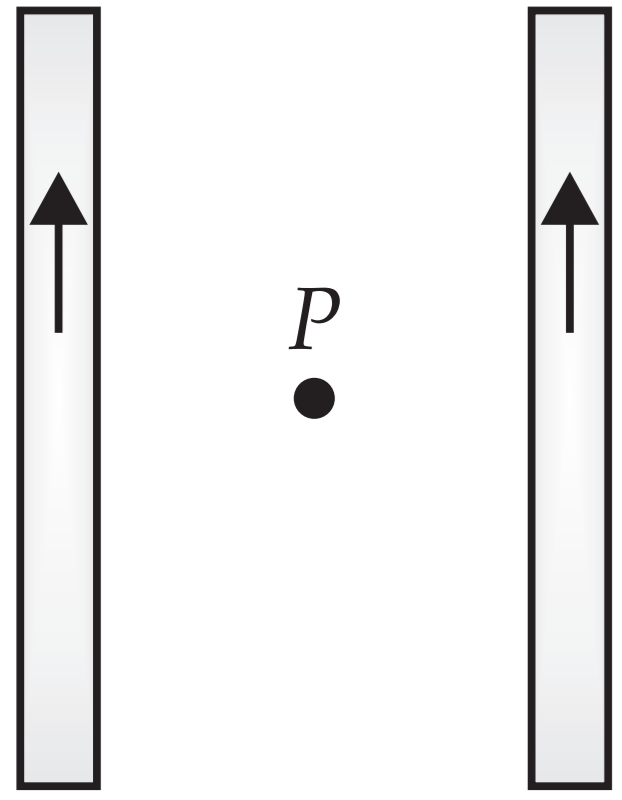
  1. Two long straight wires are set parallel to each other. Each carries a current i in the same direction and the separation between them is 2r. The intensity of the magnetic field midway between them is:
  1. $\mu_0\frac{\text{i}}{\text{r}}$
  2. $4\mu_0\frac{\text{i}}{\text{r}}$
  3. $\text{Zero}$
  4. $\mu_0\frac{\text{i}}{\text{4r}}$
  1. A long straight wire carries a current along the z-axis for any two points in the x - y plane. Which of the following is always false?
  1. The magnetic fields are equal.
  2. The directions of the magnetic fields are the same.
  3. The magnitudes of the magnetic fields are equal.
  4. The field at one point is opposite to that at the other point.
  1. Biot-Savart law can be expressed alternatively as:
  1. Coulomb's Law.
  2. Ampere's circuital law.
  3. Ohm's Law.
  4. Gauss's Law.
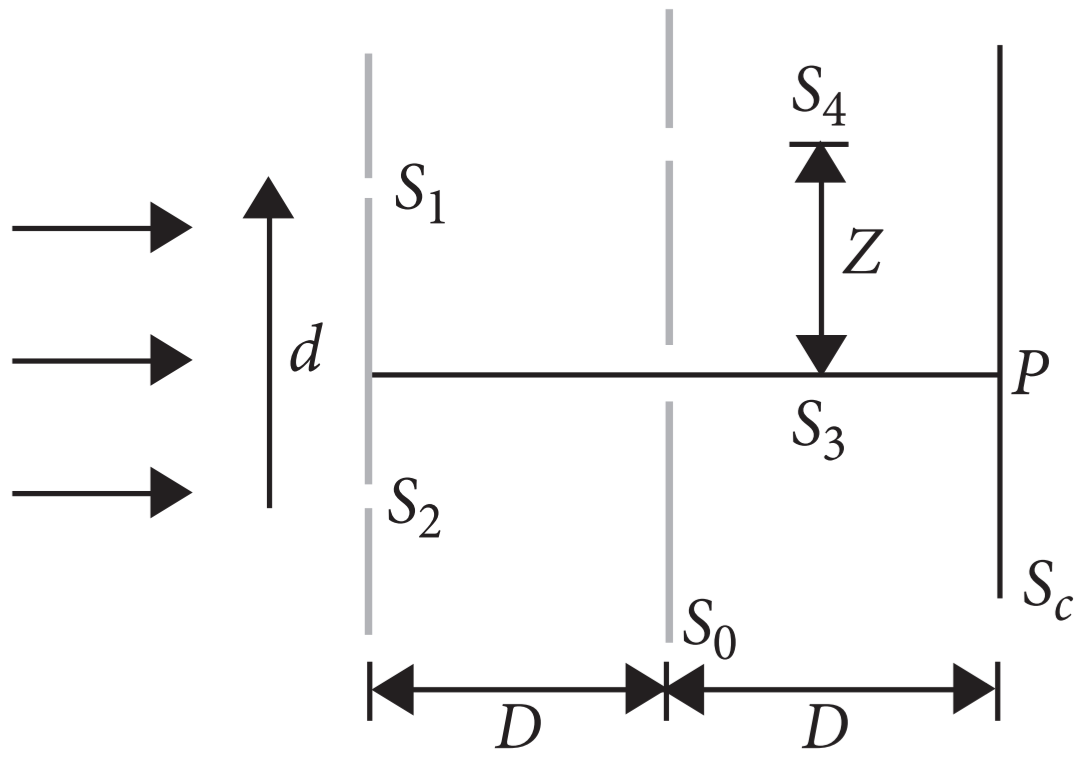
Consider the situation shown in figure. The two slits $S_1$ and $S_1$ placed symmetrically around the central line are illuminated by monochromatic light of wavelength $\lambda$. The separation between the slits is d. The light transmitted by the slits falls on a screen $S_0$ place at a distance D from the slits. The slits $S_3$ is at the central line and the slit $S_4$ is at a distance from $S_3.$ Another screen $S_c$ is placed a further distance D away from $S_c.$
  1. Find the path difference if $\text{z}=\frac{\lambda\text{D}}{2\text{d}}$.
  1. $\lambda$
  2. $\frac{\lambda}{2}$
  3. $\frac{3}{2\lambda}$
  4. $2\lambda$
  1. Find the ratio of the maximum to minimum intensity observed on $S_c$ if $\text{z}=\frac{\lambda\text{D}}{\text{d}}$
  1. 4
  2. 2
  3. $\infty$
  4. 1
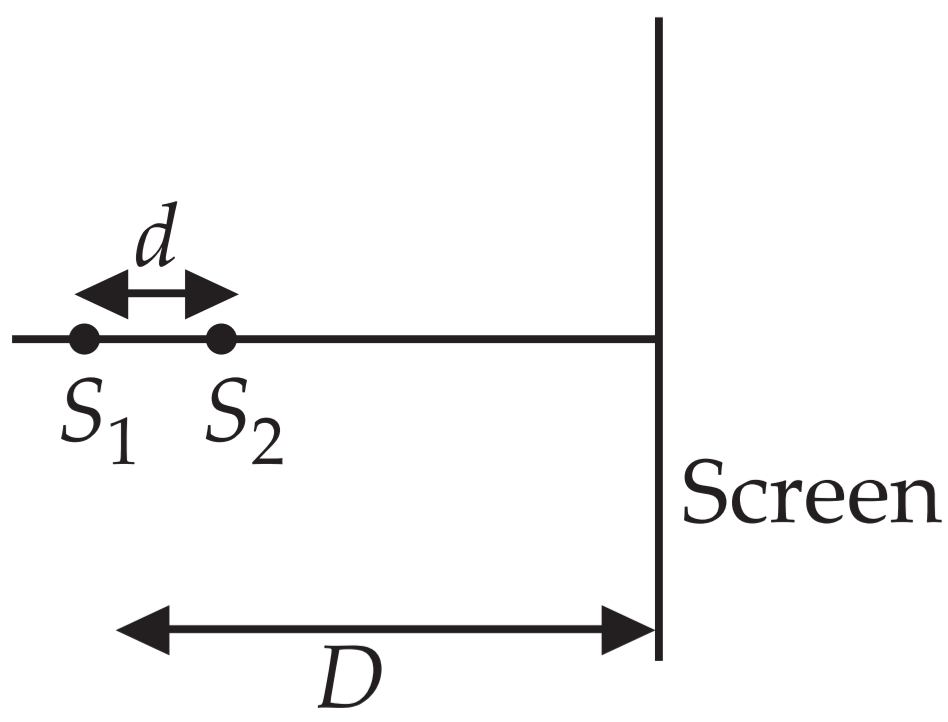
  1. Two coherent point sources $S_1$ and $S_2$ are separated by a small distanced as shown in figure. The fringes obtained on the screen will be:
  1. Concentric circles.
  2. Points.
  3. Straight lines.
  4. Semi-circles.
  1. ln the case of light waves from two coherent sources $S_1$ and $S_2$, there will be constructive interference at an arbitrary point P, if the path difference $S_1P - S_2P$ is:
  1. $\Big(\text{n}+\frac{1}{2}\Big)\lambda$
  2. $\text{n}\lambda$
  3. $\Big(\text{n}-\frac{1}{2}\Big)\lambda$
  4. $\frac{\lambda}{2}$
  1. Two monochromatic light waves of amplitudes $3_A$ and $2_A$ interfering at a point have a phase difference of 60º. The intensity at that point will be proportional to:
  1. $5A^2$
  2. $13A^2$
  3. $7A^2$
  4. $19A^2$
A lady cannot see objects closer than 40cm from the left eye and closer than 100cm from the right eye. While on a mountaineering trip, she is lost from her team. She tries to make an astronomical telscope from her reading glasses to look for her teammates.
  1. Which glass should she use as the eyepiece?
  2. What magnification can she get with relaxed eye?