Question
Can a particle have acceleration at an instant if its velocity is zero at that instant? Give example.
Answer

Yes, it is possible. In motion under gravity at the highest point of its motion velocity is zero but acceleration a = g in downward direction.

Need a full question paper?

Generate a complete, print-ready paper with questions like this in minutes — across 16+ boards, with answer keys.

Start Generating Free

Similar questions

Define temperature on the basis of the zeroth law of thermodynamics.
Two thermos flasks are of the same height and same capacity. One has a circular cross-section while the other has a square cross-section. Which of the two is better?
A circular road of radius 50m has the angle of banking equal to 30°. At what speed should a vehicle go on this road so that the friction is not used?
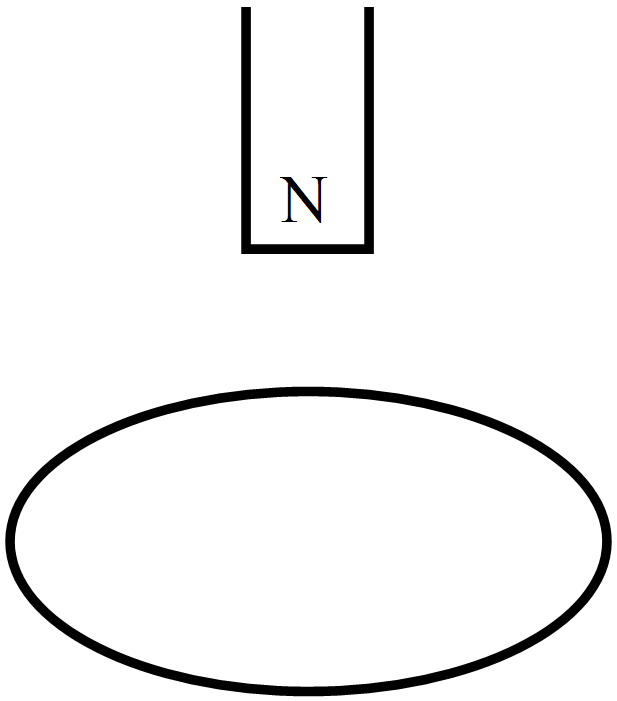
The north pole of a magnet is brought down along the axis of a horizontal circular coil. As a result, the flux through the coil changes from 0.35 weber to 0.86 weber in an interval of half a second. Find the average emf induced during this period. Is the induced current clockwise or anticlockwise as you look into the coil from the side of the magnet?
A string is wrapped over the edge of a uniform disc and the free end is fixed with the ceiling. The disc moves down, unwinding the string. Find the downward acceleration of the disc.
Name one system where the compressional and tensional modulus of elasticity are different. Give reason.
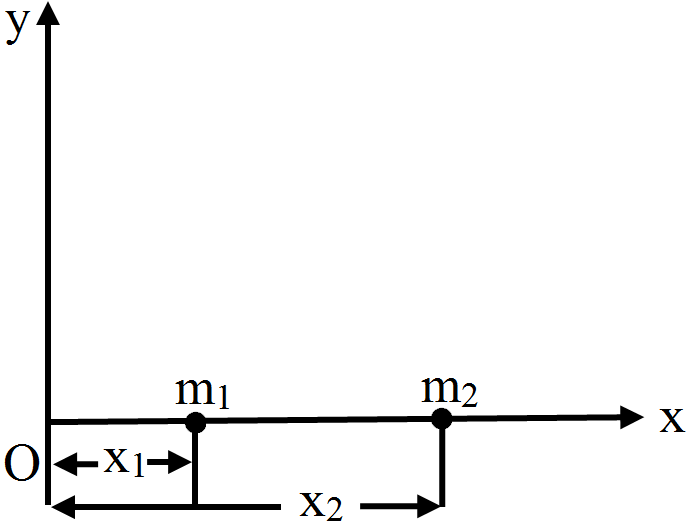
What will be the centre of mass of the pair of particles described below in figure on the x-axis?
Suppose the platform of the previous problem is brought to rest with the ball in the hand of the kid standing on the rim. The kid throws the ball horizontally to his friend in a direction tangential to the rim with a speed v as seen by his friend. Find the angular velocity with which the platform will start rotating.
Can two states of an ideal gas be connected by an isothermal process as well as an adiabatic process?
A spherical surface of radius 30cm separates two transparent media A and B with refractive indices 1.33 and 1.48 respectively. The medium A is on the convex side of the surface. Where should a point object be placed in medium A so that the paraxial rays become parallel after refraction at the surface?