MCQ
Can the resultant of $2$ vectors be zero
  • A
    Yes, when the $2$ vectors are same in magnitude and direction
  • B
    No
  • Yes, when the $2$ vectors are same in magnitude but opposite in sense
  • D
    Yes, when the $2$ vectors are same in magnitude making an angle of $\frac{{2\pi }}{3}$ with each other
Answer

Correct option: C.
Yes, when the $2$ vectors are same in magnitude but opposite in sense
c
Yes, when the $2$ vectors are same in magnitude but opposite in sense

Need a full question paper?

Generate a complete, print-ready paper with questions like this in minutes — across 16+ boards, with answer keys.

Start Generating Free

Similar questions

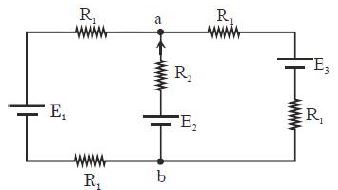
For the circuit shown, with ${R_1} = 1.0\,\Omega $, ${R_2} = 2.0\,\Omega $, ${E_1} = 2\,V$ and ${E_2} = {E_3} = 4\,V$, the potential difference between the points $‘a’$ and $‘b’$ is approximately (in $V$)
A heavy nucleus $N$, at rest, undergoes fission $N \rightarrow P+Q$, where $P$ and $Q$ are two lighter nuclei. Let $\delta=M_N-M_P-M_Q$, where $M_P, M_Q$ and $M_N$ are the masses of $P, Q$ and $N$, respectively. $E_P$ and $E_Q$ are the kinetic energies of $P$ and $Q$, respectively. The speed of $P$ and $Q$ are $v_P$ and $v_Q$, respectively. If $c$ is the speed of light, which of the following statement(s) is(are) correct ?

$(A)$ $E_P+E_Q=c^2 \delta$

$(B)$ $E_P=\left(\frac{M_P}{M_P+M_Q}\right) c^2 \delta$

$(C)$ $\frac{v_P}{v_Q}=\frac{M_Q}{M_P}$

$(D)$ The magnitude of momentum for $P$ as well as $Q$ is $c \sqrt{2 \mu \delta}$, where $\mu=\frac{M_P M_Q}{\left(M_P+M_Q\right)}$

A ball is allowed to fall from a height of $10 \,m$. If there is $40 \%$ loss of energy due to impact, then after one impact ball will go up by ........ $m$
A proton and a deutron both having the same kinetic energy, enter perpendicularly into a uniform magnetic field $B$. For motion of proton and deutron on circular path of radius ${R_p}$ and ${R_d}$ respectively, the correct statement is
The kinetic energy of $SHM$ is $1/n$ time its potential energy. If the amplitude of the $SHM$ be $A$, then what is the displacement of the particle?
Dimensional formula of heat energy is
The electric field of an electromagnetic wave in free space is represented as $\vec{E}=E_0 \cos (\omega t-k z) \hat{i}$.The corresponding magnetic induction vector will be :
At constant volume, temperature is increased. Then
The reverse biasing in a $PN$ junction diode
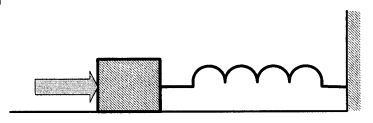
A block of mass $0.18 \ kg$ is attached to a spring of force-constant $2 \ N / m$. The coefficient of friction between the block and the floor is $0.1$ . Initially the block is at rest and the spring is un-stretched. An impulse is given to the block as shown in the figure. The block slides a distance of $0.06 \ m$ and comes to rest for the first time. The initial velocity of the block in $m / s$ is $V = N / 10$. Then $N$ is