The kinetic energy of $SHM$ is $1/n$ time its potential energy. If the amplitude of the $SHM$ be $A$, then what is the displacement of the particle?
Medium
Download our app for free and get started
$\mathrm{K}=\frac{1}{\mathrm{n}} \mathrm{up} \Rightarrow \frac{1}{2} \mathrm{m} \omega^{2}\left(\mathrm{A}^{2}-\mathrm{x}^{2}\right)=\frac{1}{\mathrm{n}} \frac{1}{2} \mathrm{m} \omega^{2} \mathrm{x}^{2}$
that $A^{2}-x^{2}=\frac{x^{2}}{n} \quad$ or $x^{2}\left(1-\frac{1}{n}\right)=A^{2}$
$x=\sqrt{\frac{n}{n+1}} A$

Download our appand get started for free
Experience the future of education. Simply download our apps or reach out to us for more information. Let's shape the future of learning together!No signup needed.*
Similar Questions
- 1Two pendulums begins to swing simultaneously. The first pendulum makes $11$ full oscillations when the other makes $9$. The ratio of length of the two pendulums isView Solution
- 2A body executes sample harmonic motion under the action of a force $F_1$ with a time period $(4 / 5)\ sec$. If the force is changed to $F_ 2$ it executes $SHM$ with time period $(3 / 5)\ sec$. If both the forces $F_1$ and $F_2$ act simultaneously in the same direction on the body, it's time period (in $second$) isView Solution
- 3A simple pendulum, suspended from the ceiling of a stationary van, has time period $T$. If the van starts moving with a uniform velocity the period of the pendulum will beView Solution
- 4Two simple pendulums whose lengths are $100 cm$ and $121 cm$ are suspended side by side. Their bobs are pulled together and then released. After how many minimum oscillations of the longer pendulum, will the two be in phase againView Solution
- 5The displacement of a particle is given at time $t$, by:$x=A \sin (-2 \omega t)+B \sin ^2 \omega t \quad$ Then,View Solution
- 6A simple harmonic oscillator of angular frequency $2\,rad\,s^{-1}$ is acted upon by an external force $F = sin\,t\,N .$ If the oscillator is at rest in its equilibrium position at $t = 0,$ its position at later times is proportional toView Solution
- 7View SolutionA simple pendulum is set into vibrations. The bob of the pendulum comes to rest after some time due to
- 8Two pendulums of length $121\,cm$ and $100\,cm$ start vibrating in phase. At some instant, the two are at their mean position in the same phase. The minimum number of vibrations of the shorter pendulum after which the two are again in phase at the mean position is :View Solution
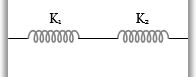
- 9View SolutionThe effective spring constant of two spring system as shown in figure will be
- 10The displacement equation of a particle is $x = 3\sin 2t + 4\cos 2t.$ The amplitude and maximum velocity will be respectivelyView Solution