Question
Can we conclude from the interference phenomenon whether light is a transverse wave or a longitudinal wave?

Answer

The interference pattern can be produced by any two coherent waves moving in the same direction. It cannot be concluded from the interference phenomenon that light is a transverse wave, as sound waves that are longitudinal in nature also interfere.

Need a full question paper?

Generate a complete, print-ready paper with questions like this in minutes — across 16+ boards, with answer keys.
Start Generating Free

Similar questions

Write the statements of Kirchhoff's laws.
A current of 10A is established in a long wire along the positive z-axis. Find the magnetic field $\overrightarrow{\text{B}}$ at the point (1m, 0, 0).
A series LCR circuit with R = 20 Ω L = 1.5 H and $C=35 \mu F$ is connected to a variable frequency 200 V ac supply. When the frequency of the supply equals the natural frequency of the circuit, what is the average power transferred to the circuit in one complete cycle?
An $\alpha-$ particle and a proton of the same kinetic energy are in turn allowed to pass through a magnetic field $\overrightarrow{\text{B}},$ acting normal to the direction of motion of the particles. Calculate the ratio of radii of the circular paths described by them.
Derive the formulas for the kinetic energy, potential energy and total energy of an electron revolving around the nucleus in hydrogen atom.
Explain how the mass of an electron can be found using Millikan's oil drop experiment.
Differentiate between electric lines of force and magnetic lines of force.
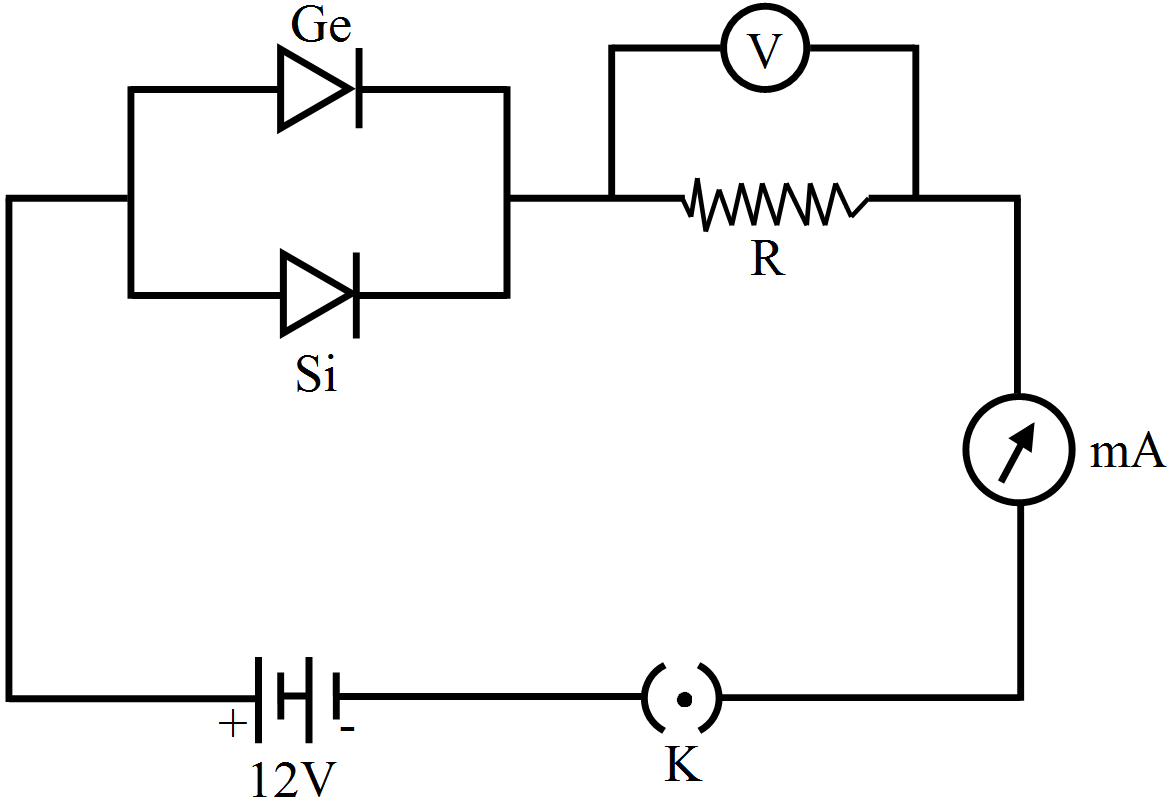
Germanium and silicon junction diodes are connected in parallel. A resistance R, a 12V battery, a milliammeter (mA) and key (K) are connected in series with them (figure). When key (K) is closed, a current begins to flow in the milliammeter. What will be the maximum reading of voltmeter connected across resistance R?
Suppose the tube in the previous problem is kept vertical with $A$ upward but the other conditions remain the same. The separation between the cross$-$sections at $A$ and $B$ is $\frac{15}{16}\text{cm}.$ Repeat parts $(a), (b)$ and $(c)$ of the previous problem. Take $g = 10\ m/s^2.$
Answer the following question:
Does the apparent depth of a tank of water change if viewed obliquely? If so, does the apparent depth increase or decrease?