Question
Can we have magnetic hysteresis in paramagnetic or diamagnetic substances?

Answer

No, magnetic hysteresis is the lagging of intensity of magnetization (I) behind magnetising force (H). When diamagnetic and paramagnetic materials are placed in a magnetic field they get weekly magnetised. Also, they lose their magnetization as the magnetic field is removed (low retentively). Therefore, they do not form magnetic hysteresis curve.

Need a full question paper?

Generate a complete, print-ready paper with questions like this in minutes — across 16+ boards, with answer keys.
Start Generating Free

Similar questions

A block of 2kg is suspended from the ceiling through a massless spring of spring constant k = 100N/m. What is the elongation of the spring? If another 1kg is added to the block, what would be the further elongation?
Plot a graph showing the variation of photoelectric current with intensity of light. The work function for the following metals is given:
Na : 2.75 eV and Mo : 4.175 eV.
Which of these will not give photoelectron emission from a radiation of wavelength 3300 Å from a laser beam? What happens if the source of laser beam is brought closer?
Using $\text{B}=\mu_0\text{H},$ find the ratio $\frac{\text{E}_0}{\text{H}_0}$ for a plane electromagnetic wave propagating through vacuum. Show that it has the dimensions of electric resistance. This ratio is a universal constant called the impedance of free space.
What is called P-N junction? Name the methods of making P-N junction. Explain the diffusion method of making $P - N$ junction.
A convex lens produces a double size real image when an object is placed at a distance of 18cm from it. Where should the object be placed to produce a triple size real image?
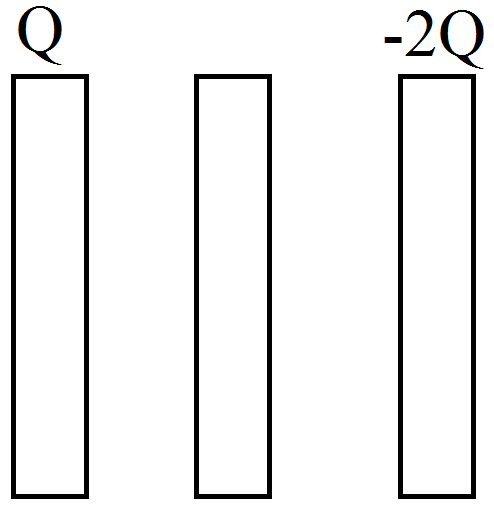
Three identical metal plates with large surface areas are kept parallel to each other as shown in figure. The leftmost plate is given a charge Q, the rightmost a charge -2Q and the middle one remains neutral. Find the charge appearing on the outer surface of the rightmost plate.

A vector $\overrightarrow{\text{A}}$ makes an angle of 20° and $\overrightarrow{\text{B}}$ makes an angle of 110° with the X-axis. The magnitudes of these vectors are 3 m and 4 m respectively. Find the resultant.
A proton and an α-particle move perpendicular to a magnetic field. Find the ratio of radii of the circular paths described by them when both (i) have equal momenta, and (ii) were accelerated through the same potential difference.
The potential V due to a charge distribution at a point (x, y) is given by V = -x2 + 3y
Calculate the electric field, in magnitude and direction, due to this charge configuration at the point (1, 1).
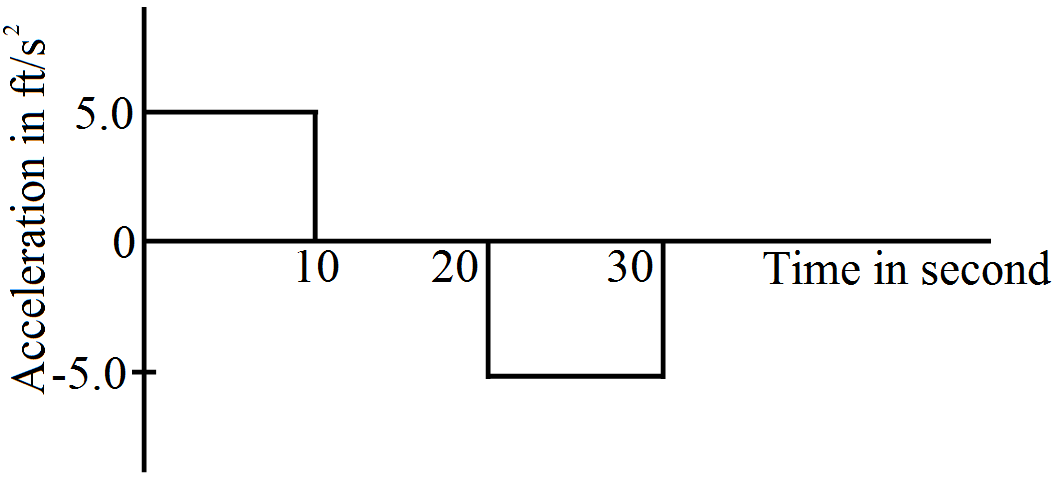
The acceleration of a cart started at t = 0, varies with time as shown in figure. Find the distance travelled in 30 seconds and draw the position-time graph.