MCQ
__________ can't be explained by ray optics.
- AReflection
- BRefraction
- CDiffraction
- DTotal internal reflection
Generate a complete, print-ready paper with questions like this in minutes — across 16+ boards, with answer keys.
A particle moving in a magnetic field increases its velocity, then its radius of the circle
|
(a) Decreases |
(b) Increases |
(c) Remains the same |
(d) Becomes half |
There are  photons of frequency
  in a beam of light. In an equally energetic beam, there are
  photons of frequency
  . Then the correct relation is
|
(a) |
(b) |
(c) |
(d) |
A mass m = 20 g has a charge q = 30 mC. It moves with a velocity of 20 m/s and enters a region of electric field of 80 N/C in the same direction as the velocity of the mass. The velocity of the mass after 3 seconds in this region is
|
(a) 80 m/s |
(b) 56 m/s |
(c) 44 m/s |
(d) 40 m/s |
A circular loop of radius 0.0157m carries a current of 2.0 amp. The magnetic field at the centre of the loop is (
|
(a) 1.57 |
(b) 8.0 |
|
(c) 2.5 |
(d) 3.14 |
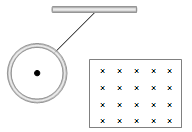
A metallic ring connected to a rod oscillates freely like a pendulum. If now a magnetic field is applied in horizontal direction so that the pendulum now swings through the field, the pendulum will
|
(a) Keep oscillating with the old time period |
|
(b) Keep oscillating with a smaller time period |
|
(c) Keep oscillating with a larger time period |
|
(d) Come to rest very soon |
A convex lens
|
(a) Converges light rays |
(b) Diverges light rays |
|
(c) Form real images always |
(d) Always forms virtual images |


